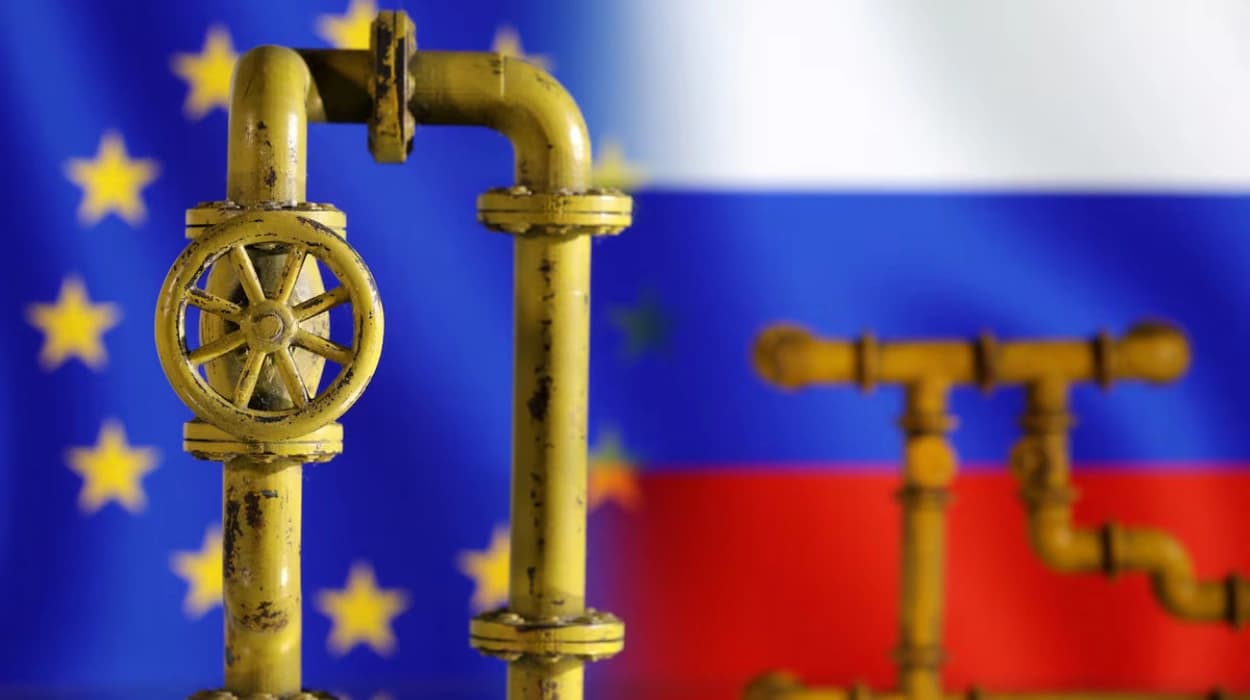
Brussels (The Palestine Telegraph Newspaper) January 26, 2026 - The Council of the European Union gave final approval to a regulation imposing a stepwise ban on all Russian natural gas imports, covering both pipeline supplies and liquefied natural gas cargoes. The measure, agreed by qualified majority among energy ministers, prohibits new contracts from January 2026, terminates short-term agreements by mid-2026, and ends long-term contracts by late 2027.
Exceptions apply to landlocked states like Hungary and Slovakia during verified supply emergencies, ensuring energy security while eliminating Moscow's leverage.
The regulation now proceeds to publication in the Official Journal, entering force one day later with direct applicability across all 27 member states. Energy Commissioner Dan Jørgensen confirmed the timeline during press briefings following the January 26 council meeting under Estonian Presidency.
EU imports of Russian gas have declined from 155 billion cubic metres in 2019 to under 15 billion cubic metres in 2025, replaced by Norwegian, US, and Qatari supplies.
Council final greenlight voting outcome details

Energy ministers convened in Brussels approving the regulation text after trilogue negotiations with European Parliament representatives. Hungary and Slovakia recorded No votes citing dependency concerns, but qualified majority threshold of 15 states representing 65 percent population secured passage. Legal base under Article 194(2) TFEU enables binding energy market measures including import restrictions for security objectives.
Publication expected January 30 triggers immediate compliance obligations including national diversification plans submission by March 1.
Phased implementation timeline contract categories
New Russian gas contracts prohibited January 1, 2026, blocking pipeline and LNG spot market access immediately. Existing short-term contracts concluded before June 17, 2025, terminate April 25, 2026, for LNG and June 17, 2026, for pipeline gas. Long-term contracts end September 30, 2027, extendable to November 1 if storage filling targets unmet under REPowerEU mandates.
Landlocked country derogation activates upon Commission verification of alternative supply exhaustion, limited to 2027 volumes tied to pre-existing long-term agreements. Spot LNG ban aligns with 19th sanctions package October 2025 prohibiting Russian cargoes at EU terminals post-January 2027.
Import volume reductions historical data trends
Eurostat records Russian pipeline imports falling 90 percent since 2022 peak of 40 billion cubic metres annually via Ukraine. LNG volumes dropped from 4.2 million tonnes 2022 to 0.8 million tonnes 2025, with Yamal and Portfolio contracts restructured or cancelled. Ukraine transit contract expires December 31, 2026, averaging 30 billion cubic metres 2025 nominations.
Germany achieved zero pipeline imports post-Nord Stream 2022, relying on Brunsbüttel and Wilhelmshaven LNG terminals. Italy's Eni terminated Gazprom deals 2024, sourcing Algeria and Azerbaijan Transit volumes.
Alternative suppliers capacity expansions contracts

Norway's Gassco reports 122 billion cubic metres exports 2025, with Troll and Johan Sverdrup fields ramping to 130 billion cubic metres capacity 2027. US LNG reached 56 billion cubic metres equivalent via Freeport, Sabine Pass, and Plaquemines terminals, with 15-year offtake agreements covering 40 percent former Russian volumes.
QatarEnergy North Field East phase delivers 32 million tonnes annually from 2026, including Golden Pass Texas terminal commissioning. Algeria's Transmed pipeline carries 54 billion cubic metres, supplemented by Betatun LNG cargoes to Spain and France.
ING terminal restrictions enforcement mechanisms
Regulation bans Russian-flagged or origin-verified LNG at 27 EU regasification terminals, enforced via customs code CN 2711110010 declarations. EMSA coordinates vessel inspections, AIS tracking, and bill of lading audits preventing transshipment laundering. Existing contracts honour clause permits termination without penalty post-legal review periods.
Greek importer Mytilineos cancelled spot cargoes 2025 following origin controls, setting precedent for compliance. Blockchain pilots by Tractebel track cargo chains from Yamal LNG to EU borders.
Ukraine transit agreement expiry preparations

Naftogaz-Gazprom 2019 contract ends 2026 without renewal, Sudzha station capacity 40 billion cubic metres unused since 2022 sabotage. Slovakia's Eustream forecasts zero Ukraine flows post-expiry, absorbing TurkStream volumes at 6 billion cubic metres annually. Hungary's MVM maintains 4.5 billion cubic metres TurkStream contracts through 2029.
Alternative routes include Trans-Adriatic Pipeline expansions and IGB Bulgaria interconnections delivering Caspian gas.
Member state derogation safeguards emergency clauses
Hungary's 20 billion cubic metres annual dependency qualifies for suspension clause activation upon 90-day alternative supply failure demonstration. Slovakia's 40 percent reliance triggers identical protections, requiring Commission notification and storage level verifications below 50 percent EU targets. Derogations limited to pre-June 2025 contract volumes, expiring October 31, 2027 maximum.
Germany, France, Italy confirm full compliance absent exemptions, with national bans legislated 2024-2025.
Russian revenue impacts gazprom financials
Gazprom 2025 revenues projected €120 billion versus €285 billion 2021 pre-war peak, EU market losses €25 billion annually. China Power of Siberia reaches 38 billion cubic metres 2027, but pricing discounts 20 percent below European benchmarks. Turkey and Serbia absorb 15 billion cubic metres pipeline volumes at reduced tariffs.
LNG reorientation to Asia yields spot premiums, but fleet constraints limit 2026 volumes to 20 million tonnes.
Storage infrastructure filling compliance levels
EU gas storages reached 95 percent capacity January 2026 with 62 billion cubic metres, exceeding Regulation 2022/1032 90 percent mandate. Germany's 500 TWh facilities, France's 13 billion cubic metres, and Italy's 19 billion cubic metres inventories support winter withdrawals through March.
2026 injection targets set 65 billion cubic metres April-October, prioritising renewable curtailment periods.
Repowereu diversification funding allocations
€225 billion Recovery Resilience Facility finances interconnections including Greece-Bulgaria and Poland-Lithuania pipelines. Innovation Fund grants €40 billion for hydrogen electrolysers reaching 20 gigawatts 2030. Just Transition Fund €17 billion supports coal regions retraining 200,000 workers gas phase-out transitions.
National plans due March 1 outline timelines for contract terminations and supplier switches.
Renewable integration gas demand substitution
Solar capacity hits 310 gigawatts 2025, wind 86 gigawatts offshore, yielding 45 percent renewable electricity share 2030 targets. Hydrogen valleys in 42 industrial clusters deploy 6 gigawatts electrolysers by 2028, blending 20 percent into existing networks.
Gas-fired capacity factors fall to 15 percent 2025, displaced by 120 gigawatts battery storage interconnections.
Infringement penalties harmonised enforcement standards
Member states enact €100 per MWh fines for violations, with daily penalties escalating to €1 million post-ECJ referrals. Commission monthly Eurostat audits trigger infringement proceedings under Article 258 TFEU against non-compliant operators.
Whistleblower directives protect terminal staff reporting Russian-origin cargoes. TTF hub spot prices stabilise €28/MWh January 2026, down 75 percent from 2022 peaks. Henry Hub linkages yield $2.80/MMBtu NYMEX futures, with 2027 contracts €25/MWh reflecting supply abundance.
CBAM tariffs apply to Russian gas-embedded steel emissions from 2026.
G7 voluntary targets cap Russian energy purchases, with Japan and India reducing LNG intakes 30 percent 2025. IEA emergency protocols mandate 60-day demand reductions upon collective triggers.
NATO Energy Security Centre Lithuania monitors pipeline sabotage risks quarterly.
Industrial mitigation demand-side measures
Fertiliser producers Yara and CF Industries activate €40/MWh price caps, curtailing 20 percent capacity during peaks. Power sector mothballs 15 gigawatts gas plants, substituting biomass and coal until 2028 decommissioning schedules.
Hydrogen subsidies fund 1.2 million tonnes blue production 2027, targeting chemical feedstocks.