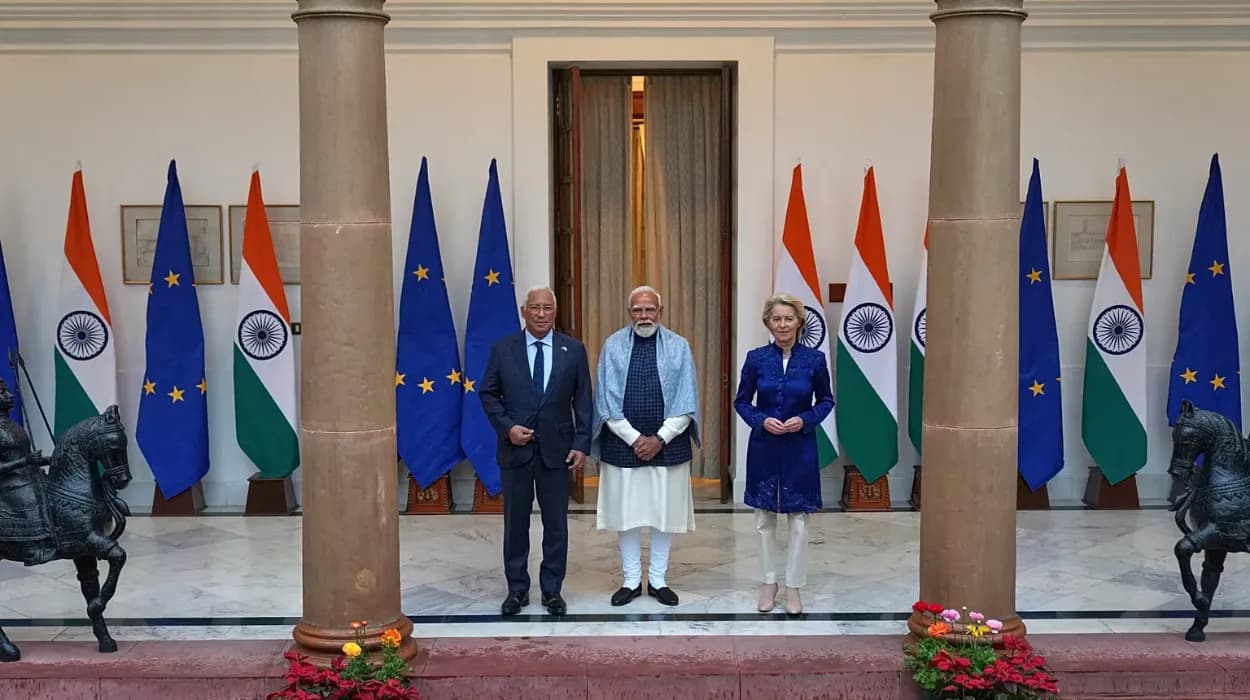
Berlin (The Palestine Telegraph Newspaper) January 27, 2026 – The European Commission and India have agreed to a comprehensive free trade agreement, with Commerzbank Economic Research highlighting substantial benefits for the German economy. The deal addresses India's high tariffs averaging 15 per cent, facilitating increased bilateral trade currently limited in scale. Ratification processes remain pending on both sides before legal implementation.
The agreement concluded following negotiations advanced during the 16th EU-India Summit. European Commission President Ursula von der Leyen announced the breakthrough alongside Indian Prime Minister Narendra Modi. Commerzbank's analysis emphasises market access gains for German exporters facing longstanding tariff barriers.
Commerzbank Economic Research Key Findings
Commerzbank Economic Research published findings stating trade between Germany and India likely increases significantly under the agreement. India's unweighted average tariff of 15 per cent represents primary obstacle currently limiting flows. German machinery, chemicals, and automotive sectors stand to gain most immediate advantages.

The report contrasts progress with stalled Mercosur negotiations encountering political resistance. EU-India implementation expected proceeds more rapidly through provisional application mechanisms. Bilateral trade volume reached €120 billion in 2025, with projections doubling within five years post-ratification.
European Commission Official Announcement
European Commission press release confirmed leaders agreed comprehensive free trade agreement text. Legal binding status requires ratification by European Parliament and Council alongside Indian parliamentary approval. Substance covers goods, services, investment protection, and sustainable development chapters.
Tariff elimination phases span seven years for industrial products, ten years for sensitive agricultural lines. Non-tariff barriers addressed through regulatory convergence and standards mutual recognition. Dispute settlement mechanism mirrors EU-Canada CETA model.
India's High Tariff Structure Targeted
India maintains protective tariff regime with peaks exceeding 100 per cent on luxury automobiles and motorcycles. EU exporters face average applied rates double European levels. Agreement dismantles 95 per cent tariff lines over transition periods. German premium brands benefit from 7-10 per cent reductions immediate effect.
Pharmaceuticals and medical devices gain duty-free access addressing India's generic industry dominance. Chemicals sector eliminates 12 per cent average duties impacting BASF, Evonik operations. Industrial machinery tariffs averaging 18 per cent phased out completely.
German Economic Sectors Anticipated Gains
German automotive industry projects €5 billion annual export growth to India. BMW, Mercedes-Benz, Volkswagen confirm production expansion plans leveraging tariff relief. Two-wheeler manufacturers access 150 million unit replacement market previously protected by 50 per cent duties.
Mechanical engineering benefits from dismantling 20 per cent average tariffs affecting SMEs. Renewable energy equipment gains preferential access competing Chinese dominance. Precision tools and automation systems penetrate manufacturing supply chains.
Ratification Process Timeline Expectations
European Commission submits agreement for legal scrubbing followed by Council approval. European Parliament Trade Committee schedules hearings March 2026. Provisional application possible post-Council decision pending full ratification. Indian Lok Sabha and Rajya Sabha debates commence February session.
Commerzbank anticipates faster timeline versus Mercosur facing farm lobby opposition. EU legal services review requires 90 days maximum. Mixed agreement status necessitates national parliament ratifications alongside EP consent.
Current Germany-India Trade Baseline Figures
Germany exported €12.4 billion goods to India in 2025, imported €8.9 billion primarily pharmaceuticals, textiles. Trade deficit persists due tariff asymmetries favouring Indian generics. Services trade balances with €4 billion German surplus in engineering consulting.
Investment stocks reach €25 billion German direct investment India, €15 billion reciprocal flows. Siemens, Bosch, Merck maintain substantial manufacturing footprints. SAP cloud services penetration accelerates under data localisation concessions.
EU-India Comprehensive Agreement Scope
20 chapters address tariff liberalisation, rules origin, sanitary standards, intellectual property. Investment court system establishes dispute resolution independent panels. Sustainable development chapter incorporates Paris Agreement obligations. Small business provisions facilitate SME market entry.

Digital trade chapter eliminates customs duties electronic transmissions. E-commerce customs moratorium extended indefinitely. Source code protection prevents forced technology transfers. Audiovisual co-productions exempted cultural exception clauses.
Comparison with Other EU FTA Negotiations
Mercosur agreement signed 2019 remains provisional application pending ratification. Political resistance centres Brazilian deforestation policies, hormone beef imports. India negotiations advanced without comparable agricultural flashpoints. Canada CETA serves implementation model with 98 per cent provisional coverage.
Japan EPA delivered 35 per cent trade increase since 2019 entry force. Korea FTA boosted bilateral trade 50 per cent over decade. Singapore FTA fully ratified demonstrates ASEAN template applicability. UK-India talks lag behind continental progress.
German Business Association Responses
BDI federation welcomed agreement addressing long-standing market access barriers. VDA automotive association projects 200,000 additional India vehicle sales annually. VCI chemicals industry anticipates €2 billion export uplift by 2030. ZVEI electrical engineering forecasts doubling market share.
DIHK chamber network confirms 3,000 member firms actively exporting India. Family-owned Mittelstand enterprises cite tariff relief transforms competitiveness. Logistics providers anticipate container throughput surge Rotterdam-Mumbai corridor.
Indian Market Access Concessions Secured
EU secures 90 per cent tariff elimination Indian industrial goods over ten years. Dairy quotas limited protecting Amul cooperative dominance. Wine spirits liberalisation phases 15 years excise tax harmonisation. Motorcycle segment opens BMW Motorrad, KTM expansion opportunities.
Services chapter grants EU architects, engineers practice rights parity. Financial services market access improves pension fund management licensing. Mode 4 provisions facilitate intra-corporate transferees short-term business visitors.
Implementation Mechanisms and Safeguards
Bilateral committee oversees implementation, resolves disputes through consultation. Safeguard clauses permit temporary tariff reinstatement import surges. Anti-circumvention provisions prevent China trans-shipment abuse. Bilateral customs cooperation combats valuation fraud.
Trade remedy instruments preserved WTO-compatible anti-dumping duties. Development cooperation chapter funds Indian SME upgrades meeting EU standards. Technical assistance builds national standards bureau capacity.
Macroeconomic Impact Projections
Commerzbank models forecast 0.2 per cent German GDP uplift by 2035. Export growth averages 8 per cent annually India trade. Employment effects create 50,000 direct manufacturing jobs. Supply chain resilience improves Asian diversification.
India GDP contribution estimated 0.8 per cent cumulative. Bilateral investment flows projected double within decade. Euro-roup purchasing power strengthens rupee peg stability. Frankfurt financial centre attracts India deposit inflows.
Political Support Across EU Institutions
European Parliament Renew Europe group endorses swift ratification. EPP Christian Democrats highlight Indo-Pacific strategy alignment. S&D socialists condition support labour standards enforcement. Greens demand binding environmental impact assessments.

Council Trade Ministers qualified majority approval expected first half 2026. German Federal Ministry Economics leads transposition domestic legislation. Länder governments confirm WTO TRIPS compliance regional competencies.
Sector-Specific Market Access Details
Pharmaceutical chapter secures patent extensions biologics. Medical devices benefit local content requirement elimination. Automotive homologation mutual recognition halves certification costs. Railway equipment standards harmonisation opens metro contracts.
Aerospace components duty-free immediate effect. Luxury goods VAT alignment facilitates e-commerce. Renewable energy local content rules dismantled IPP tender participation. Digital services consumption tax moratorium preserves SaaS revenues.
Dispute Settlement and Enforcement
State-state dispute settlement utilises independent arbitrators three-year maximum resolution. Investor-state mechanism provides neutral forums expropriation claims. Transparency rules mandate public hearings amicus submissions. Appellate mechanism prevents forum shopping abuses.
Sustainable development chapter employs civil society forums monitoring labour rights. Trade sanctions limited proportionate response violations. Renegotiation clause activates every five years adaptation clause.
Business Community Implementation Priorities
German-India Business Association coordinates 500 firm working groups. Customs simplification roadmap targets single window clearance. Logistics working group proposes dedicated freight corridors. Intellectual property enforcement hotline operationalises rapid complaint mechanism.
SME export academy receives €50 million funding trade promotion. Digital marketplace platform connects 10,000 Mittelstand suppliers Indian buyers. Supply chain finance facilities lower working capital costs.