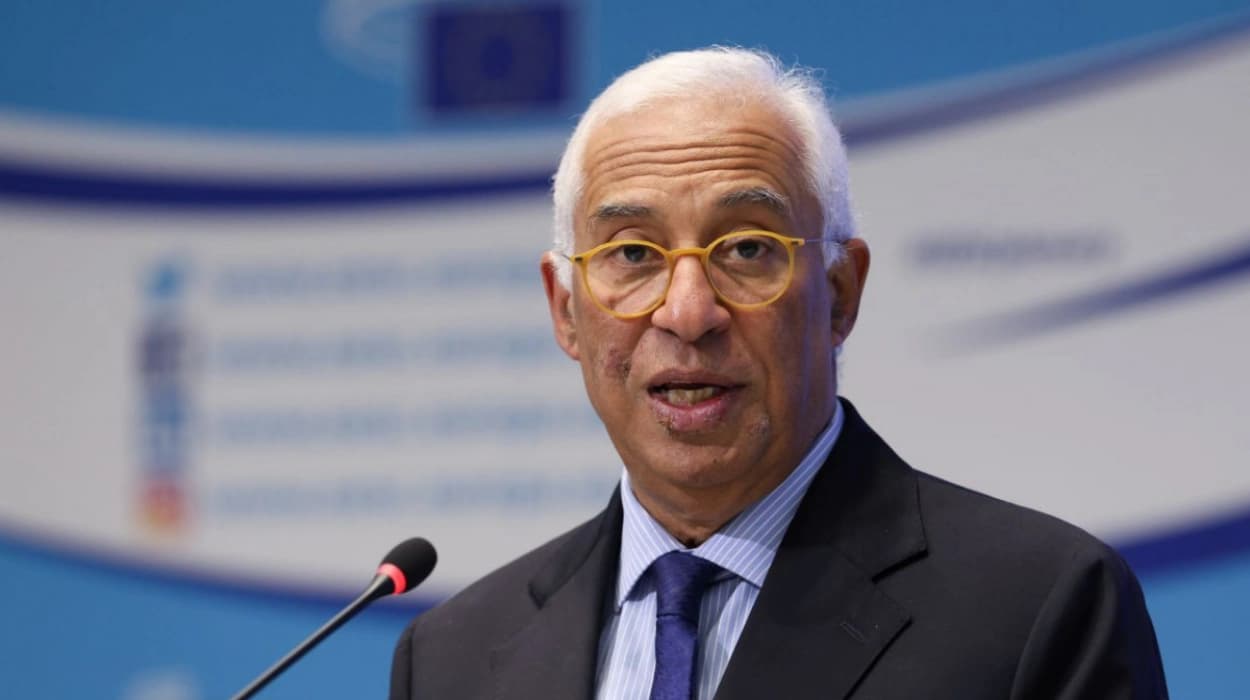
European Council president António Costa warned the Trump administration against interfering in EU affairs, calling the US strategy a major policy shift.
The policy paper, which was published on Friday, asserts that migration and a censorious EU are "undermining political liberty and sovereignty" and that Europe is facing "civilizational erasure." It states that the US will "cultivate resistance" in the union to "correct its current trajectory," confirming not just the Trump administration's animosity toward Europe but also its goal of weakening the group.
According to Costa, the indication that Washington would support nationalist groups in Europe was intolerable. Speaking on Monday, he stated that while he and Trump have always disagreed on matters like the climate catastrophe, the new approach went
“beyond that … What we cannot accept is the threat to interfere in European politics,”
he said.
“Allies do not threaten to interfere in the domestic political choices of their allies,”
the former Portuguese prime minister said.
“The US cannot replace Europe in what its vision is of free expression … Europe must be sovereign.”
The Kremlin praised the strategy plan over the weekend, saying it "corresponds in many ways to our vision." Meanwhile, a $120 million (£90 million) fine levied by the EU on Elon Musk's social media site X further strained ties between the US and the EU.
On Sunday, Musk declared that the bloc ought to be "abolished and sovereignty returned to individual countries." Christopher Landau, the US deputy secretary of state, claimed that US security was being jeopardized by the "unelected, undemocratic, and unrepresentative" EU.
The memo, according to analysts, defined a US policy initially presented by JD Vance at this year's Munich Security Conference in a speech accusing EU leaders of stifling free expression, failing to stop illegal immigration, and fleeing from the genuine opinions of people.
“It transposes that doctrine into an officially backed state line,”
said Nicolai von Ondarza, the head of European research at the German Institute for International and Security Affairs.
“It really represents a fundamental shift in transatlantic relations.”
In particular, Von Ondarza stated that it was "really no longer possible for EU and national European leaders to deny that US strategy towards its European allies has radically changed" due to "open US backing for regime change" in Europe.
Political involvement in Europe to support far-right nationalists is now "a core part of America's national strategy," according to Max Bergmann, director of the Europe, Russia, Eurasia program at the Washington-based Center for Strategic and International Studies.
Bergmann added:
“This isn’t just a speech from a novice vice-president weeks into a new term. It is US policy, and they will try to implement it.”
Moreover, he said, it could work:
“In a fragmented political landscape, a 1-2% shift can change elections.”
EU leaders “will have to confront the fact that the Trump administration is coming for them politically”, Bergmann said.
“Do they just accept that Trump is funding their political downfall? Or does this begin to cause an incredible amount of friction?”
Mujtaba Rahman, of the Eurasia Group risk consultancy, agreed.
“The US is now officially committed, alongside Moscow, to interfering in European electoral politics to promote nationalist and anti-EU parties of the far right,”
he said.
According to him, the first election that Washington would attempt to sway if the paper were US policy would be Hungary's parliamentary election in April of next year, where the incumbent, nationalist, and Moscow-friendly Viktor Orbán is up against a fierce opponent.
The policy document was "actually useful," according to Minna Ålander of the Center for European Policy Analysis. What has been clear all year long that Trump and his supporters are openly antagonistic toward Europe is codified in policy in plain and white.
According to Ålander, European politicians "cannot ignore or explain the fact away any more." Any expectation that things will return to the previous normal seems more and more absurd. Finally, Europe must take the lead and quit squandering time attempting to control Trump.
Europeans have "lulled themselves into the belief" that Trump is "unpredictable and inconsistent, but ultimately manageable," according to Nathalie Tocci, director of Italy's Instituto Affari Internazionale. Although comforting, this is incorrect.
She claimed that the Trump administration has
"a clear and consistent vision for Europe: one that prioritizes US-Russian ties and seeks to divide and conquer the continent, with much of the dirty work carried out by nationalist, far-right European forces."
Flattering Trump "will not save the transatlantic relationship," according to Tocci, who claimed that these forces "share the nationalist and socially conservative views championed by Maga and are also working to divide Europe and hollow out the European project."
Sinan Selen, the head of Germany's spy agency, stated on Monday that he
"would not draw from such a strategy document the conclusion that we should break with America."
Jana Puglierin, a senior policy fellow at the European Council on Foreign Relations, emphasized that Trump was still unpredictable and that the document might not be significant in the end.
But the US obviously sought to "redefine what Europe means, to Europeans," she said. According to Puglierin, the goal was to prove that
"we are the aberration, that we have somehow forgotten our true values and heritage, and that European greatness therefore needs to be restored with the help of 'patriotic' parties."
Europeans "need to see the relationship much more pragmatically," according to her. Recognize that serving Trump breakfast with a monarch, vowing to spend 5% of GDP on defense, or flattering him endlessly won't work.
Appeasement "has not worked on trade, it hasn't worked on security, and it won't prevent the US supporting Europe's far right," according to Von Ondarza. The bloc must develop a solid plan of its own. He claimed that a summit later this month will be a "decisive test of Europe's ability to say no" to the US.
What specific measures does the US National Security Strategy propose about Europe?
The US National Security Strategy (NSS), released December 5, 2025, proposes specific measures for Europe under" Promoting European Greatness," prompting the mainland to reverse" civilizational erasure" from unbounded immigration, falling birthrates, suppression, nonsupervisory overreach, and suppressed public individualities to remain dependable NATO abettors with feasible husbandry colors.
Help Europe in reclaiming" civilizational tone- confidence and Western identity" through unapologetic festivity of public histories characters and rejection of international bodies eroding sovereignty.
Combat mass migration projected to make NATO members" maturitynon-European" within decades, alongside profitable recession from low birthrates and policy failures. The NSS warns of an" unrecognizable" Europe in 20 years absent corrections, prioritizing US alliances with" creative, able, confident" nations over current circles.