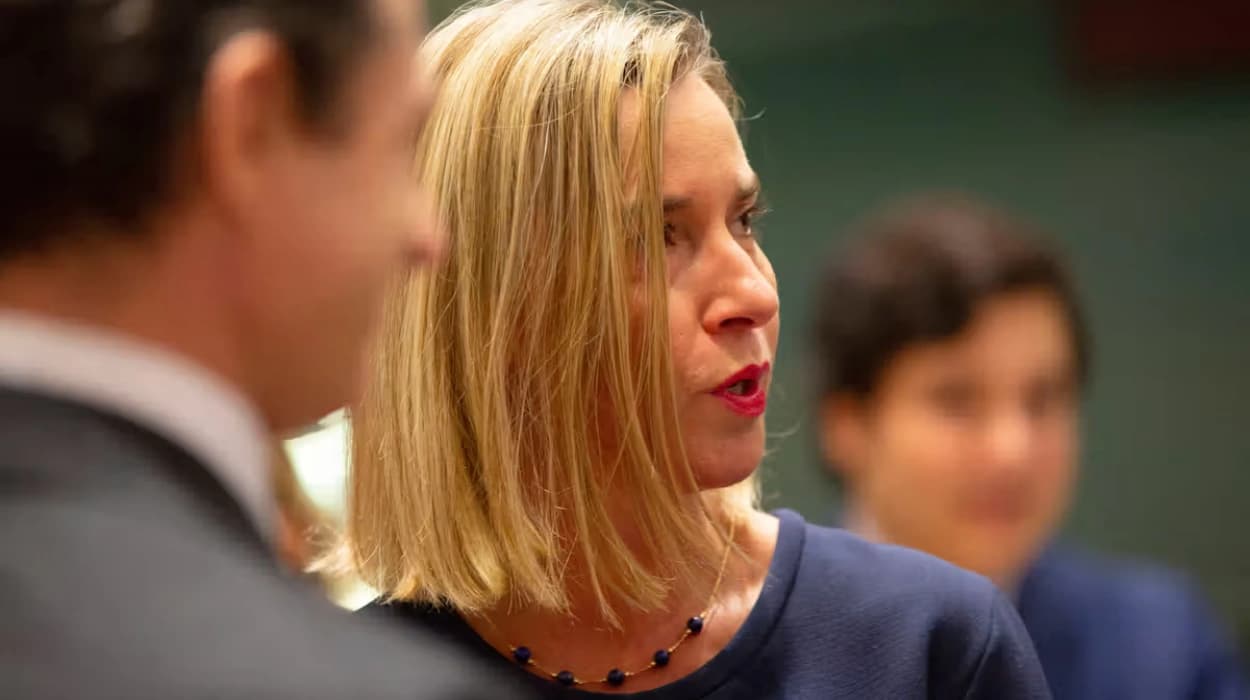
Prosecutors say the EU’s former foreign policy chief Federica Mogherini faces corruption allegations after three arrests in a major fraud probe.
The arrest of Federica Mogherini, who led the EU foreign service from 2014 to 2019, risked harming the EU’s international image just as it strives to exercise influence in discussions aimed at resolving the crisis in Ukraine. Ukraine has been under pressure from the EU to address widespread corruption.
Following raids on a council in Bruges and the services of the EU political service in Brussels, Belgian authorities made the apprehensions on Tuesday. Mogherini now works as the rector of the College of Europe, a notorious institute of European studies.
Mogherini, a senior college employee, and a senior European Commission official were held at the European Public Prosecutor's Office's request and questioned by the Belgian Federal Judicial Police, the office said in a statement.
“The accusations concern procurement fraud and corruption, conflict of interest and violation of professional secrecy,"
the prosecutor's office said.
The three were not considered flight risks and were freed, the office said.
As the bloc’s top diplomat, Mogherini was responsible for supervising the Iran nuclear talks, leading efforts to repair long-strained relations between Serbia and Kosovo, and a number of other foreign policy and security matters.
Police examined the houses of the accused, numerous buildings of the college and the offices of the European External Action Service, or EEAS, the EU’s equivalent of a foreign office, which stands at the hub of the bloc’s institutions in Brussels, the prosecutors said.
No outside actor, or country, has been mentioned so far in the probe.
Mariapaola Cherchi, Mogherini's attorney, told The Associated Press that her client was
"transparent, clear, and serene"
during her ten-hour interrogation. Mogherini did not respond to the accusations. She said she was convinced Mogherini would be cleared
"on the basis of such a transparent interrogation, without any strain on any side.”
The college declared that it "remains committed to the highest standards of integrity, fairness, and compliance both in academic and administrative matters" and that it will assist with the investigation.
The EU's independent public prosecutor's office stated that it had "strong suspicions" of fraud in the awarding of a tender to administer a training program for junior diplomats at the EU Diplomatic Academy in 2021–2022.
The monies involved are relatively little. The EU set aside 1.7 million euros($1.98 million) to fund the training program from July 2024 to June 2025 in order to make the EU Politic Academe.
The corruption disquisition against Mogherini is the rearmost to hang European institutions.
Exposures of a cash- for- influence operation called Qatargate, including high- profile center- left EU lawmakers, helpers, lobbyists and their cousins, surfaced in 2022. Officers from Morocco and Qatar were indicted of paying backhanders to sway opinions. Both countries deny involvement. The liability of a trial is uncertain, as no one has been set up guilty or is being held pending trial.
How could these charges affect the College of Europe and its programs?
The corruption charges against Rector Federica Mogherini and others oppressively blemish the College of Europe's prestige as the" EU's finishing academy," potentially inhibiting top aspirants, alumni donations, and partnerships.
EPPO's inquiry into procurement fraud, conflict of interest, and secretiveness breaches may spark checkups by OLAF and EU funders, indurating unborn subventions or assessing prepayment demands. The College's reliance on EU subventions for programs like the Politic Academe( launched 2022) faces heightened scrutiny, with impunity lifts signaling institutional involvement.
The €3.2 m Spanjaardstraat structure purchase, allegedly told by prescience, raises fiscal questions during ongoing examinations. Durability measures are pledged, but registration for 2026/27(€30,000 freights) may suffer.