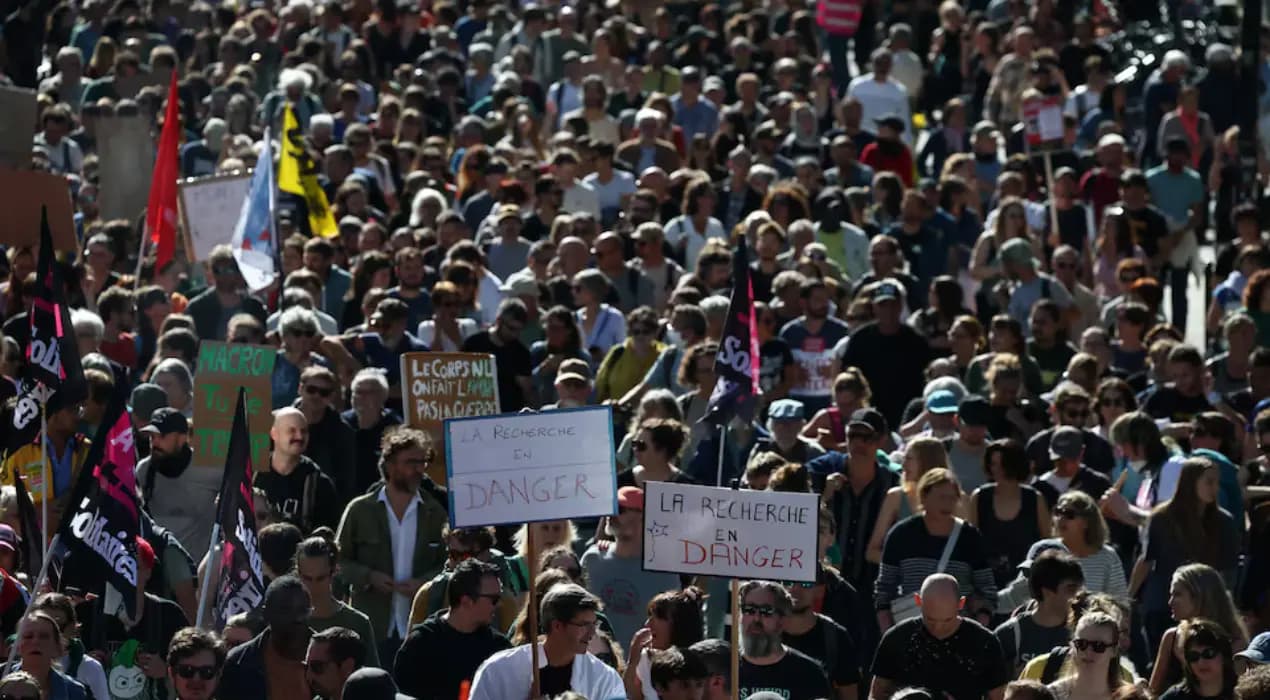
Hundreds of thousands protested across France against austerity, pressuring President Macron and new PM Sebastien Lecornu to drop budget cuts.
Teenagers stopped dozens of high schools for hours, and other workers, including teachers, train drivers, pharmacists, and hospital personnel, went on strike as part of the protest day.
Protesters and unions demanded that the economic goals of the previous government be abandoned, that more money be spent on public services, that the wealthiest pay more taxes, and that an unpopular policy that required people to work longer to receive a pension be reversed.
"The anger is immense, and so is the determination. My message to Mr. Lecornu today is this: it's the streets that must decide the budget,"
said Sophie Binet, head of the CGT union.
According to the CGT, one million people participated in the rallies and strikes. Authorities believed that there were around half as many demonstrators.
"I would like to emphasise that in almost all cases, marches and demonstrations took place under favourable conditions,"
he said during a briefing held shortly after the end of the Paris rally.
The amount of violence was lower than Interior Minister Bruno Retailleau had predicted, notwithstanding a few altercations on the fringes of the gatherings.
Macron's new prime minister is rushing to form a new cabinet and a budget for the upcoming year.
In a post on X, he promised to reconvene with the unions "in the coming days," adding,
"The demands made by the union representatives and echoed by demonstrators in the marches are at the heart of the consultations I have initiated."
"This is a warning, a clear warning to Sebastien Lecornu,"
said Marylise Leon, the head of the CFDT, France's largest union.
"We want a socially fair budget."
According to the FSU-SNUipp union, one in three primary school teachers worldwide went on strike Thursday, and almost one in two of them left their jobs in Paris.
While the majority of the nation's high-speed TGV train lines operated, regional trains were severely impacted, according to officials. In order to slow down traffic on a highway close to the city of Toulon in the southeast, protesters assembled.
On multiple occasions, police in Paris used tear gas to scatter black-clad troublemakers who were throwing stones and beer cans at them. Additionally, police intervened to prevent bank-targeting.
Brief altercations also occurred on the fringes of other protests, such as in Nantes and Lyon, where three people were reportedly hurt, according to French media.
According to the interior ministry, more than 180 persons have been taken into custody. Throughout the day, over 80,000 police and gendarmes, along with riot squads, drones, and armored cars, were scheduled to be deployed.
Even though Lecornu wants to cut the budget deficit, which was nearly over the EU's 3% cap last year, he will have to fight to obtain parliamentary support for a 2026 budget because he depends on other parties to pass legislation.
Last week, parliament dismissed Francois Bayrou, Lecornu's predecessor, for proposing a budget squeeze of 44 billion euros. Although the new prime minister has indicated a readiness to compromise, he has not yet stated what he will do with Bayrou's plans.
How is Macron planning to respond to the protests?
Authorities have mobilized more than 80,000 police and gendarmes, assisted by drones, armored vehicles, and water cannons, to control protests and deter violence, indicating a serious security commitment to possible disruptions and sabotage from extremist groups.
Prime Minister Lecornu, who assumed office recently, promised to break with previous approaches, but both unions and citizens have waited to see if there will be any real change in austerity or pension reforms.
Despite the protests, the government is determined to continue with its budget plan to save €44 billion including savings from public services and pension reforms to address France's significant deficit and debt.