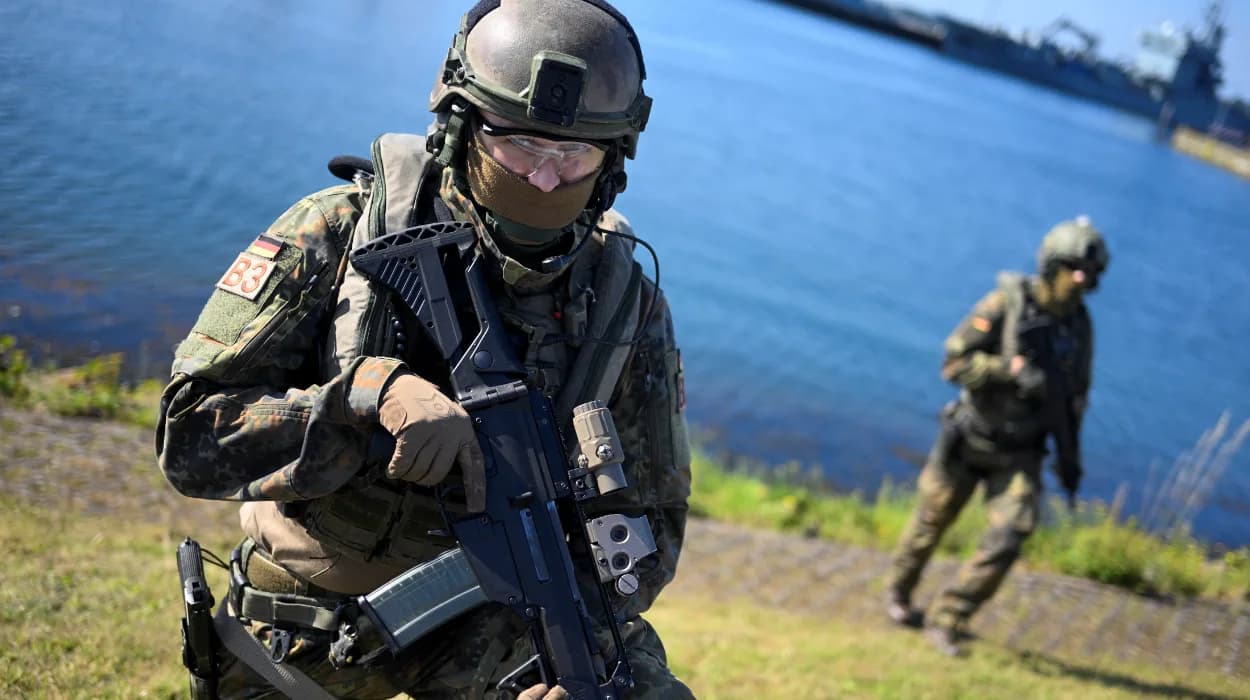
Germany’s coalition government has agreed on a new military service plan aimed at boosting troop numbers, ending months of political debate over defense reforms.
All 18-year-old men will be required by the new military service plan to complete a questionnaire on their eligibility for service and, starting in 2027, to go through a medical screening.
Berlin is making this decision in an effort to build the most powerful conventional army in Europe.
The head of Rheinmetall, the largest defense company in Germany, told the BBC that he thinks the goal may be achieved in five years.
Armin Papperger told the BBC that "clear decisions" were being made by the government and that Chancellor Friedrich Merz's goal to strengthen the Bundeswehr was "realistic."
German defense commander Gen. Carsten Breuer issued a warning earlier this year, stating that the Western NATO alliance needed to get ready for a potential Russian invasion within four years.
Merz's conservative CDU/CSU and the center-left Social Democrat SPD agreed to reinstate military duty "to start with" when they established a coalition earlier this year.
There are now about 182,000 soldiers in the Bundeswehr. With the addition of about 200,000 reservists, the new military service model seeks to raise that number by 20,000 over the course of the following year and to between 255,000 and 260,000 over the following ten years.
All 18-year-old men and women will receive a questionnaire starting next year to gauge their interest in and desire to enlist in the military. For men, it will be required, while for women, it will be optional.
Following the end of the Cold War, Germany's defense budget fell, and conscription was discontinued in 2011.
Friedrich Merz declared earlier this year that the norm for German defense "now has to be whatever it takes" in response to Russia's full-scale invasion of Ukraine, despite Germany's historical reluctance to demonstrate military strength.
The White House of President Donald Trump has put pressure on NATO nations around Europe to increase investment.
Rheinmetall has made a substantial profit as a result of European rearmament.
Its CEO, Armin Papperger, whose firm also supplies Ukraine, said:
"We make a lot of money because there is a huge demand."
"We have to grow strong on vehicles, on ammunition, we have to have our own satellite competencies. We do much more on the electronics and artificial intelligence... than ever before,"
he said.
A US report last year suggested the Rheinmetall boss had been the target of a Russian assassination plot. There was no confirmation at the time and Mr Papperger would not be drawn on the report, saying:
"I feel good, I feel safe."
Asked about whether he felt Europe was in a state of a cold or hybrid war, he said:
"Whatever you call it, it's not a peaceful time."
How does the plan affect recruitment targets and timeline?
Germany's new military service plan sets ambitious reclamation targets and timelines to address labor force deaths in the Bundeswehr while maintaining voluntary service as the core principle.
To achieve this, all 18- time-old men will be needed to complete provocation and medical assessments, starting gradually with full perpetration by summer 2027. The draft law, effective from January 1, 2026, empowers the Bundestag to spark conscription only if voluntary investiture fails to meet set targets, therefore keeping conscription as a backup rather than immediate policy.
The reclamation timeline is phased, fastening originally on assessments and voluntary investiture drive advancements, also potentially invoking obligatory service if faults persist. This allows flexible scaling of labor force figures over the medium term while aiming for a steady increase as voluntary service rates ameliorate.