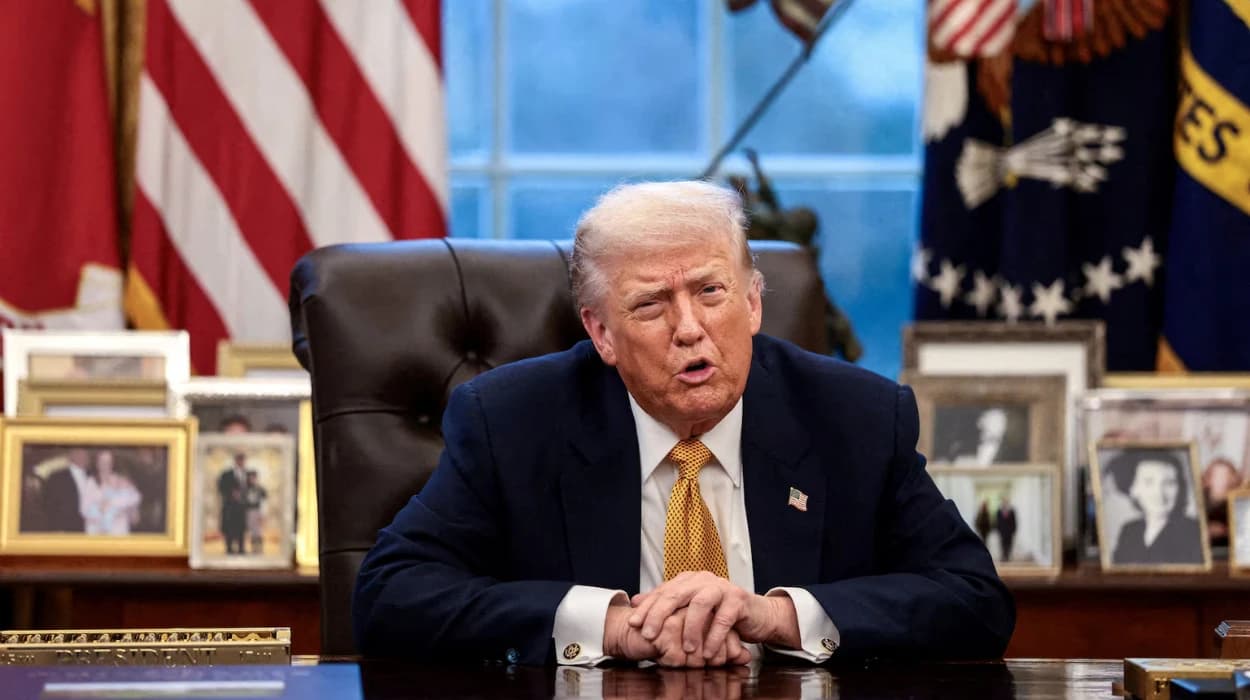
Washington (The Palestine Telegraph Newspaper) 20 January 2026 – United States President Donald Trump has continued efforts to invite various countries to join a proposed “Peace Council” aimed at fostering global stability. Multiple nations have received formal invitations in recent weeks, with Trump emphasising the council's role in resolving international conflicts. The initiative follows his reelection and inauguration, building on campaign promises for diplomatic engagement.
President Trump announced the latest round of invitations during a White House briefing on 19 January 2026. He stated that the Peace Council would serve as a platform for direct negotiations between major powers, bypassing existing multilateral frameworks. Invitations extended to key allies and adversaries alike, including Russia, China, Saudi Arabia, Israel, Iran, and several European Union members.
Origins and Objectives of the Peace Council
 Credit: Evan Vucci
The concept emerged during Trump's 2024 reelection campaign, where he pledged to establish a new forum for peace talks outside United Nations structures. In a speech on 15 November 2025, post-election, Trump described the council as a “high-level group of strong leaders” focused on ending wars in Ukraine, the Middle East, and Asia. The initiative draws from his first-term experiences with summits involving North Korea and the Taliban.
White House officials outlined the council's structure in a December 2025 memorandum, proposing 15 permanent members with veto power and rotating seats for regional representatives. Objectives include immediate ceasefires in active conflicts, trade normalisation, and counter-terrorism cooperation. Trump reiterated these goals in his 20 January State of the Union address preview, stressing voluntary participation without preconditions.
Invitations carry no binding commitments, allowing recipients to nominate delegates for preliminary meetings. The first session is tentatively scheduled for March 2026 at Mar-a-Lago, Florida, pending confirmations.
Recent Invitations and Responses
 Credit: aa.com.tr
On 18 January 2026, the US State Department delivered letters to Russian President Vladimir Putin and Chinese President Xi Jinping, urging their involvement. Trump personally telephoned Putin, according to Kremlin spokespersons, discussing Ukraine as a priority agenda item. Xi received his invitation during a virtual call, with Beijing acknowledging receipt but offering no immediate response.
Saudi Crown Prince Mohammed bin Salman confirmed acceptance on 19 January via state media, pledging to advocate for Gulf stability. Israel’s Prime Minister Benjamin Netanyahu expressed support, highlighting potential Middle East peace tracks. Iran’s Foreign Ministry confirmed receiving the note but described it as “under review,” amid ongoing nuclear talks.
European responses varied. France and Germany indicated willingness to participate, with President Emmanuel Macron stating alignment with transatlantic goals. The United Kingdom, under Prime Minister Keir Starmer, welcomed the outreach, committing liaison officers. Turkey’s President Recep Tayyip Erdogan accepted, citing opportunities for Syria and Black Sea resolutions.
Diplomatic Outreach Timeline
 Credit: chellaney.net
Trump initiated contacts in December 2025, starting with NATO allies. On 10 December, invitations went to Canada, the UK, and Poland, all of which affirmed interest. India’s Prime Minister Narendra Modi responded positively on 5 January 2026, nominating a delegation led by External Affairs Minister S. Jaishankar.
Brazil and South Africa, representing BRICS nations, received bids on 12 January, with Brazilian President Luiz Inácio Lula da Silva praising the multilateral approach. Egypt and the United Arab Emirates confirmed on 16 January, focusing on Red Sea security. Pakistan acknowledged the invitation, linking it to Afghanistan stabilisation efforts.
Over 20 countries now hold invitations, per State Department tallies. Non-responses include North Korea and Venezuela, though Trump mentioned ongoing “backchannel” communications.
Role of US Envoys and Mediators
US Special Envoy Tom Barrack, recently active in Syria, leads coordination efforts. Barrack visited Damascus on 18 January, securing Syrian President Ahmed al-Sharaa’s tentative interest in observer status. In Ukraine talks, Envoy Keith Kellogg contacted Kyiv and Moscow, aligning Peace Council proposals with Minsk II revivals.
Trump appointed additional envoys for regional desks, including Ambassador Victoria Coates for the Middle East. Coates met Saudi and Israeli counterparts in Riyadh on 17 January, advancing joint proposals. The National Security Council oversees logistics, budgeting an initial $50 million for summit preparations.
Congressional briefings occurred on 15 January, with bipartisan support from Senate Foreign Relations Committee chairs. Funding cleared the House on 18 January via supplemental appropriations.
Global Context and Related Developments
The push coincides with de-escalation in Syria, where a government-SDF ceasefire took effect on 18 January 2026. Trump linked the timing, crediting US mediation via Barrack for the deal integrating SDF forces into the Syrian army. Oil fields in Deir ez-Zor transferred to Damascus control, stabilising exports.
In Ukraine, Trump’s team proposed a 30-day pause, inviting Kyiv and Moscow to council sessions. Zelenskyy acknowledged the offer on 19 January, pending NATO consultations. Putin’s office confirmed discussions, emphasising territorial integrity clauses.
Middle East tracks target Gaza and Lebanon ceasefires. Invitations to Hamas and Hezbollah proxies remain unexplored, focusing instead on state actors. Yemen’s Houthi leadership received indirect overtures through Oman.
Statements from Key Figures
Trump addressed reporters on 19 January: “This Peace Council will get deals done fast—real leaders, real results.” Putin responded via TASS: “We welcome initiatives promoting dialogue.” Xi’s foreign ministry readout noted “constructive engagement prospects.”
Macron tweeted: “France stands ready to contribute to global peace.” Erdogan declared: “Turkey will use the platform for just solutions.” Al-Sharaa, in Damascus, called it “a step toward Syrian sovereignty.”
UN Secretary-General António Guterres welcomed parallel efforts, avoiding overlap claims. NATO Secretary-General Mark Rutte endorsed allied participation.
Operational Framework Details
Proposed rules include closed-door plenaries, with public communiqués post-session. Voting requires consensus on binding resolutions, supermajorities for declarations. Secretariat rotates annually among founding members.
Headquarters discussions favour neutral venues like Geneva or Vienna, with virtual options. Cybersecurity protocols mirror G7 standards, per White House tech advisors.
Budget allocations cover travel, translation, and secure communications. Private sector pledges, including from Elon Musk’s ventures, support logistics.
Historical Precedents and Influences
Trump cited the 1978 Camp David Accords and 1990s Dayton Agreement as models. His first-term Abraham Accords informed the inclusive design. Advisors reference Yalta Conference structures for great-power dynamics.
Critics in prior debates noted G20 parallels, but Trump distinguished by conflict resolution focus. Supporters highlight flexibility over bureaucracy.
Participation Challenges Ahead
Logistical hurdles include scheduling amid regional crises. Syria’s Abdi-Mazloum visit to Damascus, delayed by weather, exemplifies coordination needs. Visa arrangements for sanctioned delegates pose issues.
Language on enforcement remains vague, with voluntary compliance emphasised. Follow-up mechanisms include quarterly reviews.
As invitations circulate, the administration monitors responses daily. Further outreach targets Africa and Latin America this week.