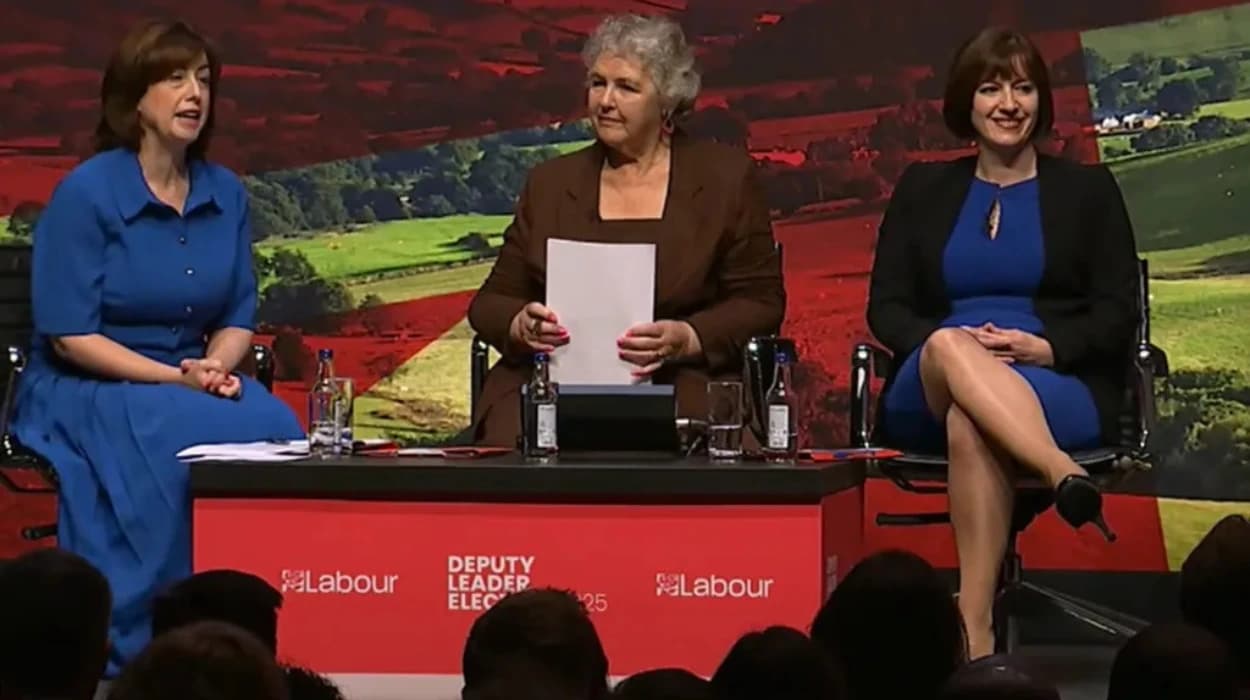
Bridget Phillipson and Lucy Powell faced off in a deputy leadership hustings at the close of Labour’s party conference in Liverpool.
A huge podium stood unoccupied in the center of the enormous stage, and former Commons Leader Powell and Education Secretary Phillipson sat on one side of it in dark blue costumes.
In case it exposed internal divides when the party was trailing in the polls, the Labour leadership did not want this contest to take place.
Despite being broadcast on Labour's YouTube page, the hustings, where the two contenders set up their booths and fielded questions from members, was moved past the annual conference's official conclusion without access to a TV camera.
Because "cumulatively applause could knock out a whole question," the audience was urged not to clap as the session got underway in a far from packed hall.
Following Angela Rayner's resignation due to what she claimed were errors in her stamp duty payment, Phillipson and Powell are competing to succeed her as the party's deputy leader.
During their two-minute presentations to the membership, Phillipson emphasized that, in her role as education secretary, she would be a voice "at the heart of government" and would present the Employment Rights Bill in its entirety.
She criticized her rival, saying she was the candidate of "division and disunity" and that Labour could not afford to turn inwards, while also addressing the need for unity and stating that she was a candidate who would encourage the government to be bold.
She emphasized that the deputieship "is a party role, not a government one" and stated that she would concentrate on getting the administration to listen to the opinions of members, council members, and communities.
She added:
"Having this debate is not dissent but an important conversation about how we can be better - because we need to be."
The administration will make better judgments
"when we reflect the views of our broad movement and when our values shine through,"
she said, adding that she would not "shy away" from having tough talks.
While there was agreement on certain points, such as that Labour should not "copy" Reform in its challenge to Nigel Farage, each candidate placed a distinct emphasis on the shortcomings of the Labour government.
Both acknowledged that the winter fuel cutbacks were a mistake, but Powell insisted that it was impossible to "sugar-coat" significant mistakes and that voter disenchantment needed to be addressed, while Phillipson suggested that the party could concentrate on "the 90% of things it got right" such as workers' rights and family hubs.
Although the Phillipson campaign highlights her higher number of nominations from the trade union movement, Team Powell is optimistic about their chances with the membership.
The results will be revealed on October 25. Labour members have till October 23 to cast their ballots for the candidate of their choice.
What were the key policy contrasts they highlighted at the hustings?
Phillipson stressed her commitment to implementing the Employment Rights Bill fully and to being a strong voice within government departments to advocate continued step changes in the agenda. She presented herself as the candidate of unity by saying it was not about the current debates inside the party, but more about delivering the government’s achievements.
Phillipson described Powell indirectly, but clearly, as representative of the issues of division and disunity, indicating the party needed to get beyond who we are and the introspective, and needed to do that without distraction by even more symbolic internal division.
Powell positioned herself as the representative of ordinary or grassroots members, and said she valued debate, as sincere engagement rather than dissent. She suggested that openly acknowledging Labour’s mistakes in the past was a necessary first step to rebuild credibility to the electorate.