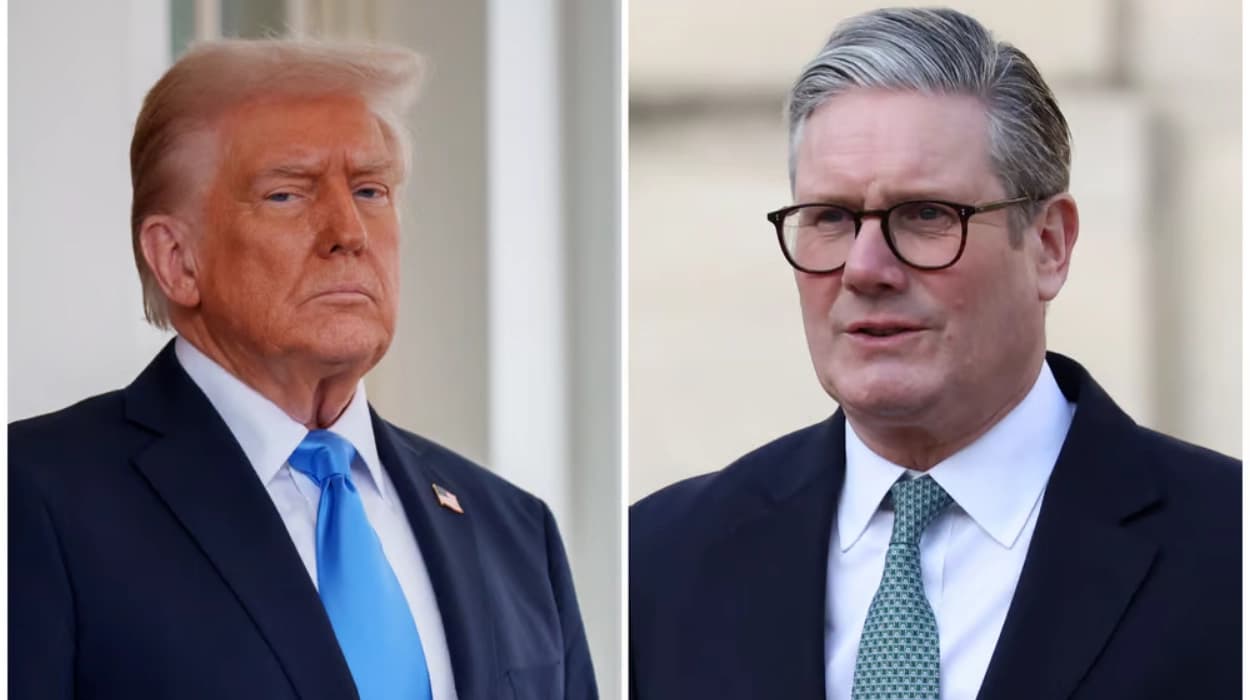
Keir Starmer says Trump and EU leaders share a vision for a “just lasting” Ukraine ceasefire as fragile diplomatic efforts continue amid the US-led plan.
Ahead of chairing a call with allies in the coalition of the willing on Thursday, the prime minister acknowledged that there were a "number of issues still to be resolved," but he denied that his optimism had faded.
German Chancellor Friedrich said on Wednesday that the US President has received the most recent draft proposals for Ukraine, which include plans for potential territorial concessions Kyiv could be willing to make.
However, he emphasized that territorial concerns were "questions that must be answered primarily by Ukrainian president, and the Ukrainian people," and that Mr. Trump had been "made clear" of this.
When asked if there was any prospect of progress into the weekend or if his hopes had been "worn down" during a visit to Norfolk, Sir Keir responded as follows:
“No, we do need to make progress.
And what President Trump wants, what Ukraine wants, what Europeans want is the same thing, which is a just and lasting peace in Ukraine after the nearly four-year aggression from Putin and Russia. So we’re working towards that aim.
Obviously there are a number of issues still to be resolved, but I’m very clear in my mind that we support Ukraine in this fight, not of their making.
They’ve paid a very heavy price. If there is to be a ceasefire and I hope there is, the Ukrainians want that above all else, it must be just and it must be lasting.”
The US relationship with Europe is under extreme strain, and this comes after Sir Keir, French President Emmanuel Macron, and Mr. Merz spoke to Mr. Trump on Wednesday.
The US president stated that they had discussed "pretty strong terms" for ending the conflict and that European leaders would like to meet with the US and Ukraine this weekend. He also stated that he believed Mr. Zelensky "has to be realistic" about the conflict.
According to Downing Street, all of the leaders had concurred that the future of Ukraine and Euro-Atlantic security was at a "critical moment," adding:
“Intensive work on the peace plan is continuing and will continue in the coming days.”
Later, the Prime Minister will co-host a conference with Mr. Zelensky, Mr. Macron, Mr. Merz, and representatives from about thirty additional countries.
The coalition of the willing, a group of nations led by the UK and France, has promised to back Ukraine and discourage Russia in the case of a truce.
According to a No. 10 spokesman, preparations for a possible peacekeeping force have been "detailed," including reconnaissance trips to Ukraine to ascertain "what units we might deploy, how and what their roles might be."
“The Prime Minister has been clear that we’re ready to put troops on the ground following the end of hostilities,”
he told
journalists on Thursday.
According to British authorities, there has been progress in behind-the-scenes discussions involving national security advisers, including Jonathan Powell of the UK.
Mr. Zelensky said his team was scheduled to present its most recent peace offers to American negotiators on Wednesday. Earlier this week, he reaffirmed his aversion to giving up land and rebuffed US demands for concessions to Russia.
His attempts to ensure that any settlement is equitable, discourages further attacks from Moscow, and takes into account the defense interests of the continent are being supported by Ukraine's European partners.
Mr. Trump has attacked the European supporters of Ukraine, calling them "weak" leaders of "decaying" countries that are unable to "produce" anything because "the war just keeps going on and on."
"The Trump Administration finds itself at odds with European officials who hold unrealistic expectations for the war perched in unstable minority governments, many of which trample on basic principles of democracy to suppress opposition,"
according to the US national security strategy released earlier this month.
What are the key points of the US drafted peace proposal?
Keir Starmer's claim highlights perceived alignment on a US- drafted 28- point peace offer for Ukraine, which seeks a ceasefire through territorial concessions, military limits and security guarantees, though details remain contentious amid ongoing variations.
The plan calls for de facto recognition of Crimea, Luhansk and Donetsk as Russian, indurating Kherson and Zaporizhzhia along current lines, and creating demilitarised zones with Ukrainian pullout from corridor of Donetsk, rejecting Kyiv's maximalist recovery pretensions.
Ukraine would admit US- intermediated guarantees( not NATO class), limit forces to 600,000 labor force, and commit to non-aggression pacts, with Russia halting irruptions and NATO breaking expansion; violations spark warrants reinstatement.