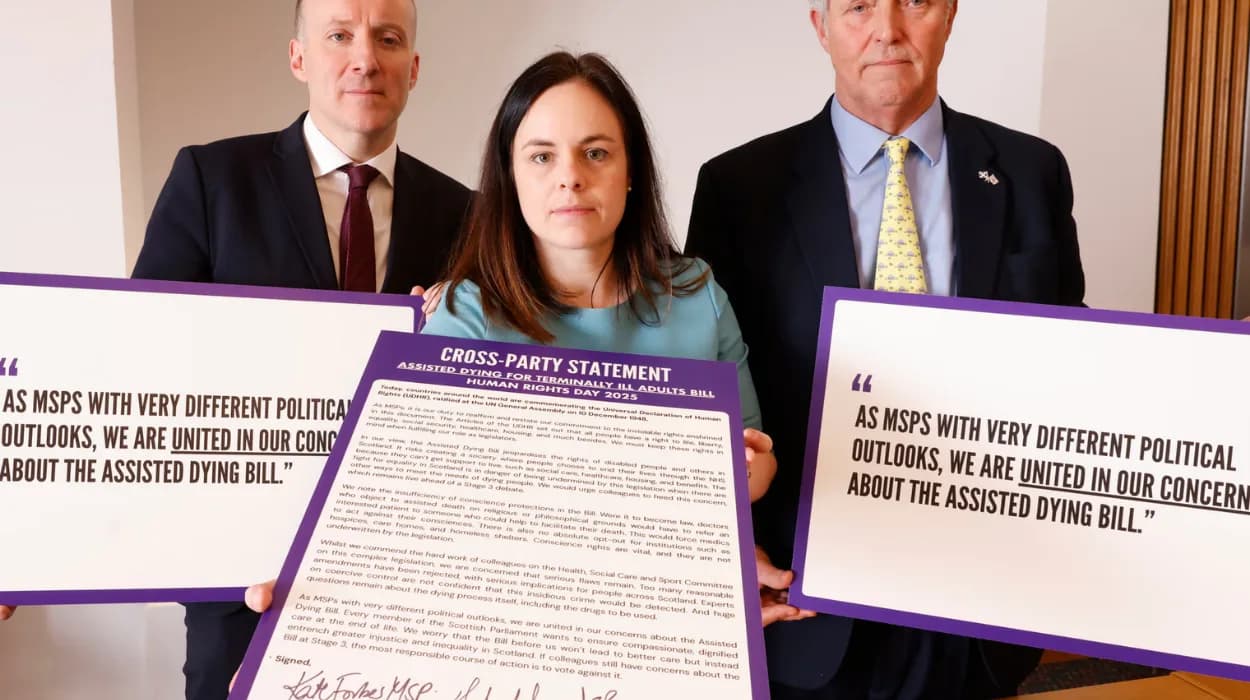
Senior Scottish politicians warn of a rise in “death tourism” as terminally ill people may travel from elsewhere in the UK to end their lives in Scotland.
A cross-party group of MSPs, including Kate Forbes, the deputy first minister, claimed that persons dissatisfied with the more stringent regulations intended for England and Wales would be drawn to Scotland's assisted dying bill due to its weaker qualifying restrictions.
There is no deadline for applying for assisted dying under the Scottish law, which is scheduled for a final vote in February. However, applicants must have lived in Scotland for at least a year and have "advanced and progressive disease, illness from which they cannot recover."
A person must be within six months of death, according to the policies for England and Wales that are being reviewed by the Lords. The implementation of Kim Leadbeater's bill could take up to four years if it is approved.
Dr. Claudia Carr, a medical ethics expert at the University of Hertfordshire's law school, voiced concerns regarding "death tourism." According to her, Scotland may have "a more positive climate for assisted death and move accordingly" as a result of some terminally sick individuals.
If Scotland's bill is passed, there is a "real risk" that some terminally sick individuals could travel there instead of adhering to the more stringent regulations in England and Wales, according to Edward Mountain, a Scottish Conservative MSP who recently revealed a diagnosis of colon cancer.
He said:
“There is always the chance that people will see Scotland, if this bill passed, which I hasten to say I hope it doesn’t, is an easier place to end your life than down south.”
Another opponent of the Holyrood law, Scottish Labour frontbencher Michael Marra, predicted that it would be contested when it came to a vote, primarily because MSPs who evaluated the draft had rejected attempts to make it tighter.
He claimed that both parliaments and the governments of the UK and Scotland have "hugely understudied" these cross-border concerns.
"How the two systems might interact is a very complex issue,"
Marra
stated.
Speaking in a personal capacity, Forbes, a member of the socially conservative Free Church of Scotland, expressed concern that some people could choose assisted dying needlessly due to the broader definitions and absence of a time limit.
She said:
“People with a potentially years to live might choose assisted dying for other factors unrelated to their terminal illness, because of poor mental health and so on.”
The Scottish Liberal Democrat MSP who introduced the Holyrood measure, Liam McArthur, minimized those worries. He claimed that moving abroad when terminally ill would provide serious and actual financial, personal, and medical difficulties.
He said:
“In practice, it seems highly unlikely someone with a terminal illness will want to go through the upheaval of moving away from their home, family, friends and medical support at this point in their life. Given that the progression of a terminal condition is rarely linear, making such a decision would be even more problematic.”
McArthur added:
“Ultimately, both my bill and the one going through the UK parliament build on best practice from around the world but there are distinct elements to the Scottish legal and health systems. It is right, therefore, that MSPs consider what approach is most appropriate here in Scotland.”
What safeguards can prevent misuse of assisted dying services?
Safeguards to help abuse of supported dying services generally include multiple layers of medical, legal and oversight checks, drawn from fabrics in authorities like Oregon, Canada and the corridor of Europe.
Cases must demonstrate terminal illness or intolerable suffering via opinion from two independent doctors, with written concurrence witnessed by anon-beneficiary and verified free from compulsion through capacity assessments.
Obligatory reflection ages (e.g., 14 days or further) allow retrospection, alongside secondary blessings from ethics panels or specialists to corroborate voluntariness and rule out external pressures. All cases bear obligatory reporting to a central controller for inspection, with occupancy attestations (e.g., 12 months minimum) to discourage" tourism", plus legal penalties for fraud and protections for expostulating healthcare providers.