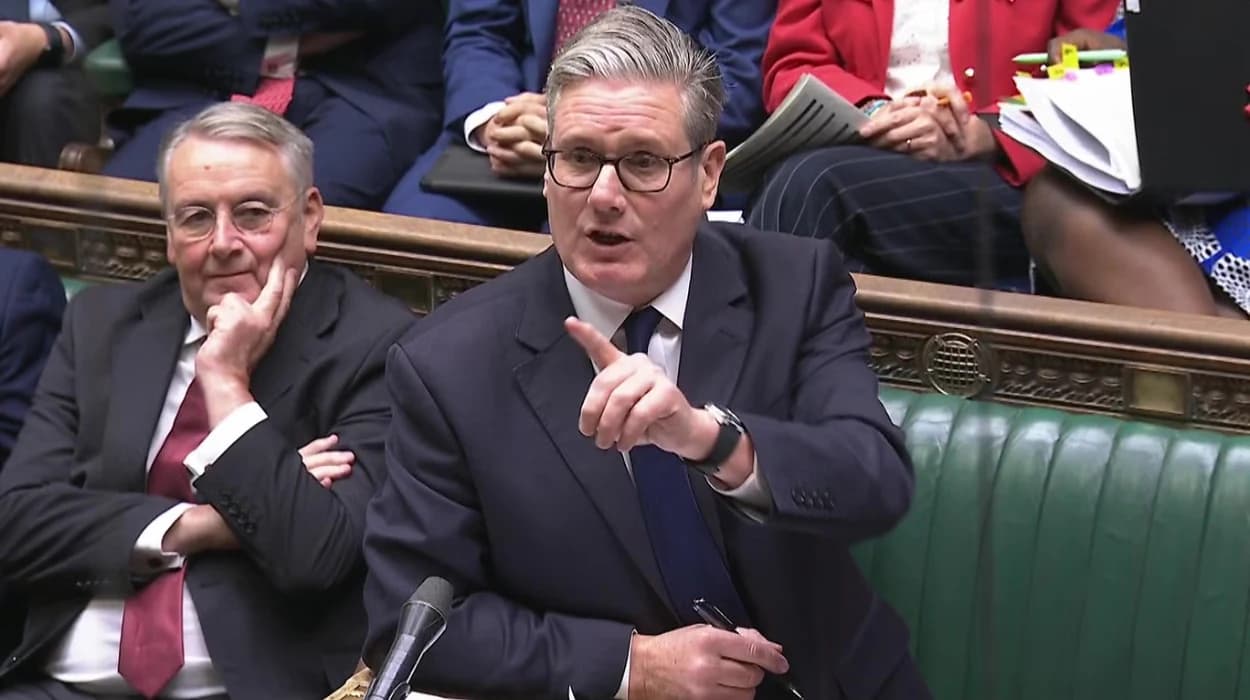
Sir Keir Starmer has announced plans to publish key evidence from the collapsed China spying case trial, pledging full transparency on the matter.
At the beginning of Prime Minister's Questions (PMQs), the prime minister insisted that the previous government was too responsible for the lack of prosecution and promised to release three witness statements that were given to prosecutors.
Significant concerns about national security and government policy toward China have been raised by the decision to drop the prosecution of Christopher Cash, 30, a former parliamentary researcher, and Christopher Berry, 33, a teacher.
Accusations of passing secrets to China were dropped last month against both men, who deny any wrongdoing. The Crown Prosecution Service said the case fell apart because the government's evidence did not demonstrate that China posed a threat to national security at the time of the alleged offenses.
Sir Keir told MPs:
“I’m deeply disappointed by the outcome. We wanted to see prosecutions.”
Sir Keir informed MPs that the argument must be founded on the stance adopted by the Conservative administration, anticipating a flurry of questions from Tory leader Kemi Badenoch.
He claimed that the 2021 and 2023 updates to the Conservative administration's Integrated Review were "extremely carefully worded to not describe China as an enemy."
“The deputy national security adviser, Matt Collins, set out the then-government’s position in a substantive witness statement in 2023, which was subsequently supplemented by two further short statements.
The cabinet secretary assures me that the DNSA faithfully set out the policy of the then-Tory government. I know first hand that the DNSA is a civil servant of the utmost integrity. Those opposite who worked with him, I am sure, would agree with that assessment.
Under this government, no minister or special adviser played any role in the provision of evidence.”
Government sources had originally claimed the CPS was blocking the release of Mr Collins’s evidence, but the organisation denied that it was the case.
Sir Keir said:
“Given the information contained, we will conduct a short process. But I want to make clear, I intend to publish the witness statements in full.”
However, the statement was anticipated by Ms Badenoch, who used all six questions to probe the prime minister on the issue.
Ms Badenoch asked:
“What on earth is the point of us having a lawyer rather than a leader as prime minister if he can’t even get the law right on a matter of national security?”
“I went on to say that our policy first, ‘We will strengthen our national security protections wherever Beijing’s actions pose a threat to our people or prosperity.’
And I finished by saying, ‘When there are tensions with other objectives, we will always put our national security first.’”
Meanwhile, Sir Keir’s response also led to allegations he may have misled parliament which were quickly denied by Downing Street.
Ms Badenoch said:
“Is he seriously saying the deputy (national security adviser) did not discuss with the national security adviser, did not discuss with home secretary or with anyone in Downing Street?”
He said:
“This is an historic moment. For the Prime Minister’s answer to be correct, normal procedure would have to have been abandoned.”
Tory chairman Kevin Hollinrake added:
“The Prime Minister almost certainly misleading Parliament today.”