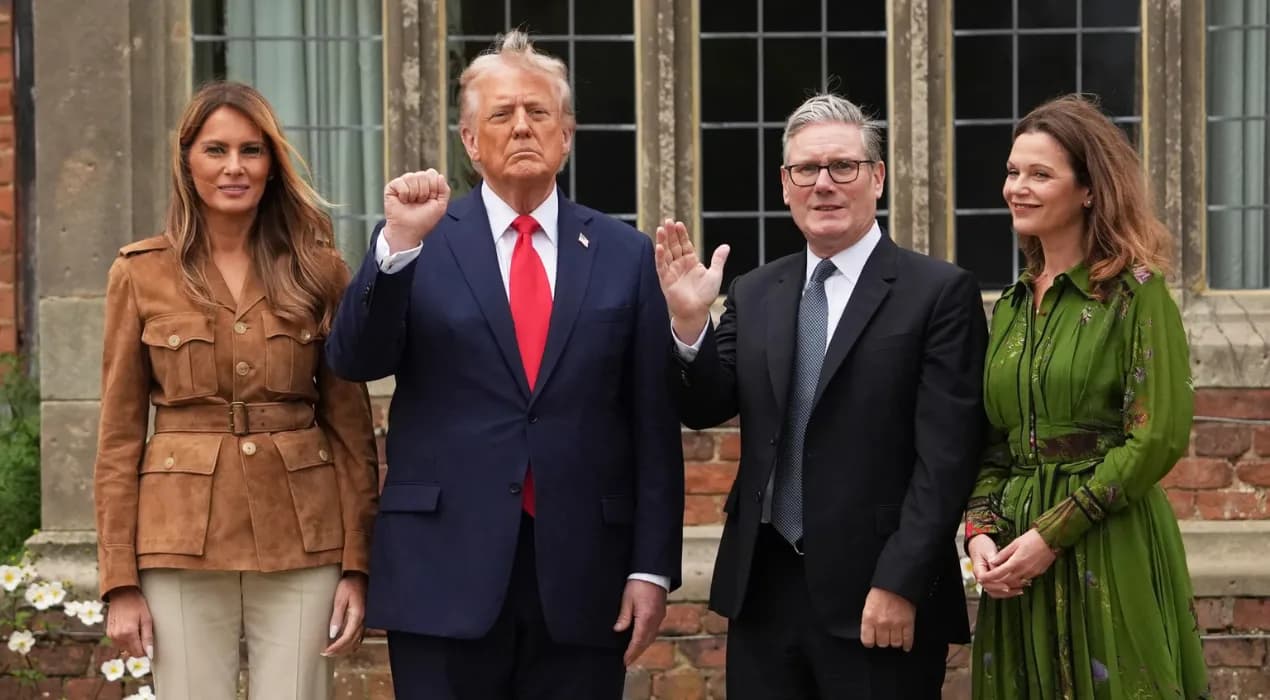
President Donald Trump praised the “pageantry and splendor” of his second UK state visit, avoiding disputes on trade and global issues during the trip.
Even while there was a noticeable lack of movement on certain important issues, the warmth between the two countries and Trump's profusion of complimentary remarks about the host nation indicated that the royal family's and British Prime Minister Keir Starmer's full-scale charm offensive had the intended impact.
Trump and Starmer had a roundtable with world business leaders where they said the accord may result in large job benefits, and they signed what both parties touted as a landmark agreement on science and technology. Trump and Starmer spoke privately on a number of issues, including the wars in Gaza and Ukraine and American tariffs on British steel imports.
“The bond between our countries is like no other anywhere in the world,”
Trump said at a news conference at Chequers, the 16th-century manor house northwest of London that serves as a rural retreat for British leaders. The U.S. and U.K., the American president said, have “done more good for the planet than any other nation in history.”
Trump's helicopter, which was transporting him from Chequers to Stansted airport for his flight to Washington, made an unexpected landing at a nearby airfield at the very end of the trip because of what the White House described as a "minor hydraulic issue." The trip was completed by a backup helicopter, and no one was hurt.
After King Charles III and Queen Camilla feted Trump and first lady Melania Trump at Windsor Castle on Wednesday with all the fanfare the monarchy can manage, including the largest military honor guard ever gathered for a state visit, the Trump-Starmer reciprocal acclaim came next.
Trump referred to the king and queen as "two fantastic people" and expressed his gratitude for their hospitality, saying he was "tremendously thankful" and "grateful beyond words."
Even high-profile points of dissent, such as Britain’s impending move to recognize a Palestinian state, stayed cordial.
“I have a disagreement with the prime minister on that score,”
Trump said, adding that
“it’s one of our few disagreement, actually.”
Starmer took the flattery a step further when Trump admitted that Russian President Vladimir Putin had "let me down" when he was questioned about his failure to arrange an agreement to end Moscow's war in Ukraine. The prime minister claimed that Trump had "led the way here" and that he and Trump had talked about how to "decisively increase the pressure on Putin."
Disagreement also existed on immigration policies.
Trump said he had made it plain to Starmer that an excessive number of illegal immigrants "destroy countries from within," and he pushed Britain to adopt a tougher stance. Nevertheless, Trump leaned over from his podium and gave the prime minister a supportive pat on the back after Starmer delivered a scathing critique of Hamas.
Starmer described the Republican president as "my friend, our friend" and mentioned "leaders who respect each other and leaders who genuinely like each other" during an earlier signing ceremony for the deal intended to encourage tech investment.
In a tribute to Trump's Scottish ancestry, the Trumps bid farewell to the king and queen at Windsor Castle before taking a helicopter to Chequers for more spectacle, which included a parachute performance and a formal honor guard with bagpipers. Winston Churchill, the wartime leader who first used the phrase "special relationship" to describe the ties between the allies, was also displayed to him in an archive.
Trump's British guests have emphasized this point on numerous occasions, nearly 250 years after the relationship had a difficult beginning in 1776.
During the visit, Britain announced that American businesses had committed to investing 150 billion pounds ($204 billion) in the U.K., including 90 billion pounds ($122 billion) from investment giant Blackstone over the next ten years. The pharmaceutical company GSK will invest over $30 billion in the United States, among other investments.
According to U.K. authorities, the agreement will result in billions of dollars being invested in nuclear energy, quantum computing, and artificial intelligence, as well as thousands of new jobs. It consists of a number of AI data centers located throughout the United Kingdom, the U.K. branch of Stargate, and an AI infrastructure initiative supported by Trump and headed by OpenAI. Microsoft is investing $30 billion for products, including Britain's greatest supercomputer, as part of an investment of 31 billion pounds ($42 billion) that American firms are unveiling in the U.K.'s AI industry.
The suffering of Palestinian civilians and Israel's actions in Gaza have drawn more and more criticism from the British government. Starmer admitted a disagreement with the president about the recognition of a Palestinian state and described the situation as "a humanitarian catastrophe."
Trump's visit brought about few significant developments, despite the prime minister's significant contribution to European attempts to strengthen U.S. support for Ukraine. At one point, Trump even maintained that the war "doesn't affect the U.S."
Although the president has voiced his displeasure with Putin, he has not followed through on his pledges to place additional sanctions on Russia. The king, in his state banquet speech Wednesday night, gave Trump a gentle nudge.
Given that Trump's visit started days after Starmer dismissed Britain's ambassador to the United States, Peter Mandelson, due to the envoy's previous friendship with the convicted sex offender who authorities claim committed suicide in 2019, it appeared that questions about Jeffrey Epstein would follow him around the entire trip.
Trump, however, mostly sidestepped the problem. Four people were detained by police in connection with a stunt in which a picture of Trump and Jeffrey Epstein was projected onto a tower at Windsor Castle.
Despite photos of the two of them together in the Oval Office, Trump only stated that he did not know the former ambassador when asked about Mandelson during the press conference.
What diplomatic outcomes resulted from Trump's UK trip?
British Prime Minister Keir Starmer and Donald Trump approved a new technology partnership that will focus on artificial intelligence, quantum computing and civil nuclear power. The partnership includes billion-dollar investments from the US dedicated to technological innovation in the UK and job creation.
The visit is a clear reaffirmation of Trump's desire to deepen economic relationships by discussing ways to lessen tariffs, make new investment commitments and encourage partnerships between American companies and UK companies, especially in emerging technology and energy sectors.
Trump described an "unbreakable bond" between the two countries, while the UK government is seeking to use the visit to bolster Britain's international standing and economic prospects.