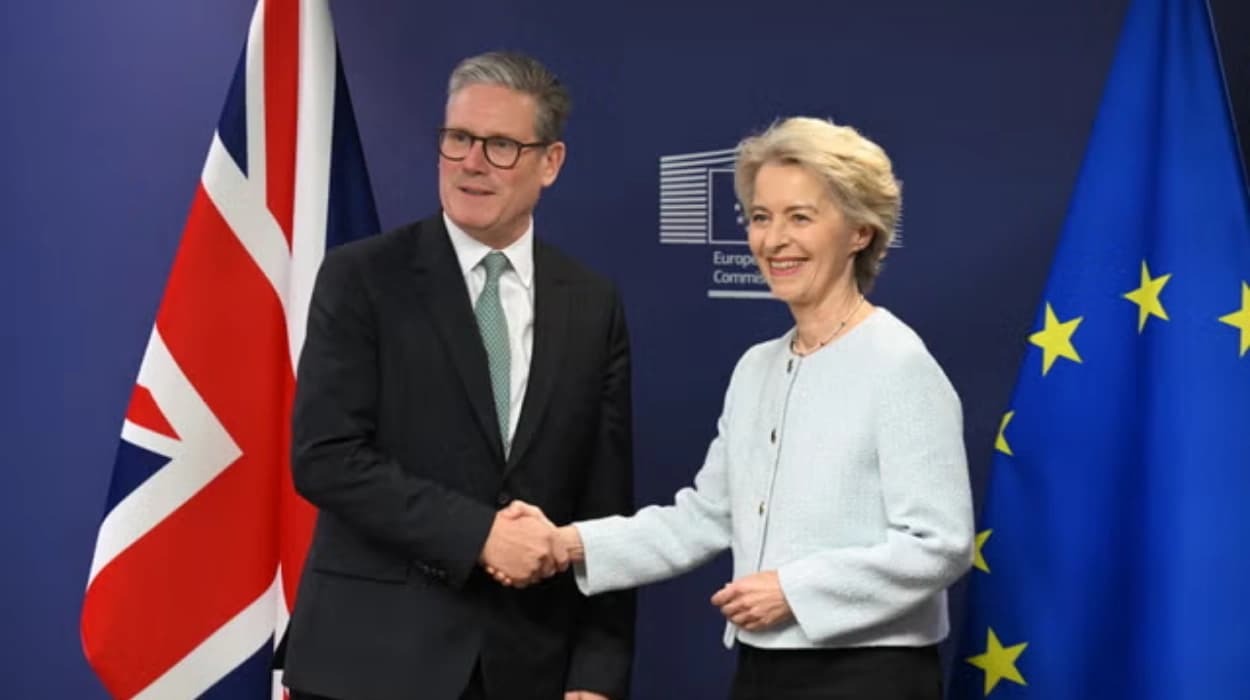
Keir Starmer plans new legislation to ease bureaucracy by allowing selective alignment between UK and EU laws.
The proposal, which will be presented this year as part of the government's Brexit reset, would grant ministers extensive power to "dynamic align" the UK with EU law in a variety of sectors, such as pesticide use, food standards, and animal welfare.
It is agreed that agreements reached with the EU, including those to unify the markets for electricity and carbon or legislation pertaining to plants and animals, may be carried out with the additional authorities.
Ministers argue that dynamic alignment will have little actual impact because UK food companies have already largely complied with EU standards since Brexit, despite the hope that it will save expensive and time-consuming paperwork for providers wishing to sell to the single market.
When the UK was a member of the EU, the government used to vote on new regulations that Brussels passed. However, the UK would now have to accept the regulations without a vote in order to maintain dynamic alignment with the trading bloc.
Both Conservative and Reform UK MPs are expected to oppose the proposals, with the Tories accusing the prime minister of "undoing" Brexit and "surrendering our freedom" in order to appease his Labour backbenchers.
But
"all international agreements involve shared rules,"
a Labour source claims.
The government is being urged to go even farther and negotiate a customs union with the EU by the Liberal Democrats, who claim that the administration is "too timid" in its ambitions for relations with Brussels.
In a Commons vote last month, some 13 Labour MPs supported ideas that would open the way for a customs union, putting pressure on Sir Keir from his own backbenchers to change his mind.
As prime minister, Sir Keir promised to mend Britain's relationship with Brussels and the bloc following years of strife and distrust under the Conservatives.
Furthermore, the prime minister implied over the weekend that the government would be open to further integration with the EU single market if it were in the best interests of the nation.
Sir Keir emphasized that Britain should "go further" in strengthening post-Brexit relations with Brussels following the signing of a trade agreement earlier this year.
In an interview with the BBC's Sunday with Laura Kuenssberg over the weekend, Sir Keir highlighted the actions previously taken to bring agriculture and food closer to the EU, saying,
"That's the sovereign decision that we have taken.
I think we should get closer, and if it’s in our national interest to have even closer alignment with the single market, then we should consider that, we should go that far.”
He added:
“I think it’s in our national interest to go further.
What I would say about the customs union is that I argued for a customs union for many years with the EU, but a lot of water has now gone under the bridge.
I do understand why people are saying, ‘Wouldn’t it be better to go to the customs union?’ I actually think that now we’ve done deals with the US which are in our national interest, now we’ve done deals with India which are in our national interest, we are better looking to the single market rather than the customs union for our further alignment.”
When asked what compromises he was willing to make in exchange, the prime minister stressed that freedom of movement, a fundamental tenet of the EU single market, was off the table.
A Labour source said:
“The bill will give us the powers to share rules with the EU. All international agreements involve shared rules. That’s their very nature.
We’re confident in making the case for specific trade-offs, where it has clear benefits for businesses and consumers.
Kemi has a short memory – it wasn’t long ago she was making similar arguments, when she U-turned on the Brexit bonfire of EU regulation in the name of pragmatism and what works in the real world.
Yet, the Tories and Reform are keen to protect a broken status quo and want to rip up our deal, all in the name of petty ideology.”
How would this bill affect UK sovereignty and parliamentary oversight?
The proposed bill would delegate significant powers to ministers for" dynamic alignment" with EU rules, raising enterprises about eroding UK administrative sovereignty by allowing administrative- led nonsupervisory changes without primary legislation in numerous cases.
Ministers could image unborn EU directives or regulations in targeted areas like agrifood norms and energy requests via secondary legislation( statutory instruments), bypassing full administrative debate and votes; critics argue this makes the UK a partial" rule- taker" from Brussels, as divergence would bear active reversal rather than dereliction independencepost-Brexit.
Labour insists safeguards include administrative scrutiny panels( e.g., via negative or affirmative resolution procedures) and limits to defined policy fields, icing MPs retain ultimate repeal power.