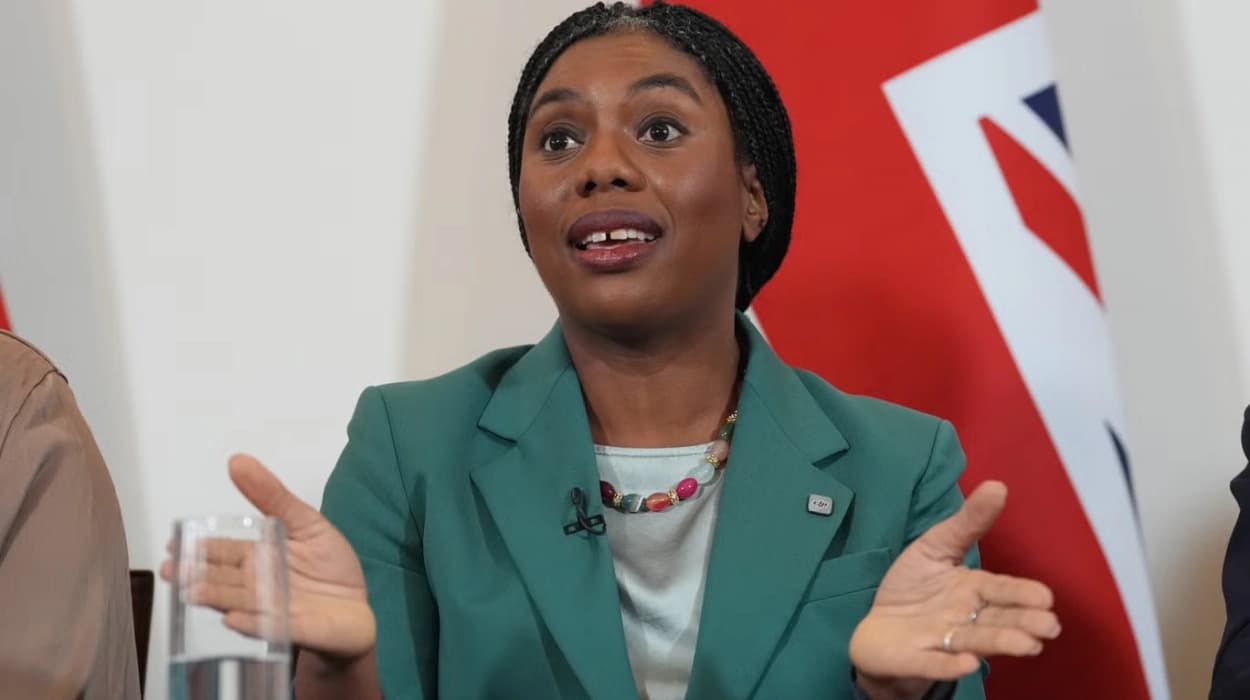
UK Conservative leader Kemi Badenoch faces mounting pressure after it emerged her shadow attorney general represents sanctioned oligarch Roman Abramovich.
His stance has been deemed "indefensible" by the Labour Party, which claims it creates a conflict of interest with his political stance.
In a letter to Ms. Badenoch on Monday, Justice Minister Jake Richards inquired as to whether David Wolfson had recused himself from any party policy pertaining to the assets of the former Chelsea owner.
Additionally, he questioned the Tory leader about if the opposition supported the government's demand that Abramovich send over £2.5 billion to help the Ukrainian people.
In the meantime, Labour Party chair Anna Turley urged Ms. Badenoch to clarify that "nobody representing a man who is currently under British sanctions can serve around her shadow cabinet table" and asked to know if she knew that Lord Wolfson was scheduled to represent Abramovich.
The Russian businessman is embroiled in a legal dispute with the Jersey government after the latter initiated an inquiry into the origin of around £5.3 billion in assets held in Jersey that are associated with him.
The UK government wants to use the money from Abramovich's sale of Chelsea FC to help reconstruct Ukraine after the conflict, but the legal action is allegedly delaying that release.
Ms. Turley called it "a totally irresponsible position for His Majesty's official opposition to be in" and accused Ms. Badenoch of "allowing her top team to moonlight second jobs that are in clear conflict with British and Ukrainian interests."
In his letter to Ms Badenoch, Mr Richards said:
“The cab rank rule [an ethical principle in which a barrister is required to accept any case in their field of expertise, regardless of who their client is] is an important principle which should always be respected, but it cannot remove conflicts of interest, or eliminate the responsibility of politicians to avoid such conflicts.
Lord Wolfson’s ability to advise you in respect of this matter is clearly compromised by the fact that he is being paid to act on behalf of Mr Abramovich.”
A Conservative party spokesperson said:
“Lord Wolfson is instructed in ongoing legal proceedings in Jersey. He is not instructed on the Chelsea FC matter.
Jake Richards’s comments are pure politics, and they show Labour still does not understand how the Bar works. Barristers act for clients, not causes.
And it’s a bit rich from this government. Labour should stop throwing mud. Their own attorney general has acted for Gerry Adams and involved himself in the Shamima Begum case. This is rank hypocrisy.
The Conservative Party led the way on supporting Ukraine and we remain committed to their cause. To suggest anything else is just Labour sinking to new depths.”
Only a few weeks prior, the Russian billionaire was under intense pressure from the authorities to turn up the £2.5 billion he earned from the sale of Chelsea Football Club.
Earlier this month, the prime minister informed MPs that a license had been granted to deliver the funds to the Ukrainian citizens who are being harmed by the Russian aggression.
Since the sale in 2022, when the UK government sanctioned Abramovich following Russia's full-scale invasion of Ukraine because of his strong ties to Vladimir Putin, the multibillion-pound earnings have been frozen in a UK bank account.
What precedent exists for disciplining shadow ministers over external work?
UK party leaders, particularly Conservative ones like Kemi Badenoch, have broad discretion to discipline shadow ministers over external work conflicts, drawing on precedents of sacking or reshuffling for perceived impropriety.
In 2012, Labour leader Ed Miliband dismissed shadow culture clerk Maria Miller( latterly a minister) over charges of dishonors, prioritizing party image amid public counterreaction.
Conservative PM David Cameron in 2012 forced Andrew Mitchell's abdication as principal scourge over" plebgate," extending to shadow- suchlike scrutiny; also, Priti Patel was sacked in 2017 as transnational development clerk for undeclared meetings, a model for opposition places.
Leaders frequently put immediate junking, demand recusal from portfolios, or apply stricter outside interest affirmations; no statutory law binds shadow ministers, so opinions rest on political judgment to avoid electoral damage, as with Boris Johnson's 2020 purge of recusant helpers.