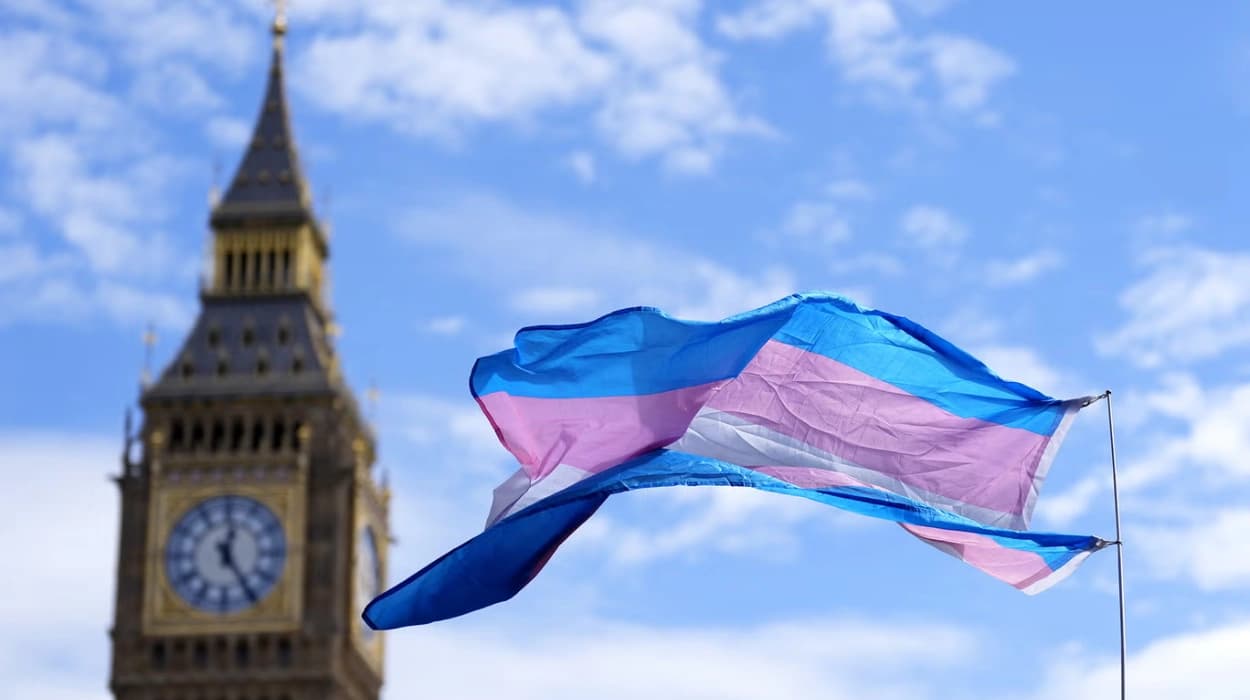
A human rights expert warns the UK government’s treatment of trans people may breach the European Convention on Human Rights amid growing concern.
New guidelines following a Supreme Court decision on transgender persons must not place them in an "intermediate zone … as not quite one gender or the other," according to Michael O'Flaherty, the Council of Europe's commissioner for human rights.
“This has contributed to narratives which build on prejudice against trans people and portray upholding their human rights as a de facto threat to the rights of others,”
he said.
Mr. O'Flaherty said that UK MPs have treated "the human rights of different groups as a zero-sum game" in a letter to David Alton, chair of the joint committee on human rights, and Sarah Owen, chair of parliament's women and equalities committee.
He added that the approach risks “certain inferences being drawn from the UK Supreme Court judgment that could lead to widespread exclusion of trans people from many public spaces”.
“This, in turn, may severely infringe on their ability to participate fully and equally in society,”
he added.
Mr O’Flaherty said trans people may also be forced under new guidance to “habitually ‘out’ themselves publicly” in order to access services, a potential breach of their right to private lives under article eight of the ECHR.
He added:
“Beyond privacy concerns, being forced to disclose sex assigned at birth may also significantly increase people’s vulnerability to harassment, abuse and even violence.”
According to the watchdog, discussions about trans rights shouldn't take precedence over initiatives to promote gender equality and prevent violence against women and girls. However, he claimed that the current discussion is overly preoccupied with limiting transgender people's freedoms and human rights.
Following the Supreme Court's decision earlier this year that trans people are not legally women under the Equality Act (2010), the Equality and Human Rights Commission (EHRC) has created new guidelines for businesses and government agencies to abide by.
A service that is offered "only to women and trans women or only to men and trans men is not a separate-sex or single-sex service under the Equality Act 2010," according to the draft guidance that was put out for consultation over the summer.
It is expected to tell schools, hospitals, leisure centres and cinemas to ban trans women from using single-sex spaces such as lavatories and changing rooms.
Hundreds of organisations have written to the government to warn that the guidance is “unworkable” and will “cause significant economic harm”.
In a recent letter, seen by The Independent, firms including Ben and Jerry’s and Lush said:
“The proposals made in the EHRC’s draft Code of Practice under the Equality Act would have serious and far-reaching consequences for UK businesses, our employees, and our customers.
Any final code similar to this draft would tell organisations that we must adopt practices that are incompatible with modern business values, create unworkable operational challenges, and cause significant economic harm.”
The prime minister’s official spokesman said: “We are clear that there are laws in place to protect trans people from discrimination and harassment.
“We proudly uphold a robust legislative framework. Trans people remain protected on the basis of gender reassignment, protected by reassigned characteristics written into the Equality Act. That was true before the ruling, and the Supreme Court underlined that. We've never supported self ID.
We have a process in place when it comes to someone changing their legal sex on that process.”
Following a trip to the UK, Mr. O'Flaherty also wrote to the home secretary, Shabana Mahmood, to caution that the government's decision to declare Palestine Action a terrorist organization and its impending crackdown on demonstrators wearing facemasks may violate the Convention.
What legal remedies can trans people pursue in the UK?
Transgender people are safeguarded from discrimination, harassment, and victimization in the employment, education, and service provision contexts in relation to gender reassignment, even though UK Supreme Court decisions have recently clarified that a gender recognition certificate (GRC) does not serve to legally change "sex" for the purposes of the Act. Service providers should not treat trans people differently, save for objectively justified and proportionate reasoning to do so.
Transgender individuals may apply for a GRC under the Gender Recognition Act 2004, which may confer legal change of gender.
In order to obtain a GRC, transgender individuals must show that they have received a diagnosis of gender dysphoria, that they live in the acquired gender and meet other requirements. GRCs or the existence of a GRC assigns legal recognition but is otherwise limited in rights regarding single vs mixed-sex.