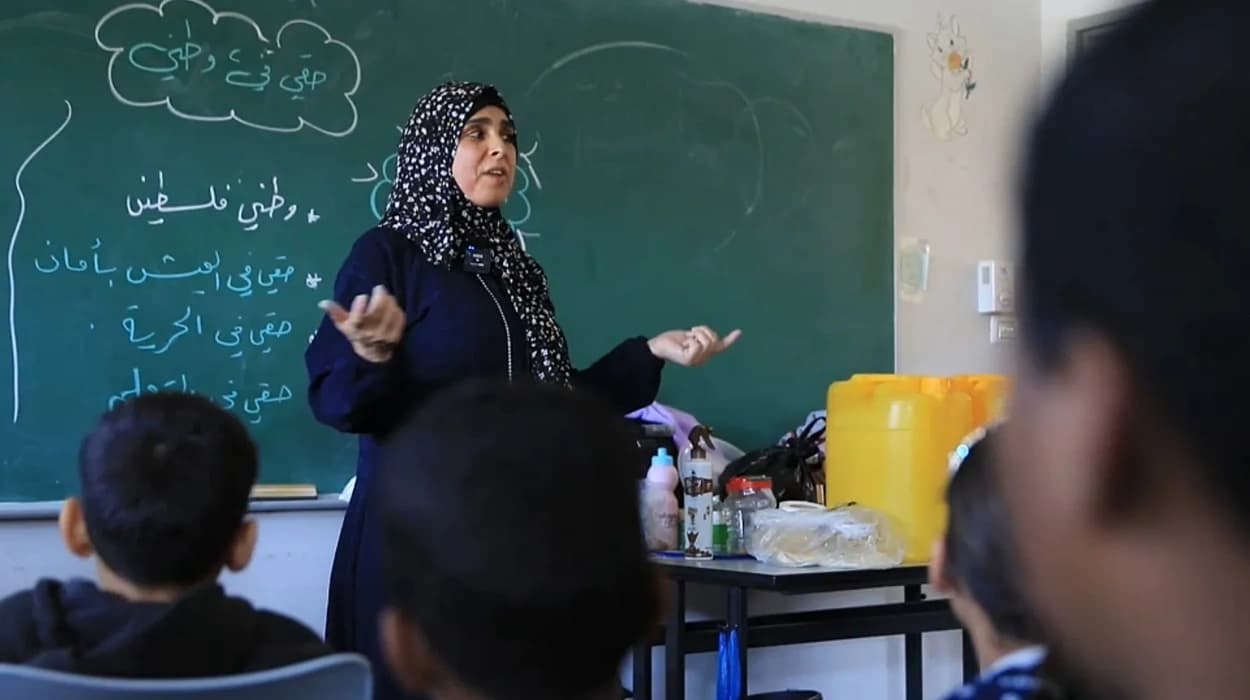
The Palestine education system is a strong and important system which caters to millions of students in the Gaza Strip and the West Bank. It has a high degree of enrollment and literacy rates and the departments are mostly supported by the Palestinian ministry of education and higher education despite the challenges faced. This article presents a sustained, comprehensive overview of the Palestinian education system, showing its forms of organisation, administration, issues that affect it and notable successes.
Overview of the Palestinian Education System
The Palestinian education has a broad range and this range includes pre-primary learning activities up to the higher education level vocational and technical training. The system is directed centrally by the Ministry of Education and Higher Education in Gaza and the West Bank and is tasked with the management of public schools, as well as the privately run schools and those subject to UNRWA refugee school administration.
Key Features and Literacy
Among the noteworthy peculiarities of the Palestinian education system, one can find its excellence in terms of literacy in Palestine, as the youth literacy ratio (15-24) is one of the highest in the Middle East, being over 98%. This literacy success reflects the community's priority on education despite the complexities imposed by geopolitical realities.
Structure of Education in Palestine
Pre-primary Education
In Palestine pre-primary schooling normally starts at the age of 4-6. Most of it is offered by the means of being a part of a privately located kindergarten, and the Ministry controls the curricula as well as the training and licensing of teachers in order to guarantee competence in terms of quality. GD ratios in pre-primary are still relatively moderate but on the rise.
Basic and Secondary Education
Every child has a mandate to receive basic education which is divided into two broad groups:
- Preparatory Stage (Grades 1-4): The emphasis on formative assessments rather than exams to strengthen learning at foundational level.
- Empowerment Stage (Grades 5-10): A preparatory stage to secondary education by having formal examinations including an examination to finally graduate in Grade 9.
The second level of education is secondary education which consists of grades 11 and 12 that provide an academic and career stream. Though the dominant form of educational path is academic education, specialized vocational training is still evolving to satisfy the demand of the labor market.
Schools in Gaza and West Bank
There are boys' schools, girls' schools, and co-educational institutions. The West Bank has more mixed schools whereas Gaza is characterized by fewer mixed schools. Also, Gaza schools have special difficulties that are occasioned by restrictions but they still provide quality education managed by the ministry.
Higher Education and Universities
In Palestine, the university level degrees are considered part of higher education; typically it takes four years to earn a bachelor degree and more years in the case of master level studies.
Palestinian Universities
There are a number of universities with prominent ones like the Birzeit University and Islamic University of Gaza found in the region. These universities are attempting to get higher education quality, and relevance even with monetary limits and physical restraint. There is a high demand for higher education since about 45 percent of Palestinians pursue a course in higher education.
International Collaboration and Challenges
In order to rid themselves of isolation issues, Palestinian Universities have forged collaboration programs with the universities of Europe and world in order to spur academic exchange and research development. Nevertheless, there are still political and logistical obstacles which affect faculty residence and mobility of the students.
Management and Curriculum
In Gaza and the West Bank, the Ministry of Education and Higher Education is at the center of a regulatory and management of the whole education sector. These are designing curriculum, recruiting and training teachers and upholding standards in education.
National Curriculum
Palestine took over a standard national curriculum in 2000, and rolled out a common gradual curriculum to develop cohesive identity and quality across education.
Vocational and Technical Education
Vocational and technical education in Palestine focuses on training people with practical skills in Formal programs offered after basic education. It encompasses industrial, agriculture, commerce and hotel management streams. Despite the moderate enrolment rate, sometimes vocational education encounters certain problems with the preferring social choice to study any kind of specialist and with the lack of financial resources.
Funding and Support
The Palestinian government budget contributes mostly to education funding. Nevertheless, there is a great contribution of donors and international organizations, which contribute to some of the infrastructure needs and shortage of resources. Due to the economic situation, the spending on education is focused as it takes up close to 18 percent of the government expenditure in the previous years.
Impact and Outlook
Palestine has education as a pillar of society and development. The implementation of such programs as those run by the recipients of awards like Hanan Al Hroub are the indicators of investment in creation of resilient and creative learners. Although many issues are still a challenge e.g. movement restrictions, lack of funding, need of infrastructure, among others, the Palestinian education system remains in the quest of achieving inclusivity and quality.
There is a sense of investment in the future through education embodied in the Palestinian education system. It has the following merits:
- Lots of school enrollments and literacy.
- Group management provides a unified curriculum.
- Expanding higher education establishments to work on the international scale.
- Constant endeavor to prepare vocational training.
Although there are political, social, and economic challenges, palestinian education is seen as a sterling light to the world and to Palestine in particular as it has been able to produce generations that serve not only their communities but also, the world at large.