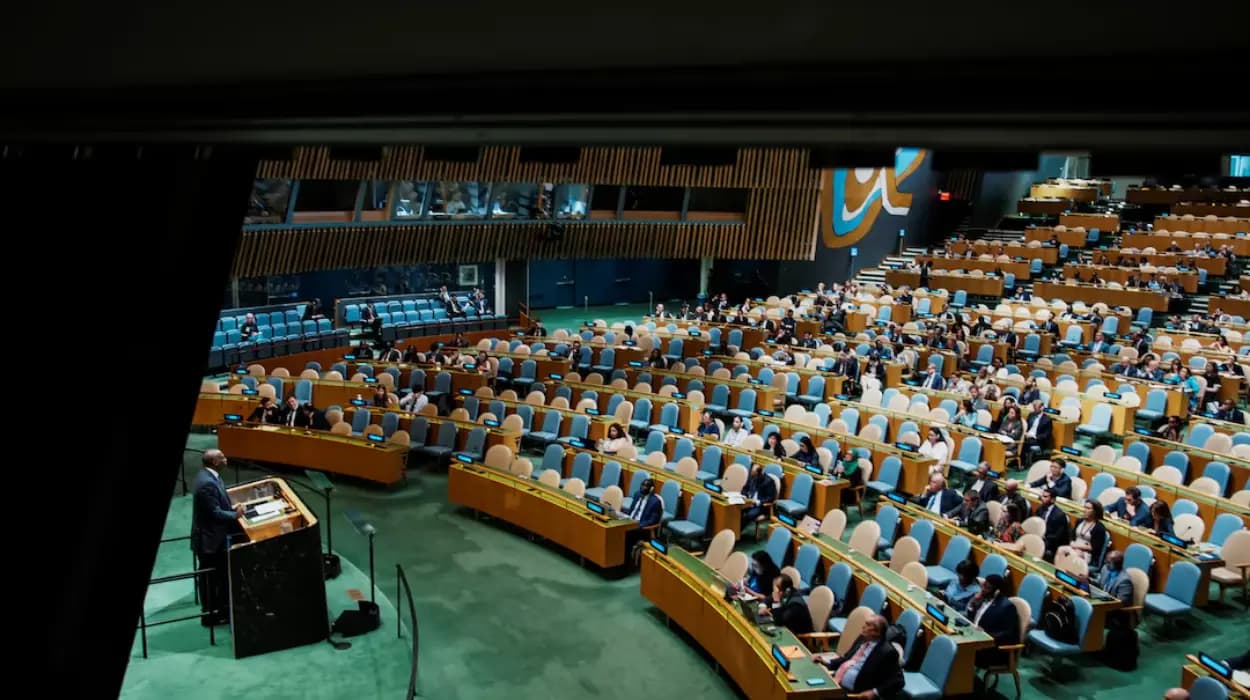
The United Nations (UN) has been very active in the Israeli- Palestinian conflict since its onset with the aim of mediating the peace and also facilitating humanitarian aid and supporting international law. However, the UN system has not acted fast enough to resolve the conflict and to address the humanitarian disaster caused by Palestinians due to the internal structure (political polarizations), geopolitical power play, and politics involved.
In history, the UN and the Israeli-Palestine partition plan have a past.
In the late 1940s, the involvement of the UN in the Israel-Palestine conflict took a formal form in the form of the UN Partition Plan of 1947. The proposal suggested that the British Mandate of Palestine should be divided into two, one where Jews will belong and another where Arabs will dominate with Jerusalem as international line.The Jewish leadership accepted the plan and the Arab States as well as Palestinian Arabs did not accept it, resulting in the 1948 Arab-Israeli war.
The outcomes of the war were the outbreak of the Palestinian refugee crisis when hundreds of thousands of people fled or were expelled. This was a humanitarian catastrophe which eventually became the trademark of the UN in the process of which it has created the United Nations Relief and Works Agency against Palestine Refugees in the Near East (UNRWA) in the year 1949.UNRWA was charged with provision of education, health, social and emergency relief to displaced Palestine refugees who remain registered.
The Partition Plan is another dividing text, which forms the basis of a core issue of the international community to the conflict.
Why Is Vatican City and Palestine Not Part of the UN?
In spite of decades of UN work, Palestine remains the non-full member state of the United Nations. Palestine was admitted by the UN General Assembly as a non-member state observer in 2012 which assigns it certain rights in UN activities without the full voting rights.
This is one of the reasons why the Palestinians have a partial status with regard to statehood. Important members of the UN Security Council, especially the United States, have criticized full Palestinian membership since negotiations are being undertaken and Israel has security issues.
The Vatican City is an observer member of the UN, the fact that reveals its religious peculiarity and of the state but not of the traditional representative of the nation-state. The Vatican is fundamentally different to Palestine in the context of its status in that it is spiritually rather than politically defined with regard to its connection to the conflict in Palestine, although it informs about its peaceful resolution and rights based on humanitarian considerations.
Humanitarian Role His Mandate: UN Relief and Works Agency for Palestine refugees (UNRWA)
The existence of UNRWA in itself is a landmark position when it comes to the daily well-being of more than 5 million registered Palestine refugees in Jordan, Lebanon, Syria, the West bank, and Gaza.
- Educates more than half a million children at the primary and secondary school communal levels,
- Healthcare services,
- Social safety nets,
- Emergency humanitarian aid,
Some researchers suggest that the rate of increase is highest especially at times when the conflict is intensified.
The mandate of UNRWA has been criticized severally under political and financial pressure with some states withdrawing their contributions under political interference allegations. Nevertheless, the agency cannot be ignored in ensuring that the living conditions of the Palestine refugees do not further erode.
UN Reports on Israel and Palestine: Documenting Violations and Crisis
The OCHA and the UN Human Rights Council are just a few UN entities that give regular reports regarding the humanitarian situation and violations in the occupied Palestinian territories.
As another example, the period between October 2023 and January 2024 presents the most dramatic manifestations of the harmful effects of Israeli military campaigns on Gaza, with more than 24,000 Palestinian people killed and millions displaced, under blockades that block the distribution of foods, water, fuel, and medical supplies.
Such reports point out that it is nearly impossible to please every single viewer, or complete everyone.
- civilian losses including women and children
- The demolition of civic facilities including schools and hospitals,
- Accessibility to humanitarian aid challenges,
- Abuse of international humanitarian law on the part of all armed groups.
The documentation at the UN is vital in building awareness at the international level and advocacy but has been subject to political opposition within the UN.
Structural Failures of the UN System in Addressing the Conflict
It is mainly structural imbalance that stands in the way of the UN to act decisively on the Israeli-Palestinian conflict:
- The UNSC permanent members are given veto powers and it allows a single country to reject resolutions. The close ally of Israel, the United States, has used this veto to block action that is deemed not to be pleasing to Israel several times.
- The consequence of this has been a pattern of failed efforts to authorize effective peacekeeping operations, ceasefire enforcement or robust sanctions based on breaches.
- In the General Assembly, where states are given equal voting rights, resolutions against violence and ceasefires are also usually passed but these are not binding and they are not enforced.
All of these structural obstacles leave the UN defenseless against preventing or halting current acts of war crimes and human rights abuses.
International Law and Accountability
The UN system offers legal frameworks which can be used to prevent mass punishment, civilian attacks, forced evictions and such like the Geneva Conventions and the Genocide Convention.
Although the international law is applicable to everybody in the same manner, political will determines the enforcement measures. There is also the issue of referral of cases to international bodies like the International Criminal Court (ICC) which due to political reasons and the fact that Israel is not a member proves difficult due to the inability of the UN to refer cases.
More recently, states have successfully moved cases before the International Court of Justice (ICJ) seeking provisional measures against apparent genocidal acts, seeking an alternative way forward by individual states and civil society in the face of UN inaction.
The Role of Civil Society and Member States
With the UN system in check, individual states, regional institutions and civil society organization are the key actors in:
- Providing snapshots of urgent humanitarian issues.
- Supporting nonviolence and human rights,
- Comprometting state to be held legally accountable via international means.
Such a multi-actor model is required to handle the current crisis and to bring to justice those who perpetrated it in the situations where the effort of the UN cannot be decisive.
The interaction between the UN and Palestine has been characterized by a complicated mix of history, politics and humanitarian activities. The UN has played an important role in providing fundamental platforms through the Partition Plan, as well as creating the fundamental agencies, namely UNRWA, in easing the conflict. Nonetheless, the political and structural shortcomings have constrained the UN in dealing with the conflict, and in safeguarding the Palestinian civilians.