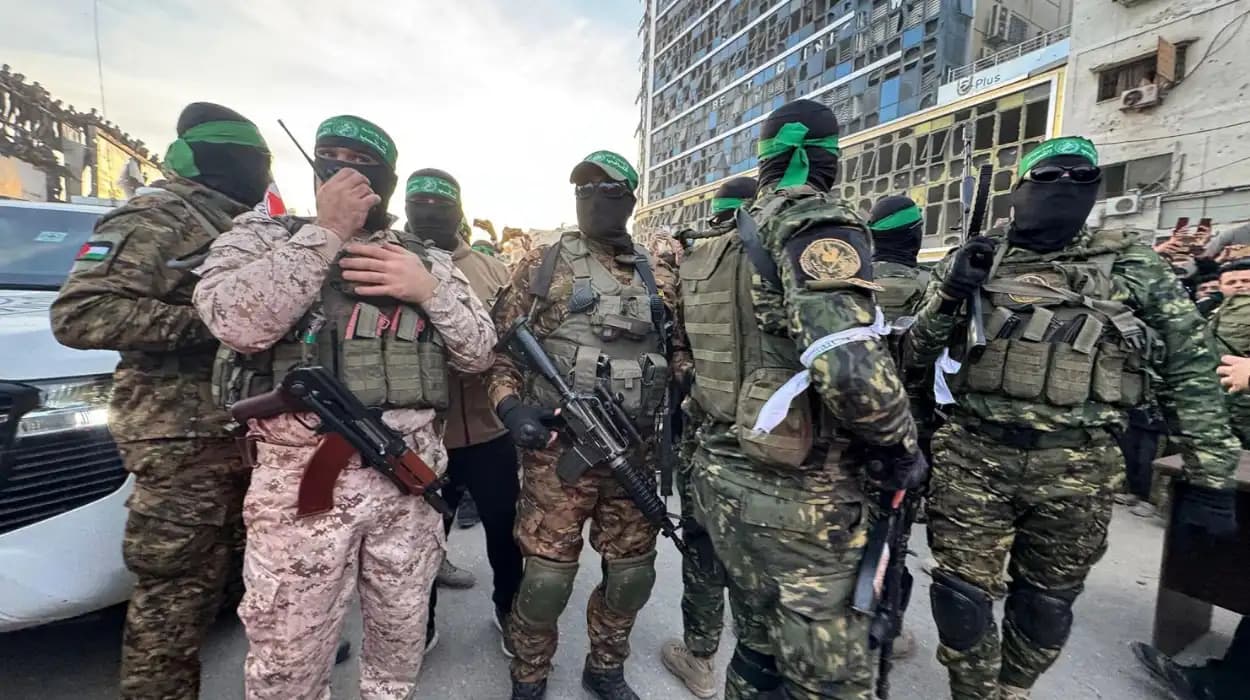
When people hear the phrase “Palestine’s army,” they often imagine conventional military soldiers defending borders, tanks on standby, and a chain of command like any sovereign nation.
The truth is far more complex. Palestine does not have an official army at all. Instead, its security landscape is shaped by political agreements, regional tensions, and internal divisions that have existed for decades.
The root of this reality lies in the Oslo Accords of the 1990s, which explicitly barred the Palestinian Authority (PA) from creating a formal military. In place of an army, the PA was authorized to form security forces tasked with maintaining internal order, combating terrorism, and safeguarding officials within the West Bank.
These forces, numbering tens of thousands, carry weapons and operate in tactical units, yet they lack the power to wage war or defend borders in the traditional sense.
Their mission is complicated further by coordination with Israel, deep mistrust from segments of the Palestinian population, and rivalry with militant groups like Hamas.
1. Why Palestine Has No Army
The absence of a formal Palestinian army is not an oversight. It’s a direct consequence of political agreements made decades ago.
Under the Oslo Accords, signed in the 1990s between Israel and the Palestine Liberation Organization (PLO), the Palestinian Authority (PA) was explicitly prohibited from creating a conventional military force.
The accords were designed to reduce tensions and maintain a fragile security balance during the peace process.
Instead of an army, the PA was permitted to establish security forces that resemble a blend of police and internal security units. These bodies are tasked with law enforcement, protecting key officials, maintaining public order, and conducting counterterrorism operations within the areas they control in the West Bank.
While these forces may carry automatic weapons and operate armored vehicles, their role and authority are a far cry from that of a sovereign state’s military. They cannot wage conventional warfare, defend borders in the traditional sense, or
independently conduct large-scale military campaigns.
This arrangement has led to an unusual security reality: the PA’s forces often work in close coordination with the Israeli Occupation Forces (IOF) to prevent attacks by militant groups, even when such cooperation is unpopular among segments of the Palestinian population.
In effect, the PA’s “security apparatus” is a hybrid model: part civilian police, part paramilitary, but never a full army.
2. Size and Structure of the PA Security Forces
While the Palestinian Authority lacks a formal army, it operates one of the most complex and sizable security networks in the region. This apparatus is not a single unified force but rather a collection of specialized branches, each with distinct responsibilities and chains of command.
The Palestinian National Security Forces (NSF) form the largest component, functioning as a paramilitary body tasked with border security within PA-controlled areas and supporting police operations during major incidents.
The General Intelligence Service focuses on gathering and analyzing information to detect threats before they materialize, playing a critical role in counterterrorism. The Preventive Security branch deals primarily with internal political threats, working to disrupt militant activity and organized crime.
The Presidential Guard, often considered the elite unit, is entrusted with protecting the Palestinian president, senior officials, and visiting dignitaries. Meanwhile, the Civil Police handle everyday law enforcement, traffic regulation, and public safety.
According to the Konrad Adenauer Foundation, the PA employs around 66,000 personnel, about 32,000 in the West Bank and 34,000 nominally in Gaza, though the latter are inactive since Hamas took control in 2007.
Other analyses place the combined total at over 83,000. This large force highlights how much the PA relies on security infrastructure, not for conventional warfare, but to maintain political control, manage civil unrest, and address the constant threat of militant violence.
3. Branch Breakdown and Roles
National Security Forces (NSF)
The National Security Forces (NSF) serve as the PA’s paramilitary backbone. Their duties range from manning checkpoints and patrolling sensitive areas to responding to internal disturbances.
While not an army in the conventional sense, their training and organization give them a military-like posture, especially in high-tension zones along the separation barrier or flashpoint cities.
General Intelligence Service, Preventive Security, Presidential Guard
The General Intelligence Service, Preventive Security, and Presidential Guard form the PA’s intelligence and elite protection core. These branches operate in the shadows, conducting intelligence gathering, counter-espionage, and pre-emptive threat disruption.
The Presidential Guard, with approximately 3,000 handpicked members, answers directly to President Mahmoud Abbas. Trained to the highest standards, they handle not only the president’s safety but also the protection of visiting foreign dignitaries.
Civil Police
The Civil Police are the public face of the PA’s law enforcement, with over 9200 sworn officers primarily stationed in the West Bank. Their responsibilities span from routine policing and traffic control to managing public demonstrations and ensuring day-to-day order.
Historically, in the mid-1990s, around 30,000 security staff were reported. By 2003, that number rose to over 50,000–53,000.
In 2013, up to 41% of PA civil servants were listed as defense or security personnel, highlighting the scale of this ministry.
4. Coordination with Israel & Tensions with Militants
Though not officially destructive to Israel, the PA’s security forces cooperate with Israel to crack down on militant groups like Hamas and Islamic Jihad.
This cooperation creates friction among Palestinians, with critics accusing the PA of enforcing Israeli policies in the occupied territories.
One of the largest internal confrontations came with “Operation Protect the Homeland” in late 2024. This campaign, primarily in the Jenin refugee camp, was directed at the Jenin Brigades, an alliance of militant factions.
The operation involved around 300 PA security officers facing about 200 militants, resulting in casualties on both sides and several civilian deaths. Israeli leadership both endorsed the PA stance and later initiated independent raids in the same area.
This operation underscored deep divisions. Many Palestinians saw it as betrayal, PA vs. militant resistance, rather than unity.
5. Other Recent Security Operations
Other notable operations include:
- Operation in Tubas (Oct–Nov 2024): A crackdown that resulted in the arrest of 80 militants, tightening PA control in the north.
- Coordinated Israeli campaign (Operation Summer Camps): A large-scale Israeli operation in August 2024 targeting West Bank militants. Its timing coincided with, and complicated, the PA’s own operations.
- Ongoing Israeli raids and PA collaboration: In early 2025, Israeli forces applied operational tactics refined during the Gaza conflict to conduct joint raids near Jenin, prompting displacement and further tension.
6. Challenges and Controversies
The PA's security model faces major scrutiny:
- Legitimacy
Erosion: Cooperation with Israeli authorities has led many
Palestinians to question the security forces’ loyalty.
- Human Rights Concerns: Reports highlight arrests of dissidents, protests, and journalists.
- Fragmented Governance: Since the 2007 Hamas takeover of Gaza, PA security operations are limited to the West Bank; in Gaza, Hamas maintains its own military wing independent of the PA.
While often labeled the "Palestine Army," the PA’s security forces are far more akin to heavily armed police or paramilitary units than a national military. They play a vital role in governance but are constrained by international agreements, internal division, and limited public trust.
Recent confrontations, particularly in Jenin, show how the PA continues to assert control in volatile areas. Yet its ability to act as a protector of Palestinian interests remains contentious.