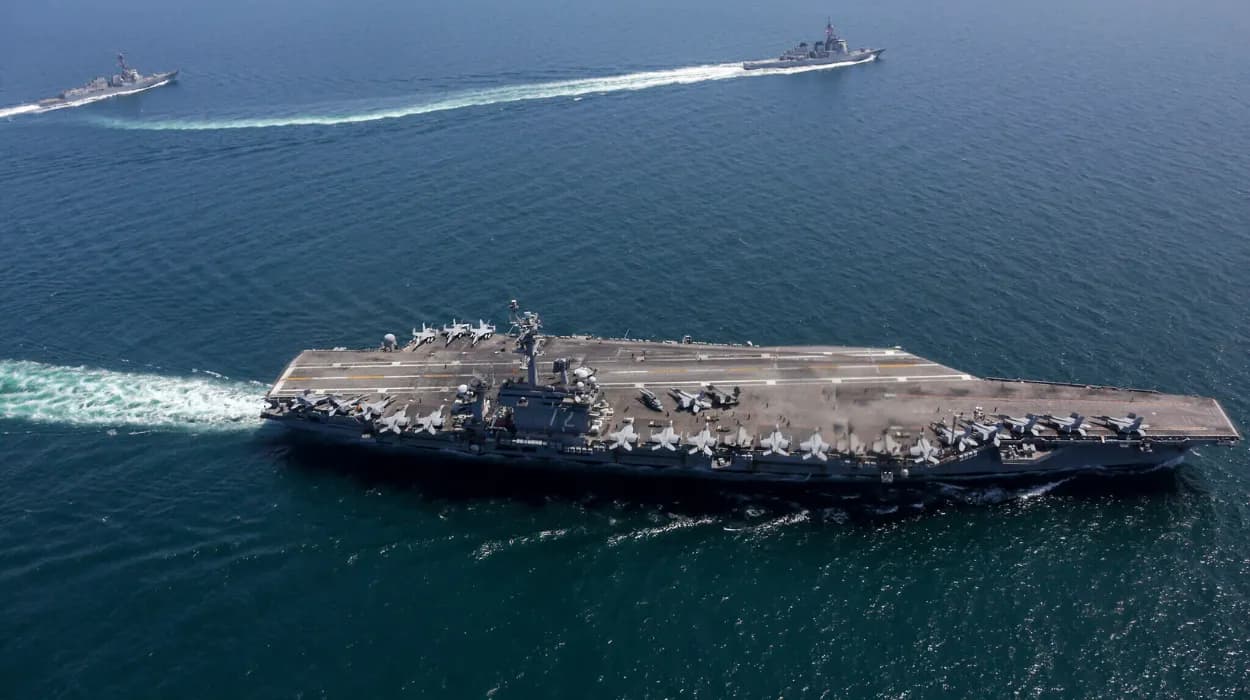
Tehran (The Palestine Telegraph Newspaper) February 04, 2026 – US military officials reported heightened alerts across the Middle East amid intelligence indicating Iran may launch a large-scale drone attack on the USS Abraham Lincoln carrier strike group. The task force, positioned in the Arabian Sea, maintains a defensive posture with bolstered air defences following recent Houthi drone interceptions. Pentagon spokespersons confirmed continuous monitoring while diplomatic channels remain open with Tehran.
The carrier strike group, comprising the USS Abraham Lincoln, nine warships, and 75 aircraft, entered the region on January 28, 2026, replacing the USS Harry S. Truman. US Central Command (CENTCOM) detected Iranian Shahed-136 drones conducting surveillance flights 200 nautical miles from the formation on February 2. Navy commanders activated Aegis missile systems and F/A-18 Super Hornets on combat air patrols.
US Task Force Composition and Defensive Measures
The USS Abraham Lincoln strike group includes destroyers USS Jack H. Lucas, USS Michael Murphy, USS O’Kane, and cruisers USS Mobile Bay and USS Princeton. Submarine USS Georgia provides underwater support with 154 Tomahawk missiles. Carrier Air Wing 9 operates F-35C stealth fighters alongside EA-18G Growlers for electronic warfare.
CENTCOM reported intercepting three Iranian drones on February 1 using SM-6 missiles from USS Jack H. Lucas. Vice Admiral George Wikoff, task force commander, ordered 24-hour radar sweeps covering 300-mile radius. Destroyers maintain 50-nautical-mile separation to optimise overlapping SM-2 and SM-3 coverage.
E-2D Hawkeye aircraft logged 120 sorties since deployment, detecting 17 Iranian UAVs. USS Princeton’s Phalanx CIWS systems test-fired February 3, confirming 4,500 rounds per minute capability against low-flying threats.
Iranian Military Statements and Drone Capabilities
Iranian Revolutionary Guard Corps (IRGC) Aerospace Force commander Brigadier General Amir Ali Hajizadeh stated on February 2 that Tehran possesses "adequate response options" to US naval presence. State broadcaster IRIB aired footage of Shahed-149 drones conducting night exercises at Bandar Abbas, 400 miles from the task force.

Shahed-136 drones carry 50kg warheads with 2,500km range, flying at 185kph below radar detection thresholds. Iran produced 3,200 units since 2022, per IISS Military Balance 2026. Recent Houthi attacks on Red Sea shipping employed GPS-guided Shahed variants supplied via smuggling routes.
Tehran Times quoted Foreign Ministry spokesman Nasser Kanaani denying attack preparations while affirming "defensive deterrence patrols." IRGC Navy deployed Kaman-class fast attack craft 150 miles from US ships on February 3, monitored by P-8A Poseidon patrols.
Regional Tensions and Recent Incidents
Houthi forces launched 12 drones at the task force on January 30, all downed by F/A-18s from USS Abraham Lincoln. Yemen-based Ansar Allah claimed the strikes targeted "American aggression enablers." CENTCOM confirmed no damage or casualties.
US State Department imposed sanctions on three IRGC drone factories January 25, freezing $800 million in assets. UN experts documented 450 Iranian drones transferred to Russia since 2024, validating Western intelligence on production capacity.
Israeli outlet Haaretz reported Mossad warnings of coordinated Iran-Houthi action passed to Pentagon January 31. UK Maritime Trade Operations (UKMTO) advised 15 merchant vessels to reroute from Strait of Hormuz February 3.
Pentagon and White House Response Protocols
Pentagon press secretary Major General Pat Ryder confirmed February 3 briefing to President Trump outlined "multiple defensive layers." National Security Council directed USS Georgia to shadowed position 100 miles northeast of Iranian waters.
Destroyer captains received updated rules of engagement authorising preemptive engagement of inbound drones at 50 miles. E-3 Sentry AWACS aircraft relayed real-time tracks to Bahrain headquarters, processing 2,400 radar contacts daily.
Secretary of Defense Pete Hegseth visited CENTCOM January 29, approving $450 million in additional Patriot missile interceptors for regional bases. US Embassy Baghdad ordered non-essential staff evacuation February 2 amid parallel militia threats.
Historical Precedent of Iran-US Naval Confrontations
Iran conducted 17 drone swarms against US Navy in 2019-2023 Gulf incidents, per CRS report January 2026. 2020 swarm targeted USS Paul Hamilton, intercepted at 12 miles by RAM missiles. 2022 incident saw 14 drones downed by USS McFaul.

Joint US-UK-French Operation Prosperity Guardian downed 1,200 Houthi drones since December 2023. Iranian Quds Force claimed credit for 80% strikes via Press TV interviews.
Strait of Hormuz transited 21 million barrels daily in January 2026, 20% global supply. US Fifth Fleet logged 5,800 ship transits since October 2023 without loss.
Allied Naval Contributions and Coordination
HMS Diamond (UK) and FS Alsace (France) joined task force patrols January 30 under Combined Maritime Forces. Italian destroyer Caio Duilio contributes SM-2 missiles to layered defence.
Australian P-8A detachment at Al Udeid Air Base provides anti-submarine surveillance. Bahrain hosts 7,000 US sailors coordinating via SHAREM exercises.
NATO deploys SNMG2 squadron including Turkish frigate TCG Yavuz 200 miles south. Coalition recorded 98 intercepts since Red Sea crisis began.
Intelligence Assessments and Threat Indicators
National Geospatial-Intelligence Agency detected 45 drone launches from Iranian coast since January 28. Signals intelligence intercepted IRGC communications referencing "Great Prophet 19" exercise simulating carrier strikes.
Satellite imagery showed 120 mobile launchers repositioned near Bushehr February 1. DIA assessment rated probability of attack at 65% within 72 hours as of February 3.
Houthi drone mother ships SS Captain Thadi and SS Siam sighted 300 miles off Djibouti, carrying 40 UAVs each. US Cyber Command reported malware targeting task force networks traced to Tehran servers.
Diplomatic Efforts and UN Security Council Activity
US Ambassador to UN Dorothy Shea requested emergency session February 4 citing Article 51 self-defence rights. Iran’s UN mission condemned "provocative US deployments" without denying drone activity.
Qatari mediation relayed Tehran messages via backchannels, per Wall Street Journal sources. Oman Foreign Minister Badr Albusaidi hosted Iranian FM Abbas Araghchi February 2 discussing de-escalation.

EU High Representative Kaja Kallas urged 27-member restraint statement. China abstained from UNSC draft condemning Houthi attacks.
Economic Impact and Global Shipping Disruptions
Brent crude rose $3.42 to $84.17 per barrel February 3 on threat premium. Lloyd’s of London added 0.5% war risk premium to Gulf transits.
Maersk cancelled 14 sailings, rerouting via Cape of Good Hope adding 14 days. 23% global container capacity idled since January 2025 Houthi escalation.
Baltic Dry Index fell 18 points to 1,892. Shanghai Containerized Freight Index reported +12% rates on Asia-Europe lane.
Congressional and Media Oversight Developments
House Armed Services Committee scheduled Hegseth testimony February 5. Senate Foreign Relations Committee released Iran drone proliferation report documenting 2,100 transfers to proxies.
Fox News aired leaked drone track footage February 2, viewed 8.2 million times. CNN Pentagon correspondent reported 300% increase in IRGC drone sorties since Truman departure.
New York Times detailed Aegis upgrade program countering Shahed swarms, citing $2.1 billion congressional appropriation.