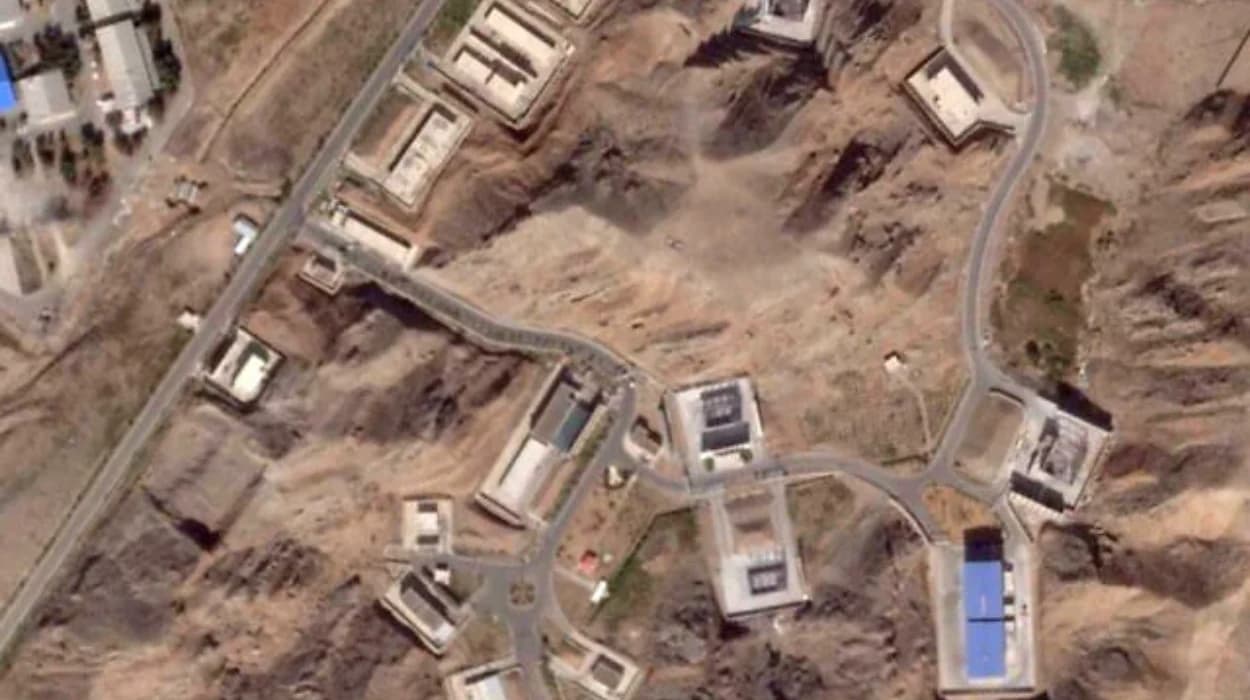
Tehran (The Palestine Telegraph Newspaper) February 06, 2026 - Satellite imagery has revealed that Iran has repaired ballistic missile sites damaged during a recent 12-day war. The facilities, which pose threats to Israel and U.S. bases and allies in the region, have been restored swiftly. This development underscores one of Iran's limited options to deter potential repeat strikes on its nuclear facilities.
Iran has completed repairs on key ballistic missile sites struck during the 12-day war that concluded last month. Commercial satellite images, analysed by defence monitoring groups, show construction activity and restored infrastructure at multiple locations across central and western Iran. The sites are known to house launchers capable of targeting regional adversaries, including Israel and U.S. military installations in the Gulf.
Imagery Confirms Rapid Reconstruction Efforts
High-resolution satellite photographs captured between late January and early February 2026 document the extent of the repairs. Craters from precision strikes have been filled, launch pads rebuilt, and support buildings reconstructed at facilities near Natanz and Isfahan. Analysts from the International Institute for Strategic Studies noted that heavy machinery and concrete pouring were visible in images dated February 2.
The repairs follow airstrikes reported by U.S. Central Command, which targeted Iran's missile infrastructure in response to launches during the conflict. Iranian state media, including Press TV, confirmed damage to "defensive installations" but claimed minimal impact on operational readiness. Restoration work began immediately after the ceasefire, with satellite data showing non-stop activity around the clock.
Strategic Sites Pose Regional Threats
The restored sites include underground silos and mobile launcher depots designed for medium-range ballistic missiles such as the Fateh-110 and Zolfaghar variants. These weapons have ranges of up to 700 kilometres, placing Israeli cities and U.S. bases in Bahrain, Qatar, and the UAE within striking distance. Imagery from Planet Labs indicates that at least five major complexes are fully operational again.
U.S. officials, speaking to Reuters on condition of anonymity, stated that the repairs demonstrate Iran's prioritisation of missile capabilities over other military needs. The facilities were part of a network used to launch over 300 projectiles during the 12-day war, according to Pentagon assessments released January 25. No new missile tests have been reported since the truce.
Conflict Background and Ceasefire Terms

The 12-day war erupted on January 15, 2026, when Iran-backed militias in Iraq and Syria fired rockets at U.S. positions, prompting retaliatory strikes. Israel joined the campaign on day three, hitting missile sites in response to drone incursions over the Golan Heights. The conflict ended with a U.S.-brokered ceasefire on January 27, mediated through Qatari channels.
Casualties included 28 Iranian Revolutionary Guard Corps members, per Tehran’s reports, alongside 12 Israeli soldiers and five U.S. personnel. Damage assessments from Jane's Defence Weekly highlighted 15 missile sites as primary targets, with 80 percent suffering moderate to severe hits. Iran's foreign ministry described the repairs as "sovereign restoration of defensive assets."
International Monitoring and Responses
The United Nations Security Council held an emergency session on February 3, where satellite evidence was presented by the U.S. delegate. Russia and China called for restraint, while France and the UK urged Iran to cap its missile programme under JCPOA revival talks. IAEA inspectors noted no disruption to nuclear site repairs nearby, though access remains restricted.
U.S. President Donald Trump, in a statement from the White House on February 4, affirmed that American intelligence tracks the sites continuously. "Iran's missile threats will be met decisively," he said, echoing warnings from his January 28 ceasefire announcement. Israeli Prime Minister Benjamin Netanyahu convened the security cabinet on February 5 to review the imagery.
Technical Details of Repairs Observed
Planet Labs and Maxar Technologies images, dated January 30 to February 4, reveal specific changes. At the Imam Ali base near Khorramabad, a collapsed bunker entrance has been resealed, with fresh earthmoving visible. Thermal imaging from commercial providers shows power restoration to command centres. Repair timelines averaged 10-14 days, faster than post-2019 strike reconstructions.
Iranian officials, quoted by Fars News Agency, attributed the speed to pre-staged materials and engineering brigades. The sites feature hardened shelters resistant to 2,000-pound bombs, explaining partial survival. U.S. Air Force B-52s and F-35s delivered the strikes, per Aviation Week reports.
Regional Allies on Heightened Alert

U.S. Central Command elevated readiness at Al Udeid Air Base in Qatar following the imagery release. Saudi Arabia scrambled F-15 jets on February 5, citing Iranian rhetoric. The U.S. Fifth Fleet in Bahrain conducted live-fire drills, with Rear Admiral Brad Cooper stating preparedness for "any contingency."
Israel's Iron Dome and Arrow systems underwent upgrades, as announced by the Defence Ministry. Gulf Cooperation Council nations requested additional Patriot batteries from the U.S., approved on February 4. No immediate threats have materialised, but patrols in the Strait of Hormuz doubled.
Diplomatic Channels Reactivate
Backchannel talks resumed in Muscat on February 5, involving U.S., Iranian, and Omani diplomats. Topics included missile range limits and nuclear compliance. EU foreign policy chief Josep Borrell scheduled a Tehran visit for February 10. Britain's Foreign Secretary David Lammy called the repairs "concerning but not surprising" in a Sky News interview.
The State Department issued a travel advisory for the region, citing missile risks. NATO allies discussed support for Israel at a Brussels meeting on February 4.
Historical Context of Missile Programme
Iran's ballistic missile arsenal numbers over 3,000 warheads, per 2025 U.S. estimates. Development accelerated post-2018 JCPOA withdrawal. Previous repairs after 2020 Soleimani strikes took months; recent efficiency reflects lessons learned. UN Resolution 2231 calls for curbs, routinely ignored by Tehran.