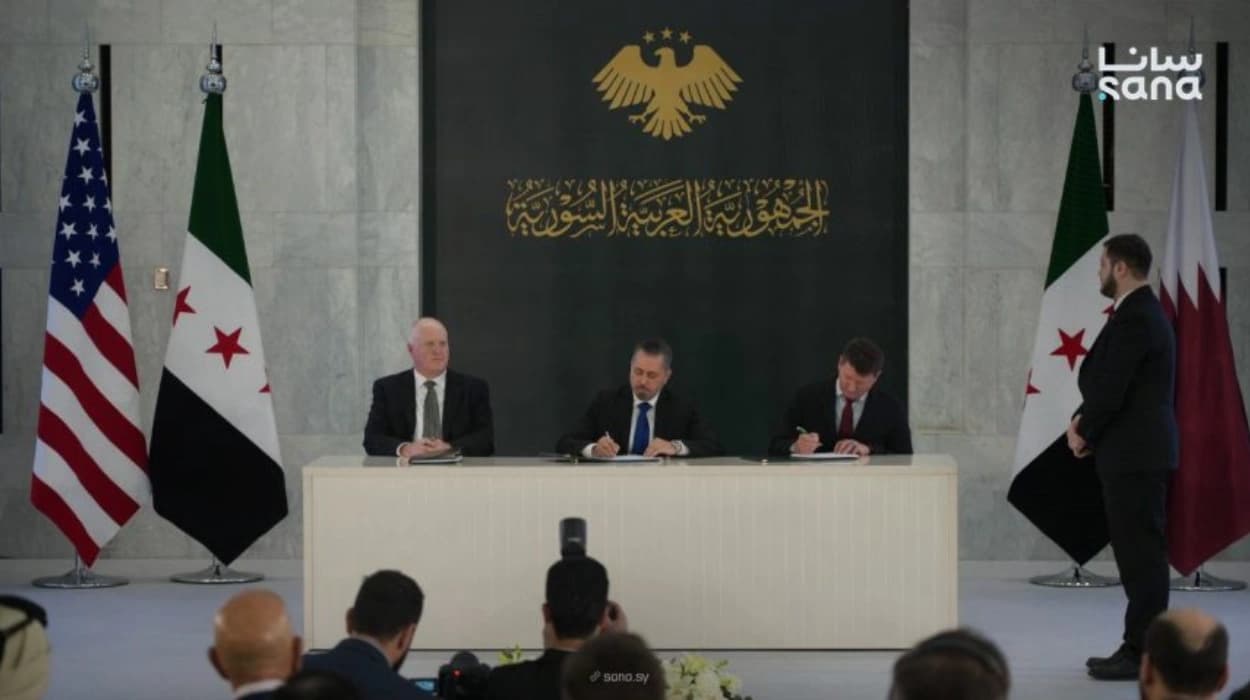
Damascus (The Palestine Telegraph Newspaper) February 04, 2026 – Syria has signed a cooperation agreement with Chevron and Power International for the development of its first offshore natural gas field. The deal covers exploration and production rights in the Poseidon block located in Syrian territorial waters in the Mediterranean. Officials stated the partnership aims to boost domestic energy supplies and generate revenue through future gas exports.
The agreement was formally signed on February 3, 2026, during a ceremony attended by Syrian Oil Minister Jamal Abdul Karim and representatives from the US-based Chevron Corporation and Qatar-based Power International. This marks Syria's entry into offshore hydrocarbon exploration, targeting an estimated 2.5 trillion cubic feet of recoverable gas reserves.
The ministry announced the deal as a step towards energy self-sufficiency amid ongoing reconstruction efforts.
Details of the Poseidon Block Agreement

The Poseidon block spans 2,200 square kilometres at a water depth averaging 1,800 metres, situated 45 kilometres northwest of Tartus. Syrian state media SANA reported that Chevron holds a 50% operating interest, Power International 30%, and the Syrian Petroleum Company (SPC) the remaining 20% carried interest. The contract term extends 25 years, with an initial five-year exploration phase obligating a minimum $250 million investment in seismic surveys and drilling.
Under the terms, Chevron will deploy advanced deep-water drilling technology, including two appraisal wells planned for 2027. Power International contributes engineering expertise from its regional LNG projects. Revenue sharing stipulates 70% to the consortium post-cost recovery, with Syria receiving royalties starting at 12.5% escalating to 20% upon commercial production. The deal awaits final ratification by the Syrian Council of Ministers.
Syrian Oil Minister Jamal Abdul Karim described the agreement as "a historic milestone" in a statement carried by state news agency SANA. Chevron's Middle East vice-president Mark Richards noted the block's proximity to established Levantine Basin plays like Israel's Leviathan field.
Strategic Importance of Syria’s Offshore Resources
Syria's Mediterranean coast stretches 180 kilometres, with offshore acreage previously unexplored due to civil war disruptions from 2011 to 2023. Preliminary geological surveys conducted by SPC in 2024 identified the Poseidon structure as a carbonate reef trap similar to Egypt's Zohr discovery. The field could yield first gas by 2030, producing up to 10 million cubic metres daily at peak.
The partnership aligns with Syria's 2026-2030 National Energy Plan, which prioritises gas development to fuel power plants and reduce reliance on imported fuel oil. Current domestic gas output stands at 25 billion cubic metres annually from onshore fields in the Euphrates basin, insufficient for 40 billion cubic metre demand. Exports via the Arab Gas Pipeline to Lebanon could commence post-2032.
Regional outlets cited the deal as Syria's first major foreign investment since sanctions eased in late 2025. Chevron's involvement signals thawing relations with Western firms, following TotalEnergies' onshore rehabilitation contracts in 2024.
Company Profiles and Regional Expertise
Chevron, a multinational energy giant headquartered in California, operates in 30 countries with proven reserves exceeding 11 billion barrels of oil equivalent. In the Eastern Mediterranean, Chevron acquired a 25% stake in Israel's Tamar field in 2020 and leads Aphrodite development offshore Cyprus. The company invested $1.2 billion in Levantine seismic data since 2022, positioning Poseidon as a logical extension.
Power International, a Doha-based conglomerate chaired by Sheikh Mohammed bin Thani, specialises in construction, energy, and real estate across the Middle East. Its Power Gas subsidiary engineered Qatar's Barzan pipeline and holds stakes in Egypt's Rosetta field. The firm brings onshore-to-offshore integration capabilities, including subsea tiebacks critical for Poseidon's remote location.
Syrian Petroleum Company, the state-owned operator, managed 15 onshore fields pre-war, producing 380,000 barrels of oil daily at peak. SPC's technical director Bassam Rahmane highlighted shared geological models with Chevron's Tamar analogue during signing remarks reported by Al-Watan newspaper.
Exploration Timeline and Investment Commitments
The consortium plans 3D seismic acquisition covering 5,000 square kilometres starting Q3 2026, utilising Chevron's BlueFin vessel. Two wildcat wells, Poseidon-1 and Poseidon-2, target drilling in 2027-2028 at depths of 4,500 metres subsea. Cost estimates total $800 million for exploration, with appraisal adding $500 million if successful.
Infrastructure development includes a 200-kilometre subsea pipeline to Tartus for onshore processing at a planned 500 million cubic feet per day facility. Power International will construct the $1.5 billion gas plant under EPC contract. Financing involves Chevron's $400 million equity, Power's $200 million, and $950 million from international lenders like BNP Paribas.
SPC mandates local content at 40%, creating 2,500 jobs during construction and 800 permanent positions. Training programmes for 500 Syrian engineers commence June 2026 at Chevron's Houston facility.
Regional Context and Comparative Projects

Syria's offshore push mirrors Israel's success, where Tamar and Leviathan fields supply 70% of domestic gas since 2013. Egypt's Zohr, discovered in 2015 with 30 trillion cubic feet, transformed it into a net exporter by 2024. Lebanon's ongoing disputes with Israel delayed its 2022 bids, but Syria's stability post-2023 enables faster progress.
The Levantine Basin holds an estimated 122 trillion cubic feet of gas, per US Geological Survey 2010 assessment updated in 2025. Cyprus awarded blocks to Eni and Exxon in 2021, with Glaucus-1 spudding in 2026. Turkey's Black Sea Sakarya field, online since 2023, underscores regional potential.
Syrian Deputy Prime Minister for Energy Abdul Karim Ali told AFP the deal complies with UN Security Council resolutions post-sanctions lift. Chevron reaffirmed commitment to ESG standards, pledging zero routine flaring and carbon capture integration.
Government Statements and Official Reactions
President Ahmed al-Sharaa hailed the signing in a televised address on February 3, linking it to economic recovery goals targeting 5% GDP growth in 2026. The ministry projected $3 billion annual revenue from Poseidon by 2032, funding reconstruction of war-damaged infrastructure.
Chevron issued a press release confirming the memorandum of understanding evolved into a full production sharing contract. Power International's CEO Rashid al-Khelaifi described it as "a gateway to MENA expansion." International media including Bloomberg and The National verified the event through Damascus sources.
Foreign Ministry spokesman Haitham Omar noted interest from Shell and BP for future bids on adjacent blocks. The deal precedes Syria's offshore licensing round scheduled for Q4 2026, offering 12 blocks totalling 15,000 square kilometres.
Historical Background on Syria’s Energy Sector

Syria's hydrocarbons date to 1940s Deir ez-Zor discoveries, peaking at 500,000 bpd oil and 30 bcm gas pre-2011. War halted offshore bids planned in 2008. Post-conflict audits by SPC revealed 2.2 billion barrels oil and 8.5 tcf gas reserves onshore.
Reconstruction since 2023 restored 80% capacity, with Russian and Iranian firms rehabilitating fields. Western re-entry began with Occidental's 2024 service contract. Offshore focus addresses declining onshore maturity, with 70% fields over 40 years old.
The Poseidon deal caps a year of deals totalling $5 billion FDI, per Economy Ministry data. Bilateral energy talks with Jordan and Iraq aim at regional grids by 2028.