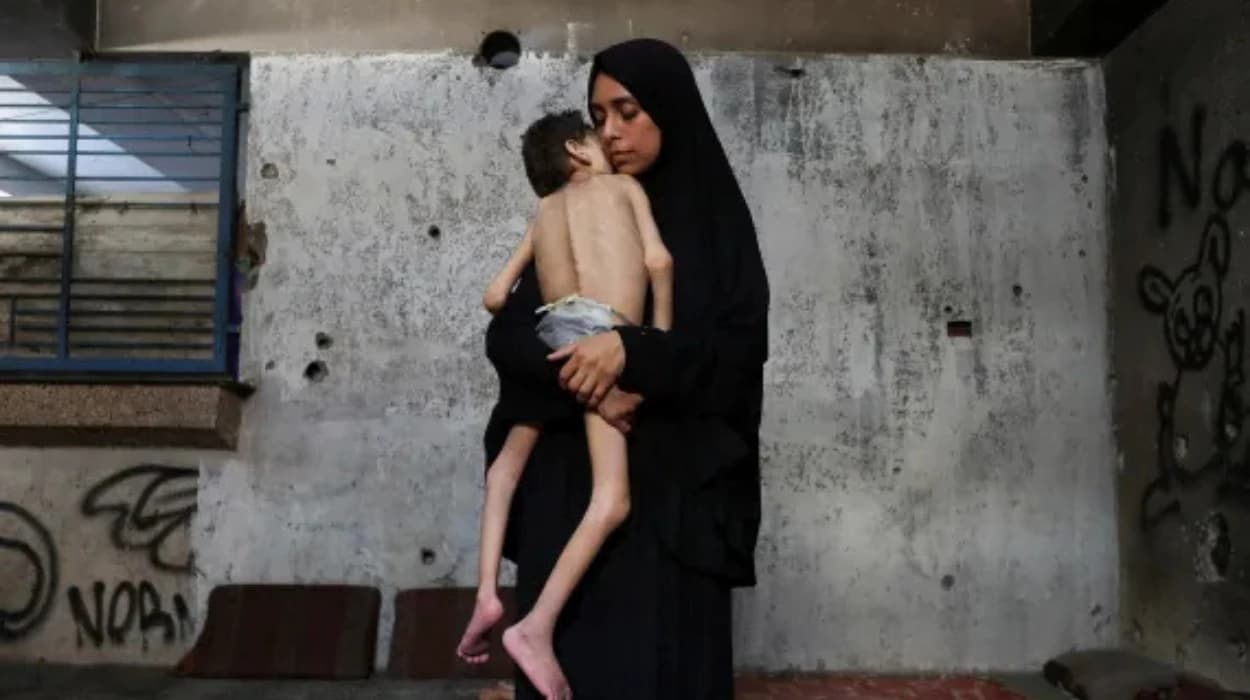
More than 113 Palestinians, mainly children, have died of starvation in Gaza since October 2023 as Israel’s siege severely restricts aid, with humanitarian agencies warning of total societal collapse. UN and medical officials describe families as “walking corpses,” while calls intensify for unimpeded humanitarian access as famine threatens the population.
Gaza’s Humanitarian Crisis: Starvation, Isolation, and Escalating Suffering
The humanitarian situation in Gaza has reached catastrophic levels, with spiralling starvation taking a devastating toll on families, particularly children. As attributed by Anadolu Agency, the United Nations Relief and Works Agency for Palestine Refugees in the Near East (UNRWA) on Thursday warned:
“Gaza is on the verge of total collapse, with widespread hunger pushing families and aid workers beyond the limits of survival”.
Amid relentless military actions and blockade, Palestinian families are not just facing food scarcity, but a full-blown, man-made famine.
Scale of Starvation in Gaza
- Reported
Deaths from Starvation:
The Gaza Health Ministry has recorded at least 113 deaths due to malnutrition and starvation since October 2023, with children comprising the overwhelming majority. - Malnutrition
Among Children:
According to Philippe Lazzarini of UNRWA, “One in every five children in Gaza City is now malnourished. Most children our teams are seeing are emaciated, weak, and at high risk of dying if they don’t get the treatment they urgently need” (Anadolu Agency). - Daily
Reality:
As reported by the BBC, and first-hand testimonies, children in Gaza hospitals cry out for bread while both medical workers and parents face growing hunger and exhaustion. A mother told BBC reporters, “My son has lost weight, plummeting from 40kg to just 10kg. Intensive care isn’t available. I can’t remember the last time my children had something as basic as milk or meat.”
Statements from International Agencies
- UNRWA Commissioner-General Philippe Lazzarini, quoted by ITV News and Anadolu Agency, relayed a statement by a colleague:
- “People in Gaza are neither dead nor alive—they are walking corpses”.
- He further stated,
- “The humanitarian system is collapsing. Our frontline health workers are surviving on one small meal a day—often just lentils—and increasingly fainting from hunger while working”.
- According to the United Nations, 6,000 loaded aid trucks containing food and medical supplies are currently blocked in Jordan and Egypt due to Israeli restrictions on crossings.
- World Health Organization (WHO) Director-General Dr. Tedros Adhanom Ghebreyesus conveyed,
- “We are witnessing a deadly surge in malnutrition-related deaths… Severe acute malnutrition centres are full, without sufficient supplies for emergency feeding. Since July 17th, 2025, rates of malnutrition have exceeded 10% among young children, while over 20% of pregnant and breastfeeding women are also suffering from severe malnourishment.”
- Save the Children and 109 other NGOs underscored that not only civilians but aid workers themselves are
- “joining the same food lines, risking being shot just to feed their families... Supplies are now totally depleted, and our colleagues are wasting away before our eyes.”
Why Are Families Unable to Cope?
According to Ross Smith, WFP’s director of emergency preparedness,
“People are dying from lack of humanitarian assistance every day, and we are seeing this escalate day by day.”
He added that a quarter of Gaza’s population faces famine-like conditions and almost 100,000 women and children are severely malnourished.
- Collapse
of Coping Mechanisms:
As reported by Philippe Lazzarini of UNRWA in ITV News and Sky News, “When child malnutrition surges, coping mechanisms fail, access to food and care disappears, and famine silently begins to unfold.” He continued, “Caretakers cannot find enough to eat, so parents are too hungry to care for their children. Those who reach UNRWA clinics do not have the energy, food, or means to follow medical advice”. - Deterioration
of Health and Hospital Services:
The United Nations Population Fund (UNFPA) and several media outlets report that Gaza’s health system is collapsing under shortages of fuel and medical supplies. Critical care, especially for maternity and neonates, is nearing total shutdown, with many giving birth in unsafe conditions and hundreds of preterm or low-birthweight babies left without adequate care.
Who Controls Aid Entry and What Are the Obstacles?
- Reduction
in Aid Deliveries:
COGAT, the Israeli authority overseeing Gaza access, claimed on CNN and Al Jazeera that roughly 70 trucks were allowed entry on certain days, whereas before October 2023, 500-600 trucks entered daily—a figure humanitarian officials say is “wholly insufficient” to stabilise even basic needs. - Blockaded
Crossings:
UNRWA has repeatedly called for the opening of all land crossings and the restoration of a UN-led humanitarian flow. As per Sky News, “Journalists and humanitarian workers are increasingly unable to feed themselves or their families as movement in and out of Gaza is blocked”. - Disrupted
Food Distribution:
Massacres at aid distribution sites have increased. The UN confirmed that 875 Palestinians have been killed while seeking food, including 201 on aid routes and hundreds more at distribution centres, as cited by Amnesty International and UN sources. Aid trucks themselves have become targets for looting and violence, with accounts of drivers unloading under threat and aid workers being injured.
What Do First-Hand Accounts from Gaza Reveal?
- Children’s
Voices:
The BBC reported the words of a 17-year-old at al-Shifa Hospital: “The doctor told me I need to eat, but how can I? I can’t even obtain a piece of bread.” A 15-year-old girl noted, “This is a severe and devastating famine. A kilogram of rice costs more than $75… If I had enough food, I’d already have left the hospital, but my wounds don’t heal due to malnutrition.” - Parents
and Families:
Adham al-Safadi told Reuters that after his six-week-old nephew Yousef died, “Finding milk is impossible and if you manage to locate it, it costs $100 for a container.” - Medical
Professionals:
Dr. Fadel Naim, head of Al-Ahli Hospital, emphasised on CNN, “Gaza requires a minimum of 1,500 aid trucks daily for a month—merely to start recovering from devastation caused by the weapon of starvation.”
How Have Media Outlets and Journalists Responded?
A rare joint statement from Agence France-Presse, Associated Press, Reuters, and the BBC demanded Israel allow more journalists into Gaza and prioritise food relief for civilians. As cited by Politico,
“We are desperately concerned for our journalists in Gaza, who are increasingly unable to feed themselves and their families.”
Are Gaza’s Deaths from Starvation Recognised as Part of International Legal Action?
- International
Criminal Court (ICC) Proceedings:
As reported by Anadolu Agency, last November, the ICC issued arrest warrants for Israeli Prime Minister Benjamin Netanyahu and former Defence Minister Yoav Gallant, citing war crimes and crimes against humanity in the context of Gaza’s devastation and starvation crisis. - Genocide
Case at the International Court of Justice:
Israel also faces proceedings at the International Court of Justice, specifically in relation to the alleged use of starvation as a method of warfare, which multiple agencies including Save the Children and Amnesty International note constitutes a war crime.
What Now for Gaza?
A “Breaking Point” for Survival
UN and NGO officials, as summarised by ITV News and Save the Children, unanimously agree that Gaza’s civilians are beyond coping:
“Families are breaking down, unable to survive. Their existence is threatened” (Philippe Lazzarini, UNRWA).
At least one-third of the population is forced to go several days without food, and humanitarian agencies warn:
“Famine silently begins to unfold when coping mechanisms fail and access to food disappears”.
Appeals for Immediate Action
- Humanitarian
Access:
The vast consensus among all humanitarian agencies and NGOs is the necessity for unrestricted humanitarian access, the immediate restoration of full land routes, the UN-led distribution system, and an urgent ceasefire to prevent further loss of life. - Protection
of Aid and Workers:
With aid workers themselves subject to hunger and violence, the international community faces mounting pressure to enforce agreements that allow safe passage for relief efforts into Gaza.
What’s Next?
With each passing day, Gaza’s starvation crisis deepens, spelling further danger for the enclave’s 2.1 million residents. As echoed by the United Nations,
“People are dying from lack of aid every day in Gaza… This is avoidable and urgent. The world cannot look away”.
The calls remain clear: unrestricted humanitarian action, protection for civilians and aid workers, and an end to blockade policies impeding food, water, and medicine.