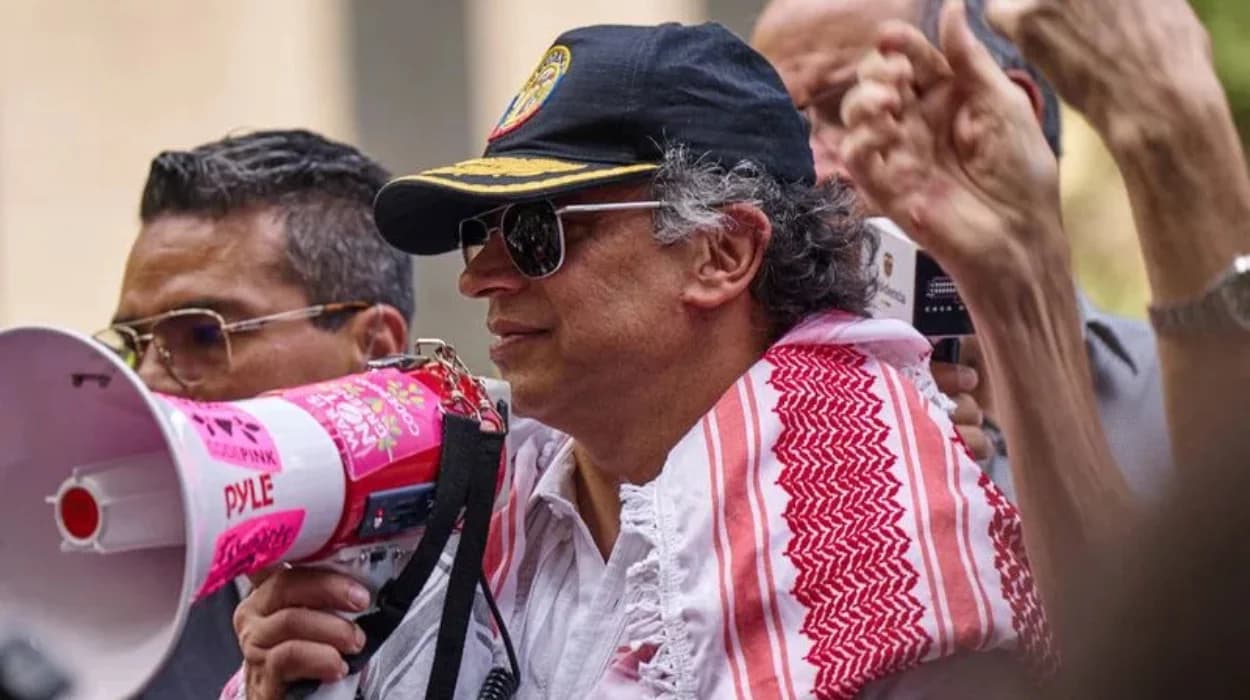
Colombian President Gustavo Petro condemned the U.S. decision to revoke his visa, accusing Washington of violating international law over Gaza criticism.
After Petro walked to the streets of New York on Friday to participate in a pro-Palestinian protest and called on American soldiers to defy President Donald Trump's instructions, the United States announced on Friday that it will cancel his visa.
"I no longer have a visa to travel to the United States. I don't care. I don't need a visa... because I'm not only a Colombian citizen but a European citizen, and I truly consider myself a free person in the world,"
Petro said on social media.
"Revoking it for denouncing genocide shows the U.S. no longer respects international law,"
he added on a post on X.
Regarding its activities in Gaza, Israel has consistently disputed accusations of genocide and said that it was acting in self-defense.
Speaking to a group of pro-Palestinian demonstrators outside the U.N. offices in Manhattan, Petro demanded that a worldwide military force be established with the goal of freeing the Palestinian people as its top priority, adding that "this force has to be bigger than that of the United States."
Petro is not the first president of Colombia to have his visa to the United States denied. A political crisis involving claims that the Cali drug cartel had supported the presidential campaign of then-President Ernesto Samper in 1996 resulted in the cancellation of his visa.
Since Trump took office again, Bogota and Washington's relationship has deteriorated. Petro threatened to impose tariffs and sanctions after blocking deportation planes from the United States earlier this year. Later, a deal was achieved between the two parties.
Following Petro's accusation that U.S. officials were planning a coup, which Washington deemed unfounded, both nations recalled their ambassadors in July.
In 2024, Petro suspended Colombian coal deliveries to Israel and severed diplomatic ties with the country.
What are the diplomatic consequences for Colombia after the visa revocation?
The visa revocation represents a significant and unusual diplomatic chastisement from the U.S. towards Colombia, and perhaps will change the nature of the collegial and cooperative relations traits that historically have marked our two nations. It indicates increasing tensions, in part related to Petro's continual condemnations of U.S. policy, and in part relating to Israel's military action in Gaza.
Moreover, military and security cooperation between the U.S. and Colombia, including counternarcotics cooperation, has been long standing. These ties may be shaken or redirected as relationships become colder.
Colombian exports to the U.S. significantly declined during previous crises with diplomatic implications (i.e., sanctions and visa denials). It also posed challenges for Colombian officials and citizens traveling to the U.S.