Hamas accused the US of complicity in Israel’s deadly strike on its negotiators in Qatar, saying Israel aims to derail Gaza ceasefire talks as Doha held funerals.
Unprecedented Israeli attacks on a Gulf state derailed already-failing Gaza negotiations and sent shockwaves through a long-shielded region.
“This crime was ... an assassination of the entire negotiation process and a deliberate targeting of the role of our mediating brothers in Qatar and Egypt,”
Hamas official Fawzi Barhoum said in a televised statement.
The ruler of the Gulf state joined mourners at the mosque in Doha, which was heavily guarded during prayers.
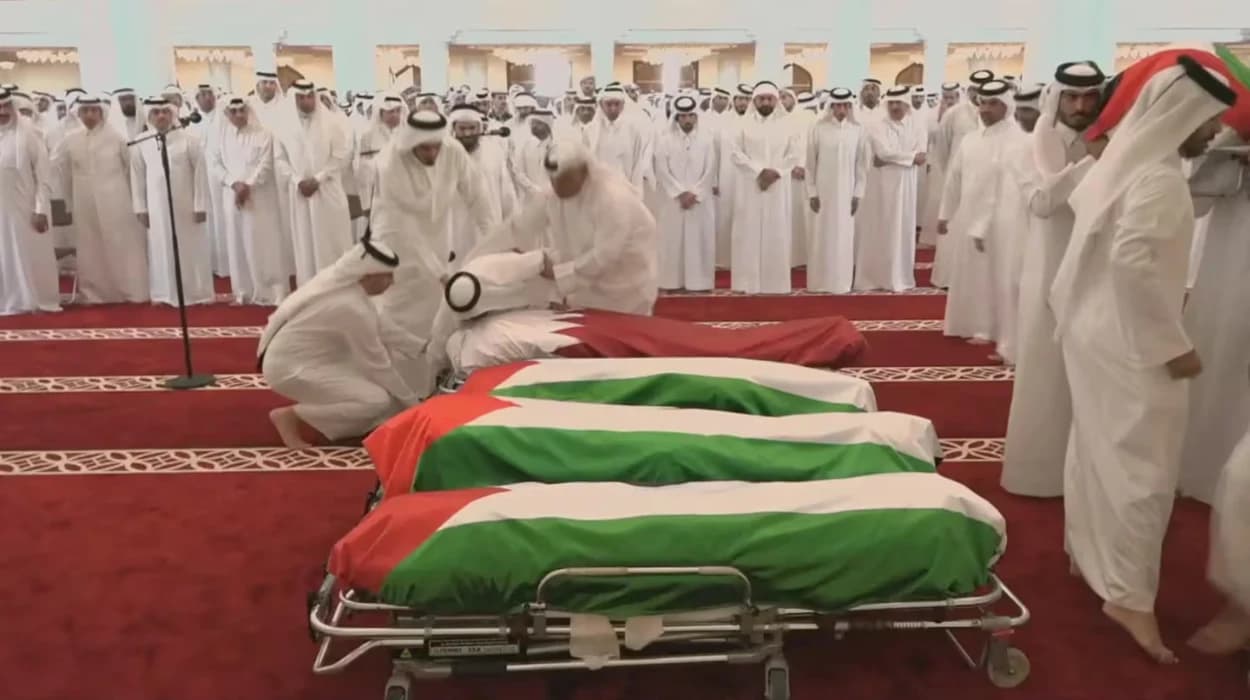
Live footage from Qatar television showed five coffins with Palestinian flags and one with a Qatari flag being carried into the mosque.
Alongside dozens of mourners, some dressed in traditional white robes and others in military uniforms, Qatar's emir, Sheikh Tamim bin Hamad Al Thani, stood facing the coffins and said prayers.
Following the funeral at Sheikh Mohammed bin Abdul Wahhab Mosque, the deceased were laid to rest in the Mesaimeer Cemetery.
Authorities increased security by installing checkpoints on the mosque's access roadways.
Washington, according to Barhoum, was "a full accomplice" in the Israeli operation.
Without mentioning Israel, the UN Security Council denounced the assault on Doha.
The statement, which needed the approval of all 15 council members, including Israel's ally the United States, stated that the Security Council "understood the importance of de-escalation and expressed their solidarity with Qatar."
According to the White House, Trump disapproved of Israel's military action.
He claimed that he had not been informed beforehand and that when he did, he asked his envoy Steve Witkoff to alert Qatar right away, but the attack had already begun.
Israel claimed to have targeted Hamas leaders, while the organization claimed that its top executives were unharmed.
According to Hamas, five of its members were slain: bodyguards Ahmad Mamlouk, Abdallah Abdelwahd, and Mumen Hassoun; chief negotiator Khalil al-Hayya's son Hamam; and his office director Jihad Labad.
Additionally murdered was Qatari Lance Corporal Badr Saad Mohammed al-Humaidi al-Dosari.
According to Barhoum, the attack on the property where Hayya lived injured his wife, his deceased son's widow, and his grandkids.
Sheikh Mohammed bin Abdulrahman Al Thani, the prime minister of Qatar, stated in an interview that he was unable to verify Hayya's whereabouts.
Despite plans by a number of Western states to recognize the State of Palestine at the UN later this month, Israeli Prime Minister Benjamin Netanyahu declared this week that "there will be no Palestinian state."
“This place belongs to us,”
he said, as he attended a signing ceremony for a major settlement project in the occupied West Bank that the United Nations has described as an “existential threat” to the viability of a Palestinian state.
Several rounds of indirect talks between Israel and Hamas have taken place in Doha.
In 2012, the United States, which has attempted to keep lines of communication open with Hamas, granted the emirate permission for the organization to establish a political office in Doha.
In response to the incident, Sheikh Mohammed expressed his wish for a coordinated regional response and indicated an Arab-Islamic meeting would be held in Doha to determine the best course of action.
Gulf neighbors have strongly condemned the incident and expressed solidarity.
The United Arab Emirates said
“any aggression against a GCC [Gulf Cooperation Council] member state constitutes an attack on the collective Gulf security framework”.
What was Qatar's official reaction to the strikes and diplomatic steps taken?
Qatar denounced the strike as a “blatant violation of international law,” a “flagrant violation” of its sovereignty and territorial integrity, and described it as “state terrorism” that endangered people on Qatari soil.
Qatar organized funerals for those killed in the strike, including Hamas members and Qatari security personnel, highlighting the seriousness of the incident on its territory.
Qatari Prime Minister Sheikh Mohammed bin Abdulrahman Al Thani called the attack “cowardly” and “barbaric” and asserted that Israel’s actions showed bad faith in ceasefire negotiations. He pledged that Qatar would coordinate with regional partners for a collective and robust response, including legal actions against Israel.