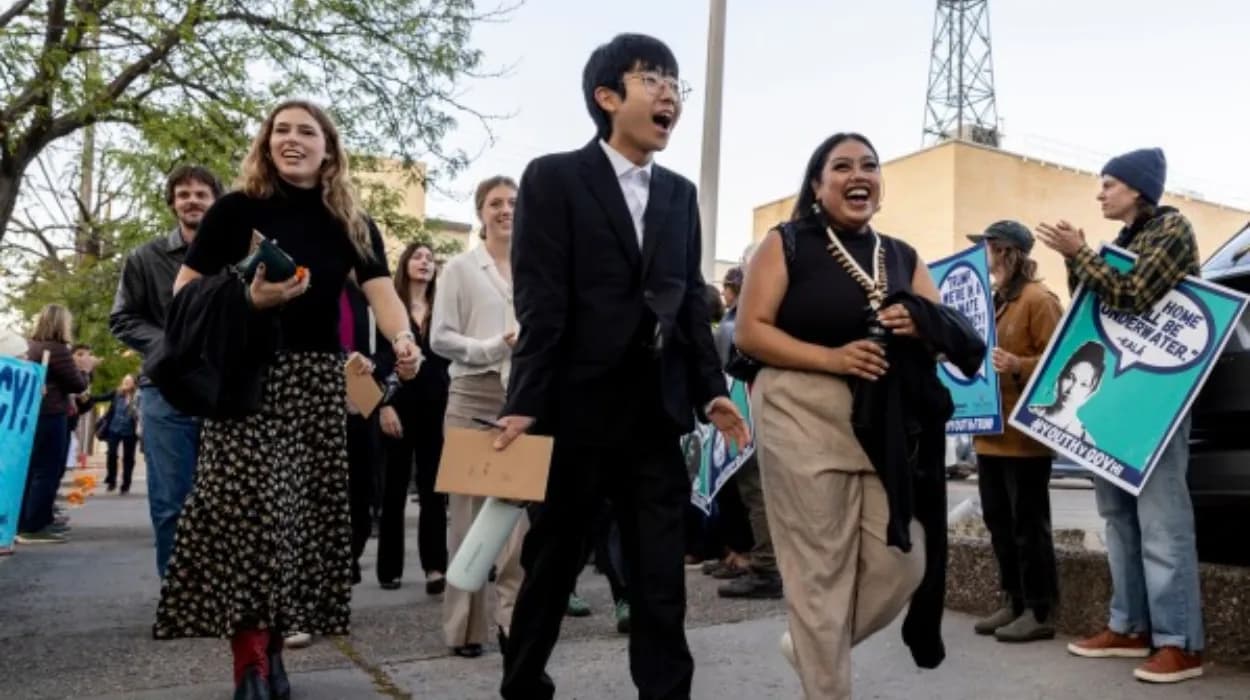
A federal judge dismissed a youth-led lawsuit against President Donald Trump, ruling the court lacked jurisdiction to challenge his fossil-fuel policies.
While the young plaintiffs in Lighthiser v. Trump had provided "overwhelming" evidence that the administration's actions would further destabilize the climate and harm them, Judge Dana Christensen of Missoula, Montana, stated in his written order that their case "must be made to the political branches or to the electorate."
"With this understanding in mind, the Court reluctantly concludes...that it cannot grant Plaintiffs the relief they seek,"
wrote Christensen.
The 22 plaintiffs, who were represented by the group Our Children's Trust and included a number of juveniles, had requested a stay against three executive orders that they claimed infringed upon their constitutional rights to life and liberty by attempting to "unleash" the production of fossil fuels while ignoring renewable energy.
Additionally, they charged that the administration was undermining federal climate science, which would have prevented the public from being aware of the growing risks.
Last month, the young people had the chance to testify at a two-day hearing in Christensen's courtroom on how global warming had affected their lives.
Among the witnesses were Jorja McCormick of Livingston, Montana, who claimed to have been traumatized by wildfires that forced her family to evacuate, and Joseph Lee, a California undergraduate who experienced a potentially fatal heat stroke.
Christensen, who has issued positive environmental judgments in the past, listened closely as the plaintiffs called experts in climate science, energy economics, politics, and children's health.
Conversely, government attorneys did not present their own witnesses or devote much time to refuting the existence of climate change.
While lawyers for the youths contended the case differed from Juliana in key ways, Christensen ultimately disagreed.
"Plaintiffs have presented overwhelming evidence that the climate is changing at a staggering pace, and that this change stems from the rise in atmospheric carbon dioxide, caused by the production and burning of fossil fuels,"
Christensen wrote.
He added that they had also shown "overwhelming evidence that implementation of the Challenged EOs will increase the concentration of atmospheric carbon dioxide, thereby exacerbating the harm Plaintiffs experience from an already-warming climate."
But he maintained the injuries were not redressable by a court, saying he was troubled by being asked to reset national energy policy to the way it was before Trump took office a second time, and by the fact that his court would be required to monitor all of the administration's actions if he sided with the youths.
"The Court reads Juliana to mandate this outcome,"
he said, but added that he would gladly hear the case on its merits if an appeals court, the Ninth Circuit, disagreed.
What legal grounds allow courts to block executive orders on climate?
Courts often review if the executive order exceeds the authority granted to the president or federal agencies by Congress. Under the nondelegation doctrine, an executive order must be grounded in existing statutory powers. If an order goes beyond delegated authority such as regulating in ways Congress did not intend the courts may block it.
Executive orders must respect the division between the legislative, executive, and judicial branches. Courts may block orders that attempt to legislate or make broad policy decisions reserved for Congress, particularly on complex issues like climate policy and energy regulation.
Executive orders can be challenged if they violate procedural requirements, such as those under the Administrative Procedure Act (APA), which requires agencies to provide notice.