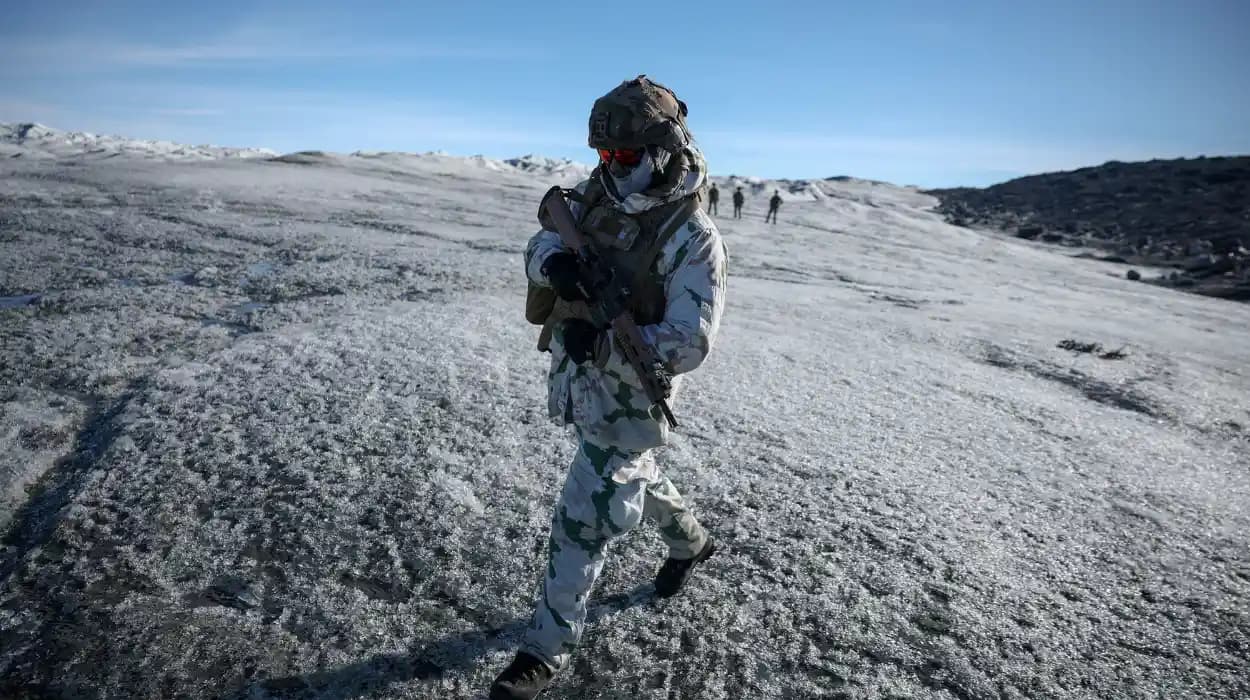
President Trump argues for US control of Greenland, citing national security and historical claims, sparking diplomatic and political debate.
Trump continued by saying that the United States was not looking to take advantage of Greenland's resource richness but rather wanted to utilize the island to oppose the influence of China and Russia, who he said had ships in the area.
A day after he designated a new U.S. envoy to the semi-autonomous Danish region, the president infuriated local officials by saying,
"We need it for national protection,"
at a press conference in Florida.
“They say that Denmark was there 300 years ago or something with a boat,”
Trump added.
“Well, we were there with boats too, I’m sure. So we’ll have to work it all out.”
Greenland has been inhabited by the Inuit for thousands of years; Europeans first came into touch with the island in the late tenth century. It wasn't until the late 19th century that the United States would get significantly involved in the exploration of the region surrounding Greenland.
Trump declared over the weekend that Jeff Landry, the governor of Louisiana, will act as a special envoy to the island territory, which he has often stated he would like to take over during his tenure.
“We have said it before. Now, we say it again: national borders and the sovereignty of states are rooted in international law,”
Danish Prime Minister Mette Frederiksen and her Greenlandic counterpart, Jens-Frederik Nielsen, said in a joint statement.
“They are fundamental principles. You cannot annex another country. Not even with an argument about international security.”
Greenland and Danish officials reacted angrily to the statement, which came after months of silence following a wave of pressure early in Trump's presidency.
Additionally, Denmark has called the American ambassador to Copenhagen.
The Trump administration's interest in Greenland appeared to be waning as recently as October.
“Right now, it seems far away. There is perhaps a feeling that we can breathe a sigh of relief,”
Prime Minister Frederiksen said
during a session of the Danish parliament at the time.
“It is my belief that we cannot.”
Trump was applying full-court pressure on Greenland early in his presidency.
The president stated he wouldn't rule out using force to seize the island in March, the same month Vice President JD Vance visited a U.S. base there.
When news reports in May suggested that the United States was stepping up its espionage in Greenland, tensions increased even further. Denmark responded by threatening to call the U.S. ambassador to get an explanation.
How would US control of Greenland affect NATO relations?
U.S. control of Greenland, if pursued aggressively by President Trump, would oppressively strain NATO relations by undermining trust in the alliance's core principle of collaborative defense under Composition 5, potentially bending America against supporter Denmark.
Denmark, as a founding NATO member, hosts U.S. bases like Pituffik under a 1951 defense agreement tied to the NATO convention; forcible preemption would bring collective defense scores, forcing abettors to choose between defying the U.S. or abandoning Denmark, eroding cohesion amid pressures over burden- sharing.
Such a move could buoy adversaries like Russia in the Arctic, prompt Europe to expel U.S. forces or seize participating means, and accelerate EU collective defense activation via Composition 42.7, segregating Washington and questioning NATO's viability.