Summary
- Trump officials said Israel would match $30 million aid.
- The U.S. gave $30 million to the Gaza Humanitarian Foundation.
- GHF was criticized for armed aid and safety concerns.
- Funding approved bypassing normal audit procedures.
- Senators and groups call to stop GHF funding.
The foundation's financing sources have been unclear, aside from the US payment that was revealed by the US State Department in June. GHF does not reveal who its contributors are.
The humanitarian crisis in Gaza and Israel's support of GHF's assistance operation, which has distribution sites only in southern Gaza and has been deemed unsafe and ineffectual by aid organizations and the UN—claims the group disputes—have led to increased international pressure on Israel.
According to the two sources, Trump's Middle East envoy Steve Witkoff's assistants, Aryeh Lightstone and Charles Leith, briefed US Senate and House of Representatives committees on the GHF operation on July 8 and 9.
According to the individuals, who spoke on condition of anonymity, they informed the congressional committees that Israel had committed to matching the $30 million that the United States gave to GHF in June, which would be sufficient to sustain the organization until the end of July.
An interview request was not answered by Lightstone or Leith, and the White House directed inquiries to the State Department. Requests for comment were not answered by the Israeli government or the State Department.
On Monday, President Donald Trump announced that the United States had disbursed $60 million for humanitarian assistance in Gaza. However, the State Department has only announced the $30 million that was approved for the GHF in June.
According to a third person with knowledge of the situation, several US officials think Trump was probably confusing US and Israeli monies.
According to the sources, Lightstone and Leith expressed to Congress their anticipation that by August, additional donors would recognize GHF's success and support its operations, enabling the foundation to expand its distribution network from four to eight locations.
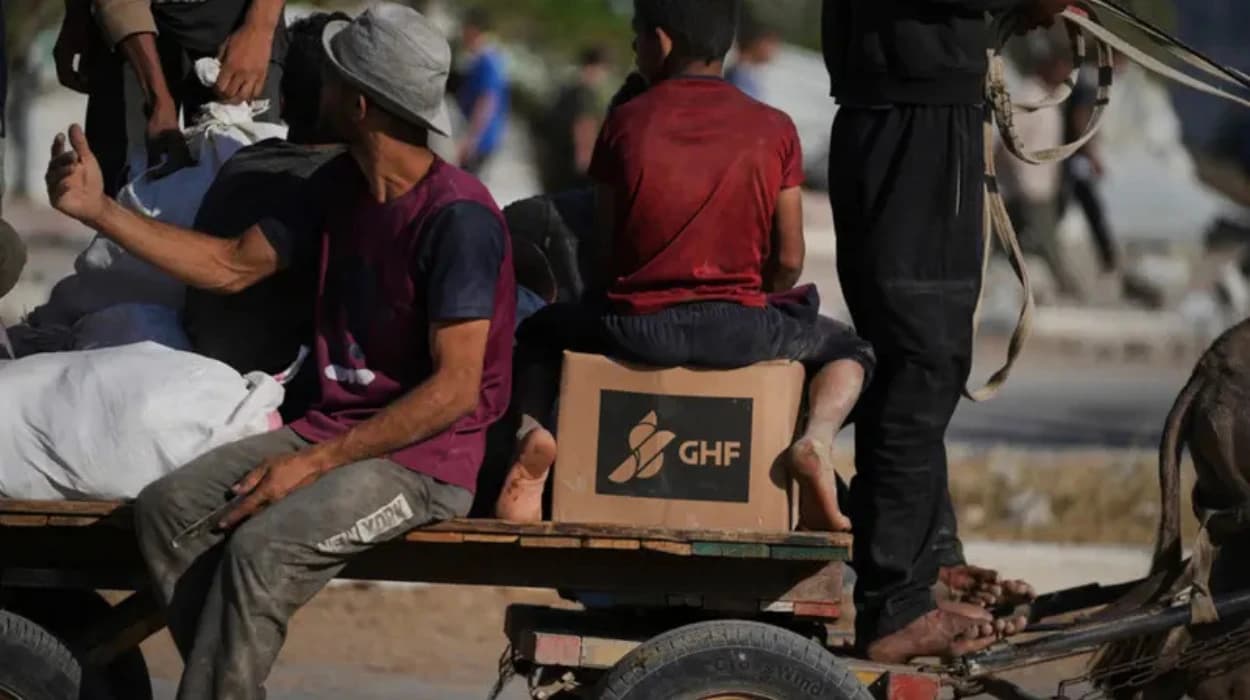
Reuters was unable to confirm whether Israel had paid the $30 million to GHF, which distributes aid to its locations in the Palestinian enclave by using for-profit US military and logistics companies.
GHF Executive Chairman Rev. Dr. Johnnie Moore, a former evangelical adviser to the White House during Trump's first term, told the Hudson Institute think tank on Wednesday that the foundation was exempt from disclosing its contributors because it was a private US charity.
He indicated that GHF required more money.
“The biggest problem is just we need more of it, and $30 million is not going to get it done,”
he said, in an apparent reference to the US contribution.
In an email to Reuters, GHF stated that it was committed to providing as much food as it could safely and that it was still urging the Israeli government to let it establish more distribution locations, particularly in northern Gaza. Regarding its funding and donors, it remained silent.
The United Nations, aid organizations, and others have attacked GHF for what they claim is a risky model of aid distribution and a violation of humanitarian impartiality requirements. GHF disputes these claims.
Israel claims that Hamas-led terrorists have been able to steal supply shipments meant for civilians from the UN-led relief system that has historically provided assistance to Gaza's citizens.
Hamas refutes the charge.
According to a new internal US government review, there is no proof that Hamas has been systematically stealing US-funded aid. A hunger monitor stated on Tuesday that a worst-case scenario of famine is developing in Gaza and that urgent action is required to prevent widespread deaths as a result of the ongoing starvation.
In his Wednesday remarks, Moore denied that famine is developing.
“That’s made up. There’s not a famine. There’s acute hunger. There’s not enough food in the Gaza Strip,”
he said.
Images of malnourished Palestinian youngsters have sparked international outrage, and Gaza health officials have reported an increase in mortality from hunger-related reasons. In contrast to Israeli Prime Minister Benjamin Netanyahu, who has maintained that there is no starvation in the heavily populated coastal enclave that has been largely destroyed by Israel's military offensive, which has killed over 60,000 people, according to Gaza health officials, Trump this week claimed that many people were starving.
Since Israel, which has been at war with the Palestinian militant group Hamas since its forces killed 1,200 people and returned 251 prisoners to Gaza in October 2023, according to Israeli estimates, cut off all supplies to the enclave in March, Gaza's food supplies have been running low.
In May, the blockade was removed, although with limitations Israel claims are necessary to stop help from going to extremist organizations.
Israel claims that starvation in Gaza is not its goal. This week, it announced measures to facilitate greater aid, such as providing more safe routes, air-dropping food, and halting fighting in some areas.
How might Israel's agreement to match the US donation influence aid distribution in Gaza?
Israel's agreement to match the US donation for Gaza humanitarian aid is likely to influence aid distribution by reinforcing a system where Israel oversees or heavily controls the delivery infrastructure. This arrangement aims to ensure that aid reaches civilians directly without being diverted to Hamas, which Israel alleges has stolen and misused aid in the past, though these claims lack public proof and are disputed by humanitarian organizations.
Specifically, the aid distribution is planned to be managed through new, internationally governed but Israel-backed compound sites in Gaza, where families receive limited, weekly aid packages designed to reduce Hamas's leverage and governance power.
Israel has committed to financing and executing the necessary infrastructure work for these secure aid distribution sites, and the US-backed Gaza Humanitarian Foundation (GHF) operates many of them with private contractors handling logistics.