Summary
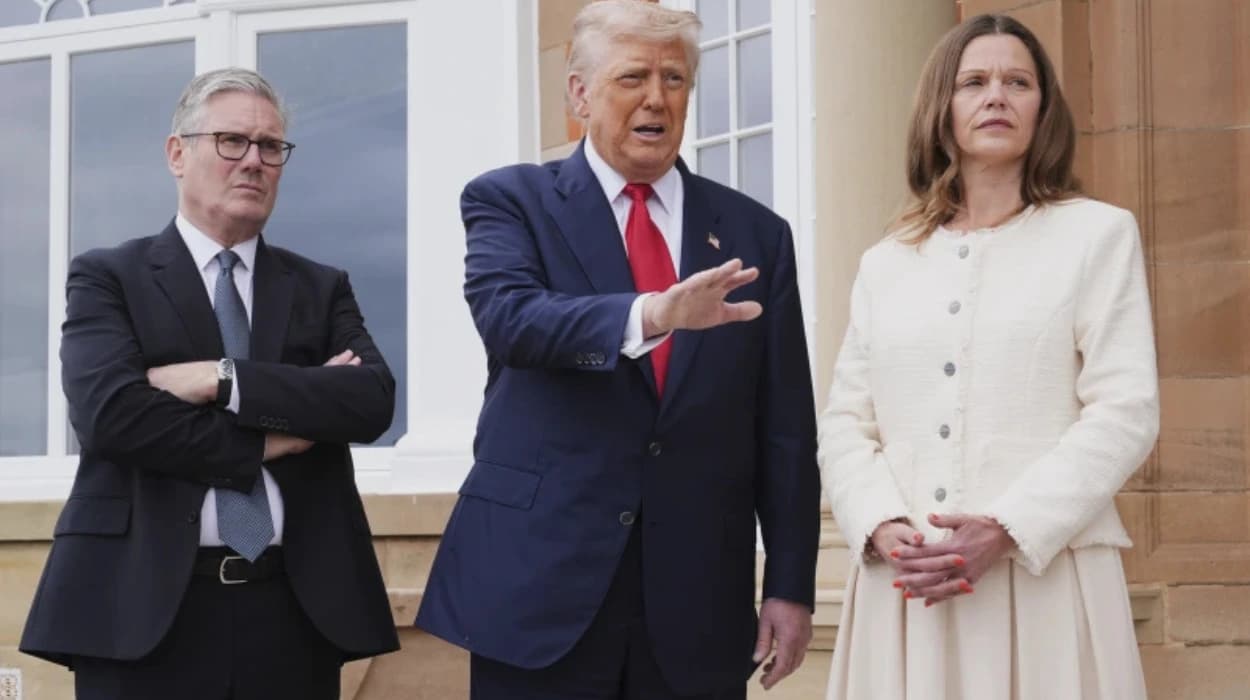
Trump met UK PM Starmer at Turnberry golf course.
Starmer urged more U.S. food aid for the Gaza hunger crisis.
Trump said the U.S. gave millions but aid was stolen.
They discussed trade and Ukraine cooperation.
Turnberry golf course used for diplomatic talks.
Trump frequently treated the meeting as though he were back in the Oval Office, and he did not pass up the opportunity to promote his Turnberry course, which boosts his family business. The two leaders, who have become closer, appeared at ease and content together.
The Republican president proudly pointed out important locations throughout Trump Turnberry and engaged in conversation with the prime minister and his wife, Victoria, for a number of minutes when they arrived.
In light of growing allegations of famine in Gaza as the Israel-Hamas conflict rages, Starmer resolved to urge the United States to play a bigger part in assisting in resolving what he described as a "desperate situation."
Trump at first was focused on complaining about the U.S. not having gotten enough credit for previously providing food aid. But he shifted tone when reporters questioned him about images of emaciated children from Gaza.
Asked if he agreed with Israel Prime Minister Benjamin Netanyahu’s remarks about concerns of mass starvation in Gaza being overstated, he replied,
“I don’t know. I mean, based on television, I would say not particularly because those children look very hungry.”
Starmer immediately was far more forceful:
“I think people in Britain are revolted at seeing what they are seeing on their screens.”
The president later Israel shifted his tone dramatically and suggested a major recalibration of U.S. policy toward the territory, suggesting that Israel “has a lot of responsibility” for what’s happening.
“I think Israel can do a lot,”
Trump said. He added that when next speaking to Netanyahu, he’d insist,
“I want them to make sure they get the food,”
noting that the U.S. and others are giving money and food to Gaza and that Netanyahu has “got to, sort of, like, run it.”
“I want him to make sure they get the food,”
Trump said.
Starmer and Trump took an Air Force One flight to the area outside Aberdeen, where the president's family owns a second golf club and is hosting a ribbon-cutting ceremony for a third on Tuesday, following their meeting. Although the new course will be open to the public on August 13 and may experience an increase in sales due to the president's promotion, Trump will be its first official participant.
Balmedie, a community near the golf course, was the site of protests. A 67-year-old retired lawyer named Jean Abbot was among them, accusing Trump of being in "the process of dismantling Western civilization."
“He is trashing what two generations of our people have fought wars to preserve, namely democracy and freedom and the rule of law,”
Abbott said.
That came after demonstrations against the president's visit while he was out golfing took place all throughout Scotland on Saturday.
Trump is attempting to redeem a post from his first term in 2019 that said, "Very proud of perhaps the greatest golf course anywhere in the world," about Turnberry because his golf courses are receiving so much attention. also strengthens ties with the United Kingdom!
Despite not being a golfer, Starmer voluntarily complied with the president's excessive control over properties that bear his name and the power of golf to affect international affairs.
The president talked at length Monday about how he spent money lavishly to upgrade the historic Turnberry course after he bought it in 2014, declaring,
“If you take a look at the windows in the various dining rooms, they’re magnificent.”
Starmer said he was excited to “see this amazing golf course” while promising Trump,
“I’ll invite you to a football ground at some stage.”
As hunger increases in Gaza, Israel has come under fire from Britain, France, and Germany for "withholding essential humanitarian assistance." After Israel temporarily loosened restrictions, Starmer said over the weekend that Britain would join Jordan's efforts to airdrop aid into Gaza.
Lawmakers from Starmer's Labour Party are also pressuring him to recognize a Palestinian state like France has, a decision that Israel and the United States have already denounced.
However, Trump stated on Monday that he "does not mind him taking a position" in reference to the prime minister possibly doing so. According to Starmer, the United Kingdom is in favor of Palestinian statehood, but it needs to be "part of a wider plan" for a two-state resolution to the Israel-Palestine problem.
Additionally, Trump and Starmer discussed a potential peace agreement to put an end to Russia's war against Ukraine, with a focus on pressing Russian President Vladimir Putin to engage in negotiations within a 50-day deadline that Trump established earlier this month.
The president stated that there is "no reason in waiting" and that he intends to declare a new timeframe to stop the war that lasts only 10 or 12 days.
The leaders' sit-down occasionally resembled Trump's encounters with foreign leaders in the Oval Office as they fielded more than an hour's worth of questions from reporters. Despite the fact that this conversation was held in Starmer's U.K., he answers a number of questions while his companion largely sits quietly.
Trump reiterated his call for the Federal Reserve to cut interest rates and brushed off repeated questions regarding the Jeffrey Epstein case. Additionally, he reiterated his long-standing grievance against wind farms, which he had unsuccessfully tried to have removed from the vicinity of his Aberdeen golf club.
At another point, Trump called London Mayor Sadiq Khan a "nasty person" and said "he's done a terrible job."
Starmer jumped in with a chuckle: “He’s a friend of mine, actually.”
As they have in the past, the two men also went out of their way to praise one another. Starmer gushed,
“Because we focus on what’s important for our two countries, we get along very well.”
Although there are still issues with steel imports, they also discussed improving a bilateral trade deal they announced last month.
The meeting came after Trump and Ursula von der Leyen, the head of the European Commission, sat down after playing golf on Sunday. Although many important elements are still missing, they unveiled a trade framework that will impose 15% tariffs on the majority of commodities from both countries.
Meanwhile, Scotland's leader has pushed Trump to remove the 10% levy on Scotch whisky that is now in place. According to First Minister John Swinney, an exemption was warranted due to the spirit's "uniqueness."
Trump was noncommittal, though, smiling as he said,
“I’m not a big whiskey drinker. But maybe I should be when I’m over here.”
How does Trump’s focus on his golf course influence the Gaza aid discussion?
During the meeting between U.S. President Donald Trump and British Prime Minister Keir Starmer at Trump's Turnberry golf resort in Scotland, Trump prominently showcased his Scottish golf properties, expressing pride in them and discussing their significance.
This focus on his golf course reflects Trump's tendency to blend personal business interests with diplomatic engagements, which in this context provided a somewhat unusual backdrop to the serious geopolitical discussions.
Despite the golf course setting and Trump's emphasis on promoting it, the talks still addressed the critical and urgent issue of humanitarian aid and the worsening food crisis in Gaza.