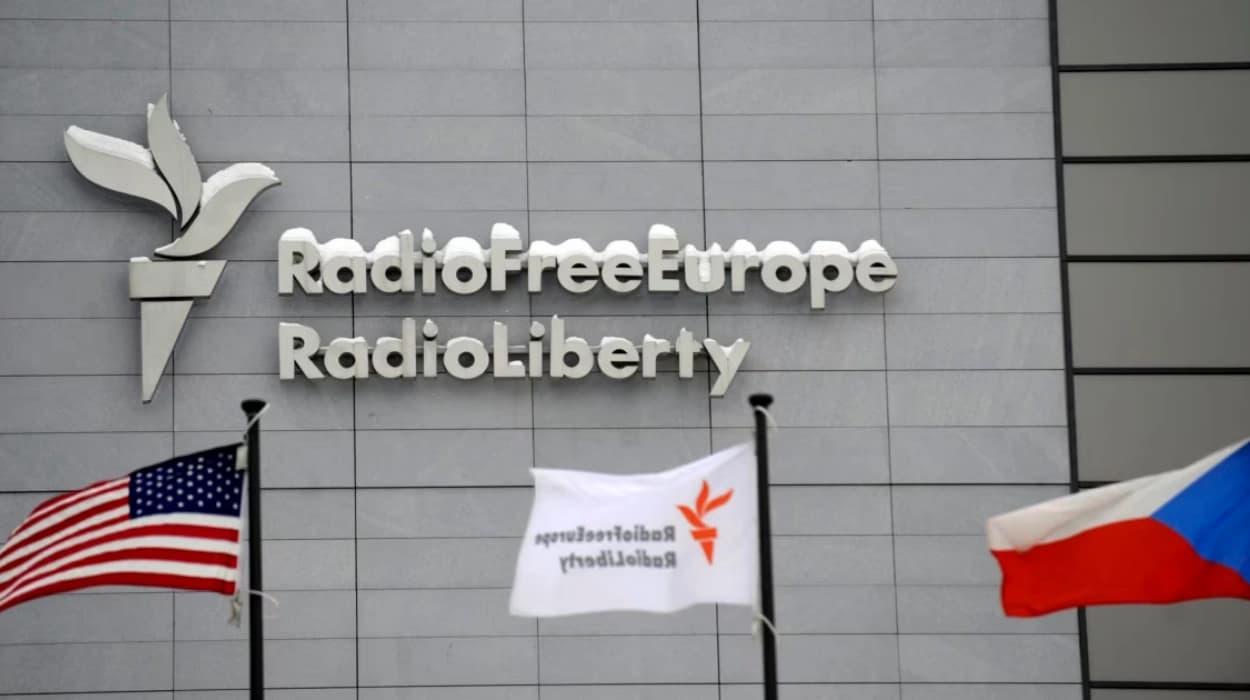
US officials restricted Radio Free Europe and Radio Liberty from broadcasting Iran protest updates to avoid “mixed messages,” Kari Lake said.
Following reports that she had blocked Radio Free Europe from accessing the transmitter in Kuwait, Lake, a lifelong MAGA supporter who currently serves as the CEO of the USAGM, moved to Facebook on Tuesday night to lash out against the "fake news."
As political discontent spreads throughout the Islamic Republic, Iran's leadership has imposed a near-complete information blackout while waging a ruthless crackdown that has killed hundreds, if not thousands, of unarmed protestors. While threatening military action in reaction to the Iranian regime's horrific crackdown, Donald Trump has assured demonstrators that "help is on the way."
“The fake news is in hyperdrive spreading lies right now about USAGM and RFE/RL broadcasting in Iran. Here’s the truth,”
Lake posted on Facebook.
“USAGM and our outlets have greatly increased coverage into Iran. VOA Farsi is providing expanded hours of TV, radio and digital coverage each day sharing the story of the brave Iranian people who have endured so much and are demanding their freedom,”
she wrote.
“Last week, I reached out to Radio Free Europe’s leadership offering additional help to further get their message into Iran. The President of Radio Free Europe, Steve Capus, agreed that we need to have a unified message so that we are not sending mixed messages to the people of Iran who are showing such bravery and courage after five decades of terror,”
Lake continued.
Capus "agreed that RFE/RL would work to better align their message with American foreign policy," she continued, but "his team has not done so." She further stated that her organization is "standing by ready to help and are simply waiting for Mr. Capus to inform us that he's made the changes he committed to," asserting that it is "USAGM's commitment to ensure coverage is consistent with American national interests."
RFE/RL announced over the weekend that it had "resumed shortwave radio broadcasts into Iran following the imposition of an internet blackout" by Iran and that it was "working with several commercial vendors" to make sure Radio Farda, its Persian-language program, could air within the nation.
“At this historic moment, when the Iranian people have been plunged into digital darkness by their government, Radio Farda’s return to the airwaves is an essential breakthrough,”
Capus wrote.
“We’re reaching the people of Iran with the facts they need to stay safe – and ensuring their voices continue to be heard. Our journalists at Radio Farda are working nonstop to fulfill our commitment to the people of Iran.”
On Monday night, Status News reported that Lake was preventing RFE/RL from broadcasting into Iran via USAGM's Kuwait transmitter, pointing out that this went against Trump's outspoken backing of the Iranian demonstrators. Lake made a generic statement without indicating if the agency will cease preventing the USAGM-run radio stations from utilizing the transmitter.
The Trump administration and Lake have been fighting for almost a year to effectively shut down not only RFE/RL but also Voice of America and many of its international affiliates, which is why USAGM's transmitter is unavailable.
The White House referred to VOA as the “Voice of Radical America” after the president signed an executive order in March directing the USAGM to effectively abolish state-funded news organizations.
Since then, the courts have consistently thwarted Lake and the administration's attempts to shut down operations at the outlets and fire hundreds of VOA employees. Simultaneously, a large number of workers have been left to sit on the sidelines and have not yet been called back to work. However, a number of foreign stations that had suspended operations, like Radio Free Asia, have started up again in recent months.
A bipartisan funding package passed by Congress this week would set aside $643 million for USAGM broadcasting and $10 million for capital enhancements, while Lake attempts to shut down and defund USAGM and its subsidiaries.
“This is exactly why U.S. international broadcasting exists. Now is the time to fully implement and resource our capabilities — including VOA Persian, Radio Farda, and the Open Technology Fund — to ensure the regime cannot cut its people off from the truth,”
Rep. Michael McCaul (R-TX) said.
What impact did the block have on protest coverage in Iran?
The USAGM block on RFE/ RL's use of the Kuwait transmitter had minimal direct impact on overall Iran kick content, as Radio Farda snappily rotated to marketable shortwave druthers and limited smuggled Starlink uploads amid the governance's total internet knockout.
RFE/ RL maintained broadcasts via private merchandisers, icing uncensored updates reached pastoral and knockout- hit areas where shortwave remains effective despite jamming attempts. VOA Farsi ramped up the affair under USAGM direction, filling airtime with aligned messaging, though critics note it echoed state media less critically than RFE/ RL.
Iran's civil internet arrestment since January 8 disassociated most digital overflows, with over 85 million affected and only sporadic Starlink videos escaping making any external content reliant on satellite/ radio anyhow of the block.