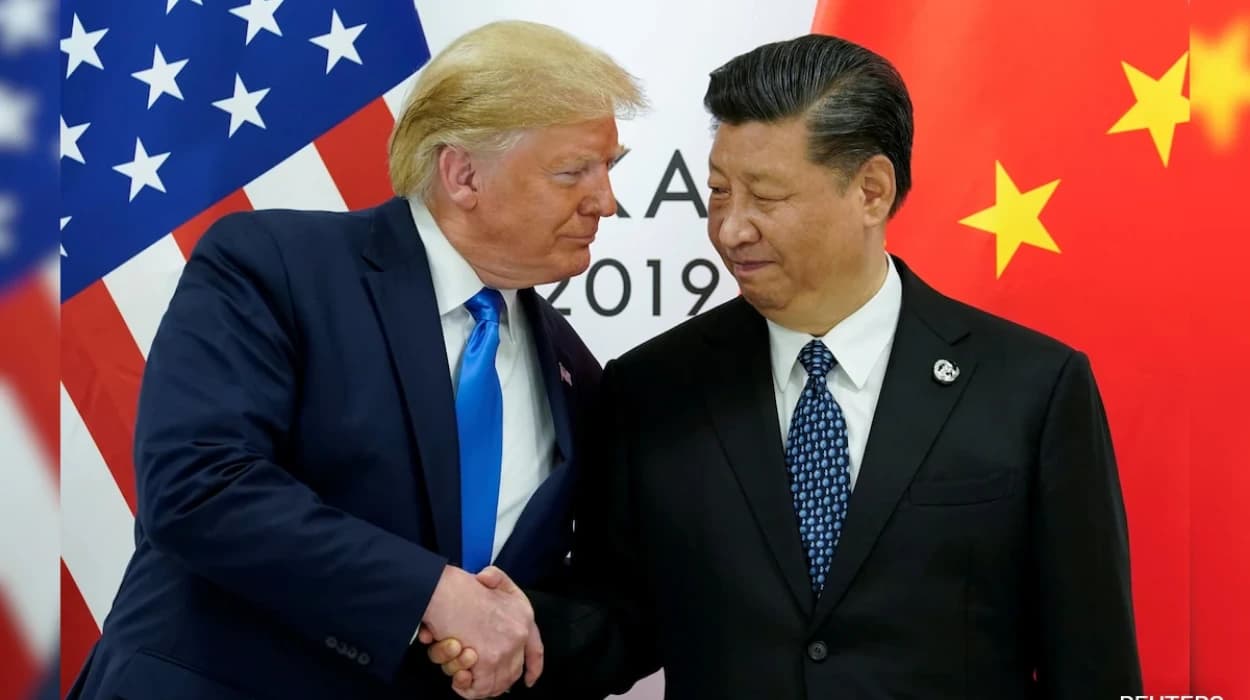
US-China trade tensions saw a recent escalation after China announced tighter export controls on rare earth elements, prompting President Trump to threaten a 100% tariff on Chinese goods effective November 1. However, U.S. Treasury Secretary Scott Bessent confirmed ongoing efforts to de-escalate and announced that Trump is still set to meet Chinese leader Xi Jinping at the Asia-Pacific Economic Cooperation summit in South Korea later this month.
Ongoing Trade Dispute and De-escalation Efforts
As reported by Scott Bessent, U.S. Treasury Secretary, the United States and China have initiated meaningful discussions to reduce trade tensions following China's declaration to tighten export controls on rare earth minerals, which are critical to global high-tech industries. This move by China sparked Trump's announcement of a 100% tariff on Chinese goods starting November 1, coupled with export controls restricting China's access to critical software.
Bessent told Fox Business Network,
"We have significantly de-escalated. President Trump indicated that the tariffs would not be implemented until November 1. He will meet with Party Chair Xi in Korea, and I believe that meeting is still set to proceed"
President Trump reinforced this stance on his social media platform Truth Social, stating,
"Don't worry about China, it will all be fine! Highly respected President Xi just had a bad moment. He doesn't want depression for his country, and neither do I. The U.S.A. wants to help China, not hurt it"
Trump’s Tariff Announcement and Reactions
On Friday prior to the easing signals, President Trump announced a sharp increase in tariffs to 100% on Chinese goods as a response to Beijing's new export controls on rare earth elements. Trump described China's actions as “extraordinarily aggressive” and further accused China of hostile behaviour, citing port fees on U.S. vessels, an antitrust investigation into Qualcomm, and the halt of soybean purchases by China, which have disrupted U.S. farmers.
Despite the firmer rhetoric, Trump later softened his tone in public remarks while en route to the Middle East. He said,
"Nov. 1 is an eternity for me,"
signalling openness to negotiations and acknowledging time to potentially resolve escalating tariff moves .
Impact on Global Markets and Investor Sentiment
Following the tariff announcement and export controls, global markets experienced volatility. U.S. stock markets initially declined sharply but partially recovered after Trump's indication of moderation. According to Henry Allen of Deutsche Bank, Trump's softened stance was perceived as a "consistent brake on policymakers" influenced by market sentiments .
Conversely, Asian markets, including China’s CSI 300 and Shanghai Composite indexes, faced pressure due to increased trade tensions, with investors uncertain about the durability of the recent market rebound.
Continued Negotiations and Prospects for a Meeting
Both countries' officials are scheduled to hold further staff-level discussions in Washington during the World Bank and IMF annual meetings this week. The anticipated Trump-Xi summit during the Asia-Pacific Economic Cooperation forum in South Korea remains planned, a key opportunity for both leaders to potentially ease tensions.
Vice President JD Vance, appearing on Fox News, urged China to
"choose the path of reason"
and suggested the U.S. holds greater leverage in negotiations, reinforcing the administration’s dual approach of firmness backed by readiness for dialogue.
Historical Context and Trade Truce Background
The current disruption follows a trade truce reached in May 2025 where tariffs between the two countries were reduced from prohibitive levels—U.S. tariffs on China lowered from 145% to 30%, and China’s tariffs on the U.S. lowered from 125% to 10%. However, layered tariffs and export controls have kept effective barriers high. Existing restrictions on Chinese imports include bans on semiconductors, design software, and aviation equipment as part of broader U.S. efforts to curb China’s technological advancements.
President Trump publicly accused China of breaching the Geneva agreement related to tariff reductions and critical mineral export relaxations, claims China denied, arguing instead that U.S. restrictions are discriminatory and retaliatory (Reuters: Journalist unnamed).
Trade Controls on Rare Earth Minerals
China’s new export controls announced for effective November 8 include rare earth elements such as holmium, europium, ytterbium, thulium, and erbium—minerals vital to manufacturing in sectors including electronics, electric vehicles, and defence.
The control of rare earth minerals is central to the trade conflict, as both nations depend heavily on these resources for advanced technologies. This confrontation over critical materials has global ramifications, influencing supply chains worldwide.