The United States has warned that Korea targeting false information could undermine tech cooperation and grant authorities sweeping censorship powers.
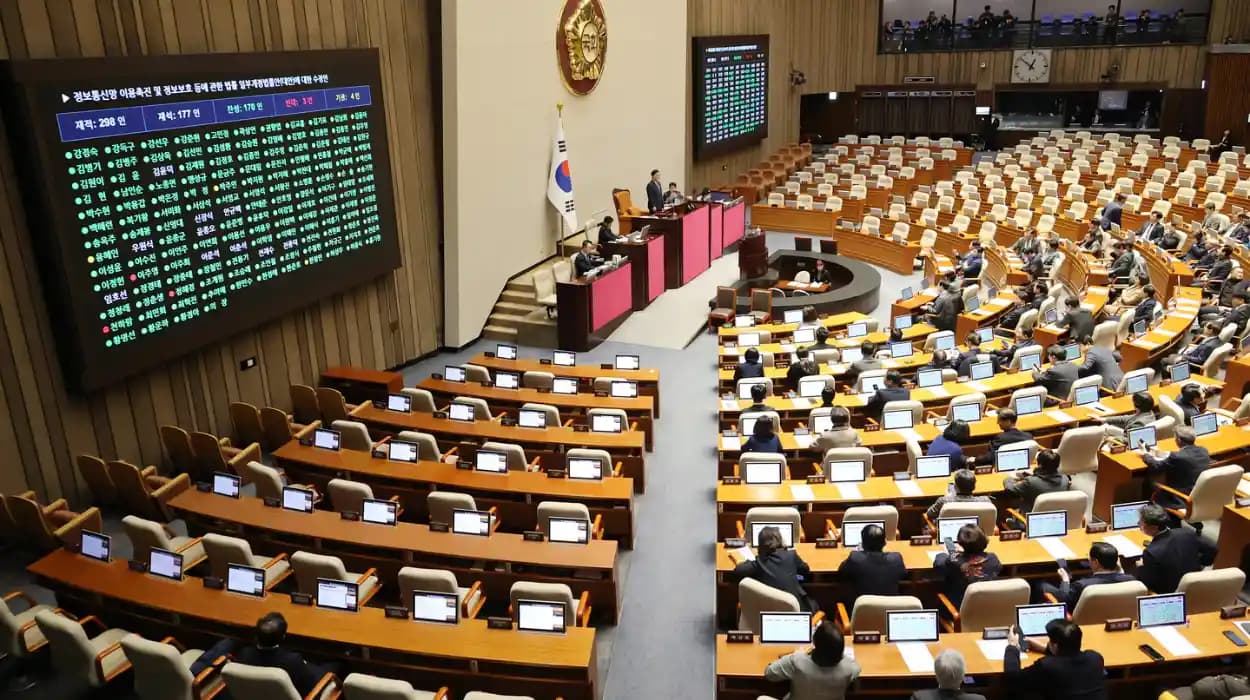
The ruling Democratic Party (DP) led the effort to revise the Act on Promotion of Information and Communications Network Utilization and Information Protection, which was passed by the National Assembly and approved by the Cabinet on December 30.
It is uncommon for Washington to publicly respond right away to a domestic law passed by a close friend; in Korea's case, this is the first time the U.S. government has influenced domestic legislation.
Concerns that the law's definition of "false or manipulated information" is unduly wide or could be applied arbitrarily seem to be reflected in the U.S. response.
"South Korea's proposed amendment to its Network Act, ostensibly focused on redressing defamatory deepfakes,"
wrote
Sarah Rogers, the U.S. undersecretary of state for public diplomacy, on X on
Tuesday.
The law, which is scheduled to go into effect in July of next year, permits judges to award damages of up to five times the actual injury when people deliberately and knowingly disseminate unlawful or misrepresented material. Large platform operators are also able to take a variety of voluntary actions, including removing content, limiting access, suspending accounts, demonetizing, and terminating services.
According to the law, information that is "wholly or partially untrue" is considered false, while information that has been "altered in a way that could mislead audiences into believing it to be factual" is considered manipulated. The U.S. State Department's mention of granting regulators "invasive license for viewpoint-based censorship" echoes critics' concerns that these criteria are unclear and may leave the government or relevant authorities to decide what is true.
Washington's position has garnered more attention in the wake of the United States' decision on December 23 to deny entry to five former senior European Union (EU) officials who were involved in the drafting of significant tech regulations due to concerns about restrictions on free expression. Rogers herself oversaw this decision.
The EU's Digital Services Act (DSA), which was passed in 2022 and permits authorities to fine platforms for failing to stop unlawful content, hate speech, and misinformation, has long been condemned by the US. The blacklisted officials' attempts to "coerce American platforms to censor, demonetize and suppress American viewpoints they oppose" were denounced by U.S. Secretary of State Marco Rubio.
Online platforms based in the United States are also subject to Korea's new regulation. The DSA was specifically mentioned as an example in the original draft, which aimed to
"impose legal obligations on large platforms to ensure rapid responses to illegal and false information."
This strategy, according to analysts, is at odds with Washington's current strategic stance of vigorously opposing foreign rules that would limit American tech companies. Critics caution that if platforms like YouTube, X, or Google are forced by legislation to control content in Korea, it could significantly limit the activities of American businesses.
In order to assist fact-checking operations, the amendment also creates a "Transparency Center" (translated) under the Korea Media and Communications Commission, which opposition parties have denounced as a "government-friendly monitoring body."
In Washington policy circles, such worries seem to be widely acknowledged.
The recent U.S.-Korea joint fact sheet is meant to stop laws and regulations from being used as instruments of market protectionism, an issue that the Trump administration is obviously focused on, according to Victor Cha, a Korean American political scientist and Korea chair at the Center for Strategic and International Studies, who spoke to the JoongAng Ilbo on Wednesday.
Both governments
"commit to ensure that U.S. companies are not discriminated against and do not face unnecessary barriers in terms of laws and policies concerning digital services, including network usage fees and online platform regulations,"
according to the fact sheet published last month in the wake of the Korea-U.S. summits.
Cha's comments imply that the spirit of the agreement might be violated by Korean law.
Additionally, a petition about the law filed by Korean civic organizations is being considered by the UN. The UN special rapporteur on freedom of opinion and expression has been asked to make an urgent plea to the Korean government by a working group of lawyers and activists.
Special rapporteurs may issue a formal letter to Seoul if they find that the concerns are legitimate. A UN envoy made a similar intervention in 2021 amid the dispute around changes to Korea's media arbitration law, which aimed to increase the penalties for media outlets that published false or misleading news reports by five times.
Could the law affect US companies operating in Korea tech partnerships?
South Korea's" False and Manipulated Information Act," passed in December 2025, could indeed impact US companies and tech hookups by assessing forfeitures up to 1 billion won on platforms hosting" illegal" content, potentially targeting AI- generated or disputed information from American enterprises.
US tech titans like Google, Meta, or OpenAI operating in Korea or partnering on AI/ semiconductors face liability for stoner- generated misinformation inciting abomination or violence, with courts suitable to order content junking and the Korea Dispatches Commission levying reprise forfeitures echoing US warnings of suppression nipping invention.
Bilateral tech ties, including common R&D under KORUS FTA, threat dislocation as Washington views the law as anon-tariff hedge favoring Korean/ Chinese platforms; precedents like US pressure on Korea's Online Platform Act show implicit tariffs or controversies if US exports face compliance burdens.