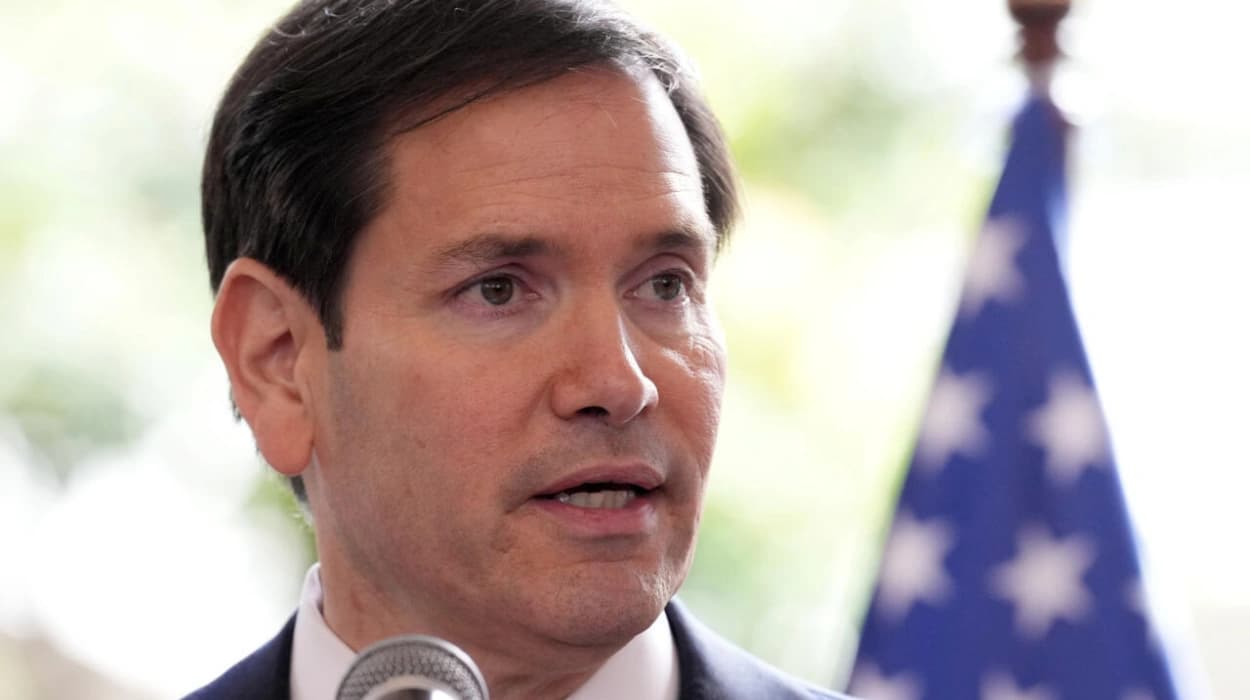
US Secretary of State Marco Rubio will reaffirm strong support for Israel ahead of French-led Palestinian statehood moves, despite tensions over Qatar strike.
Following his mild reprimand of Israel for Tuesday's raid on Hamas in Qatar, a crucial US military and diplomatic ally, President Donald Trump will have dinner with Qatar's prime minister on Friday, the White House announced.
Rubio, however, will depart for Israel on Saturday after having a separate meeting with Sheikh Mohammed bin Abdulrahman Al Thani at the White House.
He will address Israeli officials on "our commitment to fight anti-Israel actions including unilateral recognition of a Palestinian state that rewards Hamas terrorism," according to a statement from the State Department's Tommy Pigott.
On September 22, France will preside over a UN session where several Western nations intend to recognize a Palestinian state centered on the West Bank.
Exasperated by Israel's enormous offensive in Gaza, France has rejected criticism from the US and Israel and asserts that the Palestinians need to find a new way.
On Friday, France, Britain, and Germany also demanded an "immediate" end to a fresh Israeli offensive that intends to take over Gaza City. The Europeans warned of widespread civilian casualties and displacement in an area that is already largely in ruins.
According to the State Department, Rubio would speak with Israel about "operational goals and objectives" and demonstrate "the US commitment to Israeli security."
"He will also emphasize our shared goals: ensuring Hamas never rules over Gaza again and bringing all the hostages home,"
Pigott said, adding that Rubio will meet families of hostages.
The strikes in Qatar, where Israel targeted Hamas leaders meeting to consider a new ceasefire proposal proposed by the Trump administration, were not mentioned in the statement.
Trump referred to the attack as regrettable and claimed that the US learned about it too late to prevent it.
Trump has consistently backed Prime Minister Benjamin Netanyahu, eliminating the majority of the public misgivings, even if they were cautiously voiced, of his predecessor Joe Biden.
Reports that Rubio would participate in the opening of a new tunnel in Jerusalem's Old City for tourists visiting the Temple Mount, the Jewish holiest site and the Muslim holy site known as the Al-Aqsa compound, were not immediately confirmed by the State Department.
"Rubio's visit is nothing less than American recognition of Israeli sovereignty over the most sensitive part of Jerusalem's Holy Basin, contradicting Washington's long-standing position since 1967,"
anti-settlement advocacy group Peace Now said in a statement.
The majority of the world does not recognize Israel's decision to annex East Jerusalem after seizing it during the 1967 war and designating Jerusalem as its undivided capital.
However, Trump defied worldwide opinion during his first term by relocating the US embassy to Jerusalem.
In response to increased Israeli settlement development in the West Bank, the Trump administration has refrained from criticizing it. At a signing ceremony for a large settlement project on Thursday, Netanyahu declared that "this place belongs to us" and that there would be no Palestinian state.
However, following warnings from the United Arab Emirates, which made the historic move of restoring relations with Israel five years ago, Netanyahu has retracted his aspirations for a broad annexation of the West Bank.
How might Rubio's visit affect US relations with Gulf states?
Rubio has taken a hardline position on Iran and is committed to working with Gulf allies like Saudi Arabia, UAE, and Qatar to not only curb Iranian influence but also threats of terrorism. A focus on Iran aligns with the security worrying for many Gulf states, and may promote increased cooperation.
He will likely advocate for U.S.-GCC security relationships to be promoted at a deeper level and could seek to revive stalled normalization discussions between Saudi Arabia and Israel, even though this remains a sensitive issue with Gulf states opposed to sidelining Palestinian statehood.
Any advancement along these fronts, however minor, could lead to paramountly and profoundly improving regional stability for the long-term and U.S.-Gulf relations.