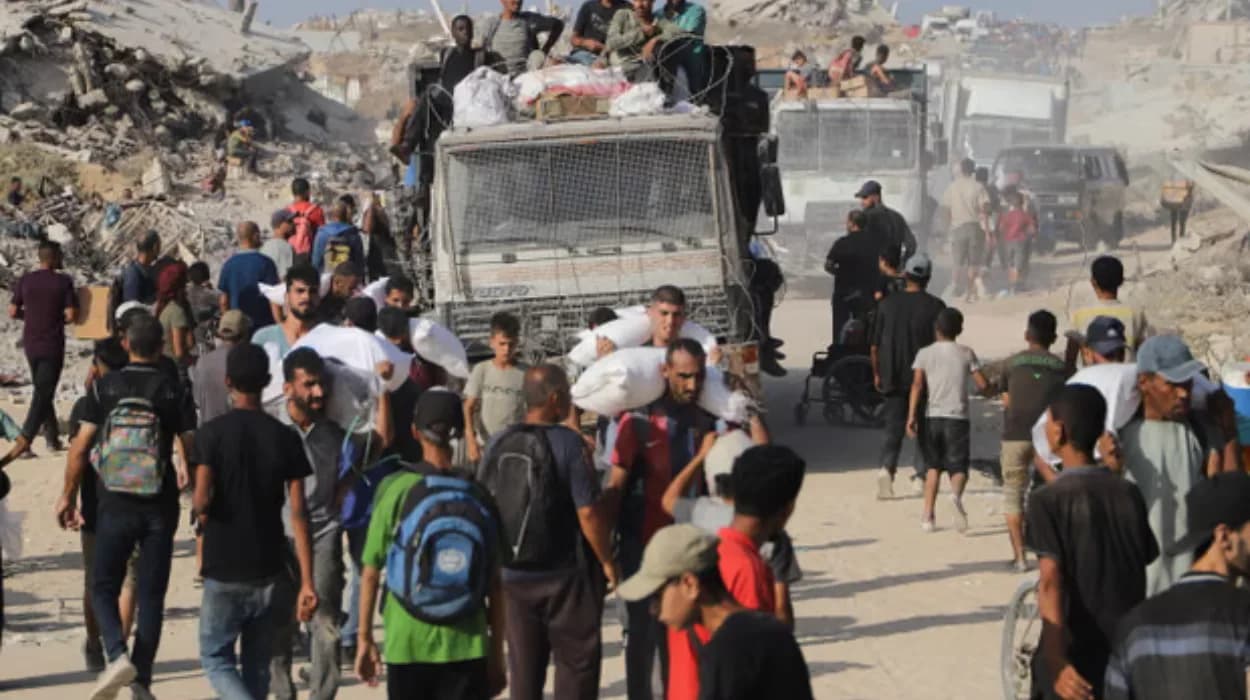
Hamas agrees to a ceasefire deal that includes releasing half of the 20 Israeli hostages, as Gaza's death toll reaches 62,000 over 22 months of war.
The proposed agreement comes after Hamas and Egyptian and Qatari officials have been negotiating in Cairo in recent days. It also comes after Israel's largest protests of the war, which demanded a deal to secure the hostages' release, confronted Israeli Prime Minister Benjamin Netanyahu on Sunday.
Large-scale street protests against Netanyahu's handling of the Gaza war and his inability to obtain the release of the remaining hostages have drawn criticism from Netanyahu, who claims that the protesters are supporting Hamas's negotiating stance.
For their part, the protest organizers have called for more protests this Sunday.
According to Egyptian sources, Hamas' most recent ceasefire proposal for Gaza, which calls for a 60-day halt in military activities, may be a step toward a complete agreement to end the conflict that has lasted for almost two years.
Half of the Israeli captives held in Gaza would be traded for Palestinian inmates during the suspension period.
The indication of progress in the protracted ceasefire talks coincides with Israel's threats to launch a massive new military offensive to seize control of Gaza City, which could force up to one million Palestinians to flee their homes, and Egypt's increased involvement in the talks as a mediator between Hamas and Israel.
Although Netanyahu has stated that Israel is no longer interested in half-hearted agreements and will only agree to stop the war if Hamas releases all of the captives at once, disarms, and permits the demilitarization of Gaza, the plan was supposed to be given to Israel on Monday.
But realistically, the most recent round of negotiations, which are based on a US-proposed framework and, according to Arab mediators, have gone a long way toward resolving earlier Israeli objections, will inevitably exacerbate Israel's already tense political climate, which is marked by sharply widening social and political divides.
Senior security officers have publicly criticized Netanyahu, stating that a fresh offensive to capture Gaza City could endanger the lives of the remaining captives. These concerns have fueled widespread demonstrations.
Due to mounting international criticism over the escalating famine in Gaza, which it is allegedly responsible for, and charges of genocide, the Israeli government's plan to take over Gaza City has caused concern both domestically and internationally.
The prime minister of Qatar, Sheikh Mohammed bin Abdulrahman Al Thani, the head of Egypt's general intelligence service, and leaders of the Palestinian groups in Gaza, who are under pressure to make an agreement, have been involved in ongoing talks in Egypt.
While Netanyahu received the backing of the US president, Donald Trump, on Monday for “confronting and defeating Hamas”, the vast scale of the demonstrations in Israel on Sunday – involving more than 400,000 people – suggested an increasing weariness in the country over the war and fury about missed opportunities to secure the hostages’ release.
In response to the protests, Netanyahu, who is wanted by the international criminal court over allegations of war crimes in Gaza, accused those participating of giving comfort to Hamas.
He said in a statement:
“The people who are calling today for the war’s end without Hamas’s defeat are not only toughening Hamas’s stance and distancing our hostages’ release, they are also ensuring that the atrocities of October 7 will recur time and again, and that our sons and daughters will have to fight time and again in an endless war.
Therefore, in order to advance our hostages’ release and to ensure that Gaza no longer poses a threat to Israel, we have to finish the job and defeat Hamas.”
Placards repeated a sentiment expressed by Goldberg-Polin’s father at his son’s funeral – “May your memory be a revolution” – adapting the familiar Jewish expression of condolence: “May your memory be a blessing.”
Responding to Netanyahu’s remarks, the Hostages and Missing Families Forum lambasted the Israeli prime minister, saying:
“They have been languishing in Gaza for 22 months, on your watch.”
Netanyahu was also fiercely criticised by the leader of the Israeli opposition Democrats party, Yair Golan, as a man who “lies as he breathes”. He said:
“The man who time and again refused to eliminate Hamas’s leaders before October 7, who funnelled hundreds of millions of dollars from Qatar to finance the tunnels and weapons that threaten our hostages.
This is the same Netanyahu who strengthened Hamas back then, and it is he who is strengthening Hamas now as well. Netanyahu doesn’t know how to win and doesn’t want to free the hostages. He needs an eternal war in order to cling to his seat and to escape a commission of inquiry [into the 7 October Hamas attack that triggered the war].”
Thousands of Palestinians have fled their homes in the eastern parts of Gaza City, which are constantly under Israeli bombardment, for locations in the west and south of the broken territory amid the threat of an impending Israeli ground operation.
How does Hamas's proposed deal compare to previous ceasefire proposals?
Like past proposals, the latest deal suggests releasing hostages in phases. This time about half of the roughly 20 remaining Israeli hostages would be freed during a 60-day truce, with the rest to follow as part of wider negotiations. Earlier offers had proposed larger initial releases (e.g., 33 hostages over 42 days) but collapsed over disagreements on conditions.
The current offer is framed as a 60-day temporary ceasefire with ongoing talks for a comprehensive agreement. Previous offers, such as one reported in mid-2024, were structured in three 42-day phases, focusing on hostage releases, prisoner swaps, Israeli withdrawals, and rebuilding Gaza.
This latest proposal includes releasing around 150 Palestinian security prisoners in return for 10 Israeli hostages initially. Earlier deals proposed thousands of Palestinian prisoner releases for a larger batch of hostages but required assurances on security and demilitarization.