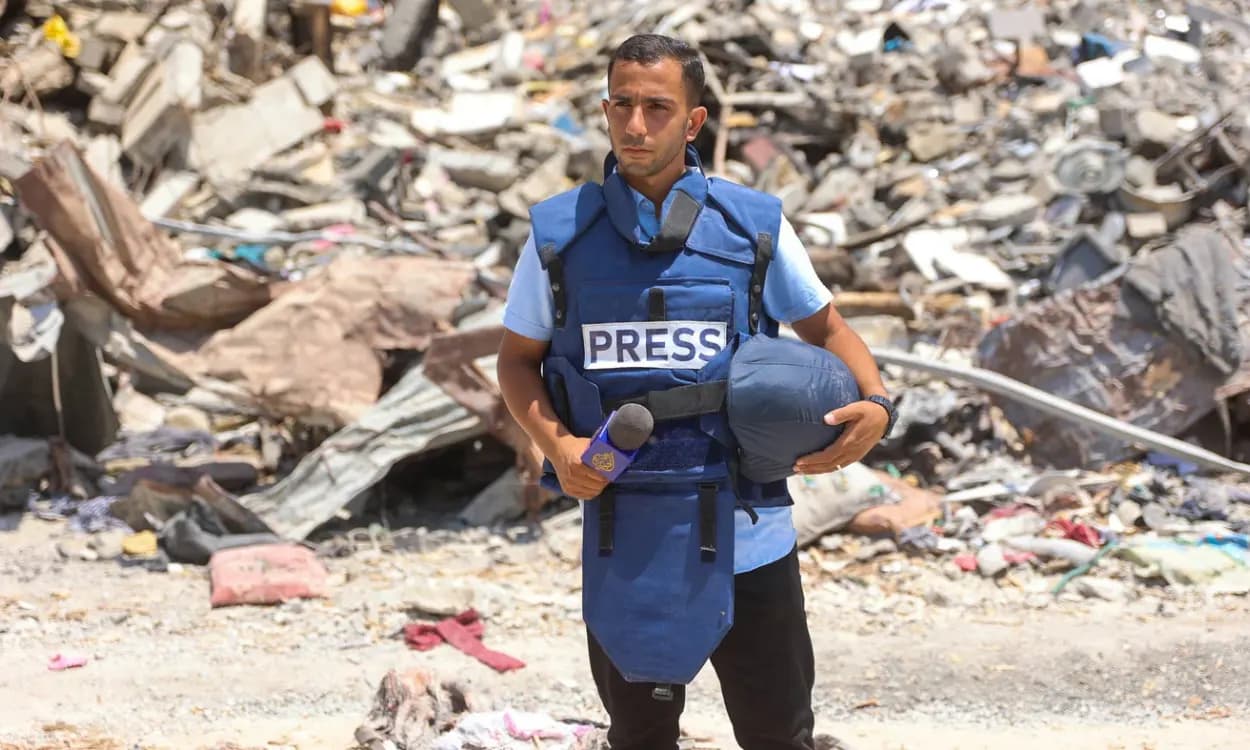
A watchdog report finds Western media helped manufacture consent for Israel’s killing of journalists in Gaza through biased narratives and selective reporting.
The conclusion of the research was that the official media failed to "contextualize the killings within the larger context of the genocide," "centered Israel's narrative," and attempted to "delegitimize pro-Palestinian sources."
In its report, Fair assessed how 15 prominent media outlets, mostly in the United States, covered Israel's targeted killing on August 10 of Al Jazeera journalists Anas al-Sharif, Mohammed Qreiqeh, Mohammed Noufal, and Ibrahim Zaher, as well as freelance journalists Moamen Aliwa and Mohammed al-Khalidi.
They found that "the same Zionist talking points that contributed to manufacturing consent for their killings" were repeated in all 15 news outlets' coverage, particularly accusations that renowned and well-liked journalist Sharif was a Hamas member.
Fair found that they all reiterated Israel's unfounded accusations that Sharif was a Hamas member posing as a journalist, despite the fact that prominent organizations including the UN, the Foreign Press Association, and the Committee to Protect Journalists (CPJ) have determined that this assertion was unfounded.
Even still, Sharif's antemortem statement claiming that Israel had targeted him in preparation for his murder was only published in nine of the 15 outlets.
“If these words reach you, know that Israel has succeeded in killing me and silencing my voice”.
This sentence is part of a much longer statement that was shared on Sharif’s social media accounts after his death.
Additionally, Fair discovered that since the war started on October 7, 2023, Israel has killed around 200 journalists, according to a CJP number, yet only four of the 15 stories published by these sources highlighted this fact. According to statistics, the number of journalists slain could reach 273.
The four magazines were The Wall Street Journal, Politico, CNN, and ABC.
Furthermore, according to Fair, none of the articles published by the 15 outlets indicated that Israeli Prime Minister Benjamin Netanyahu was under arrest for purposefully leading attacks against civilians or that he had been charged with war crimes by the International Criminal Court.
Fair claims on its website that it has been recording allegations of censorship and prejudice in the media since 1986. It claims to examine media practices that marginalize minority, oppositional, and public interest perspectives.
Fair thinks that in order to create independent public broadcasting, support robust non-profit information sources, and dismantle powerful media corporations, structural reform is required.
Days before Israel killed six more Palestinian journalists on Monday, including investigative journalist Hassan Douhan, freelance journalist Moaz Abu Taha, freelance journalist Ahmed Abu Aziz, who also worked with Middle East Eye, freelance journalist Mariam Dagga, who worked with the Associated Press and other media outlets, Reuters photojournalist Hussam al-Masri, freelance journalist Mohamed Salama, who worked with Al Jazeera and Middle East Eye, and freelance journalist Mohamed Salama.
What impact could the watchdog report have on press credibility and media regulations?
Such a report might raise questions among audiences about potential media bias, framing, or selective reporting, potentially eroding public trust in news organizations. It could prompt debates about the fairness, thoroughness, and accountability of news coverage on sensitive conflicts like Gaza.
However, watchdog reports can also motivate media outlets to improve transparency, correct errors, and strengthen editorial standards, which may rebuild or enhance trust over time. The report could stimulate calls from policymakers and media reform advocates for tighter regulations on journalistic ethics, conflict reporting standards, and transparency requirements.
It may lead to increased scrutiny of how media outlets handle issues of conflict sensitivity, misinformation, and propaganda. Regulators might consider measures to ensure balanced coverage and avoid misleading narratives that could influence public opinion or policy unjustly.