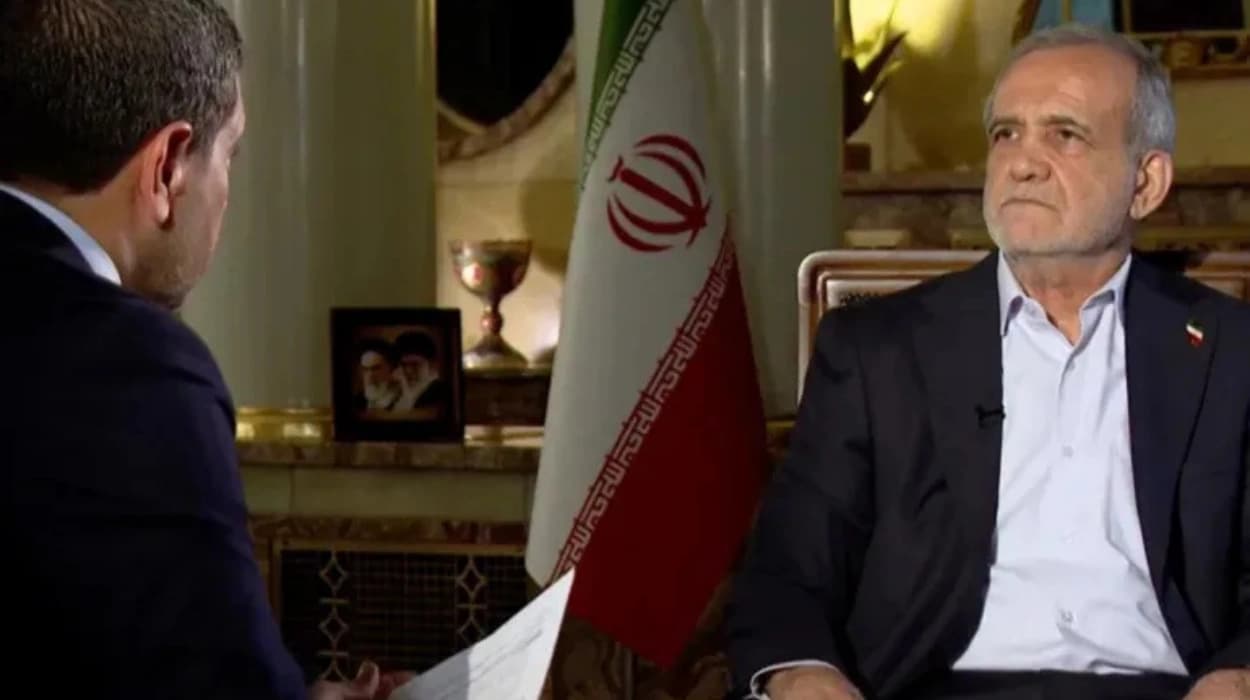
President Masoud Pezeshkian of Iran has declared his nation fully prepared for any new conflict with Israel, stating Iran will not discontinue its nuclear activities regardless of external pressure. In high-profile statements, Pezeshkian rebuffed prospects of long-term ceasefire and reaffirmed Iran’s resolve, quoting both security and diplomatic motives.
What Has President Pezeshkian Stated About Iran’s Readiness for War with Israel?
As reported by Al Jazeera, during an exclusive televised interview on 23 July 2025, President Masoud Pezeshkian openly declared,
“We are completely ready for any fresh military action from Israel, and our forces are prepared to strike deep within Israel once more.”
Al Jazeera noted this
interview as Pezeshkian’s first major appearance after the 12-day Iran-Israel
conflict.
Pezeshkian went further:
“We do not have high hopes for the ceasefire. That is why we have equipped ourselves for every conceivable scenario. Israel has caused us harm, and we have retaliated. They have inflicted significant blows on us, and we have hit them hard as well, but they are hiding their losses.”
In a report for Kayhan, it was noted Pezeshkian expressed,
“We are fully prepared for any new Israeli military move, and our armed forces are ready to strike deep inside Israel again.”
He also outlined doubts regarding Israel’s intent to uphold ceasefire terms and emphasised vigilance regarding all potential responses.
Pezeshkian, speaking to Middle East Eye via Al Jazeera, rejected statements made by US President Donald Trump regarding the presumed end of Iran’s nuclear programme, underscoring,
“The country's nuclear capabilities are in the minds of its scientists and not in the facilities. We reject nuclear weapons and this is our political, religious, humanitarian and strategic position. We believe in diplomacy, so any future negotiations must be according to a win-win logic, and we will not accept threats and dictates.”
How Did the Iran–Israel Conflict Escalate in 2025?
A Twelve-Day War
According to the Wikipedia summary of the recent conflict, the “Twelve-Day War” erupted on 13 June 2025 when Israel launched a surprise attack against Iranian military and nuclear targets. Israeli air and ground forces carried out extensive missile and air strikes, resulting in assassinations of Iranian commanders and scientists. Iran responded with over 550 ballistic missiles and 1,000 suicide drones against Israeli territory, while its regional allies also targeted Israel.
The United States joined hostilities on the ninth day by striking three Iranian nuclear sites. Satellite imagery and subsequent Iranian admissions indicate substantial damage was inflicted. However, reports from the Associated Press and Iranian officials challenge claims that Iran’s nuclear capacity was “totally obliterated,” suggesting only temporary setbacks.
As reported by Anadolu Agency, Pezeshkian insisted that
“under the current circumstances, lasting peace will only be possible if the Zionist enemy ceases its hostilities and provides firm guarantees to end its terrorist provocations. Failure to do so would result in a far more forceful and regrettable response from Iran,”
highlighting the severe toll the violence took on both sides.
What Is the Status and Future of Iran’s Nuclear Programme?
Determined Continuation Despite Attacks
As detailed in a UK Parliament briefing, since 2019 Iran has significantly exceeded the enrichment regimes set out in the 2015 nuclear deal (JCPOA), now enriching uranium to 60% – well above levels needed for civilian use. The International Atomic Energy Agency (IAEA) found Iran non-compliant with safeguards, with the country having enough highly enriched uranium for several nuclear devices, should it choose to pursue weaponisation, although there is no evidence of such a move so far.
Following strikes on its nuclear facilities, Iran’s atomic chief Mohammad Eslami stated via Al Jazeera,
“preparations for recovery were already in place, and our strategy is to ensure uninterrupted production or services.”
Ayatollah Ali Khamenei added,
“the assault did not cause any significant harm”
and that nuclear activities will continue. Analyses from the Arms Control Association and further reporting by Al Jazeera suggest that while the strikes “set the programme back by months,” Iran’s resolve to maintain and rebuild its nuclear activity remains firm.
Has Pezeshkian Provided Conditions for Peace?
In an Anadolu Agency statement on 20 June 2025, President Pezeshkian specified that
“ending the current war depends on Israel ceasing its airstrikes unconditionally.” He insisted, “We have always pursued peace and stability,”
but warned,
“failure to do so would result in a far more forceful and regrettable response from Iran.”
When questioned by Iran International about regional peace, Pezeshkian argued,
“We are prepared to give up all our weapons, provided Israel also disarms, and an international organization steps in to ensure compliance.”
Yet, he accused Israel of escalating threats in Gaza and Lebanon and reiterated that Iran’s policy is fundamentally defensive.
What Was the Result of the 2025 Ceasefire and Will It Hold?
The ceasefire, agreed under US mediation on 24 June 2025, remains tenuous. According to the Times of Israel, Pezeshkian said Iran would “respect a ceasefire if Israel does,” making reciprocation a key requirement. Despite the ceasefire, missile exchanges and isolated strikes have continued, with both sides accusing the other of violations.
What Are the Current Assessments of the Nuclear Programme’s Capabilities and International Oversight?
Reports from Arms Control Association and the UK
Parliament’s Commons Library highlight that while the Fordow and Natanz
enrichment sites were targeted, Iran managed to relocate enriched uranium
beforehand, and international inspectors have yet to fully assess damages.
The IAEA’s Rafael Mariano Grossi signalled that inspections would
“continue as soon as safety conditions allow,”
expressing concern over 60% enrichment and the stockpile well above JCPOA thresholds. Nonetheless, Iran insists its nuclear policy is driven by peaceful intent and national rights under the Nuclear Non-Proliferation Treaty (NPT).
What Is the Human and Regional Cost of Recent Hostilities?
The conflict’s toll has been grave. Anadolu Agency
documented that at least 639 Iranians and more than 25 Israelis were killed,
with many hundreds injured on both sides due to missile and air raids.
Civilian infrastructure, including research and health facilities in Iran, and
several Israeli urban regions, saw extensive damage. Protests erupted across
Tehran against both Israeli and US actions, which included rare public
participation by President Pezeshkian himself.
How Are International Players and Diplomatic Efforts Evolving?
The Commons Library briefing notes that E3 (UK, France,
Germany), Russia, China, and the US have all engaged with Iran in separate
negotiations, though the US has now adopted a firmer posture following attacks
on Iranian nuclear sites. Talks in Oman between Iran and the US—brokered by the
Gulf states—were derailed by the escalation in hostilities.
According to Iran International, Pezeshkian also accused Israel of deliberately
drawing Iran into a major regional war, especially after a series of
assassinations within Iran’s borders, which he promised would “not go
unanswered”.
The situation remains volatile, and Western diplomatic sources indicate little
progress is likely while both parties perceive existential threats and continue
military posturing.
President Masoud Pezeshkian’s statements to Al Jazeera and other outlets represent Iran’s deliberate signalling: readiness for renewed conflict, refusal to halt nuclear development, and non-negotiable conditions for peace. The international community remains divided, and recent warfare has only deepened mutual mistrust.
Iran’s nuclear ambitions and its confrontation with Israel mark a critical juncture in Middle Eastern security. Pezeshkian’s unapologetic posture and the country’s rapid nuclear recovery efforts point to a prolonged stand-off, with direct ramifications for regional and global stability.