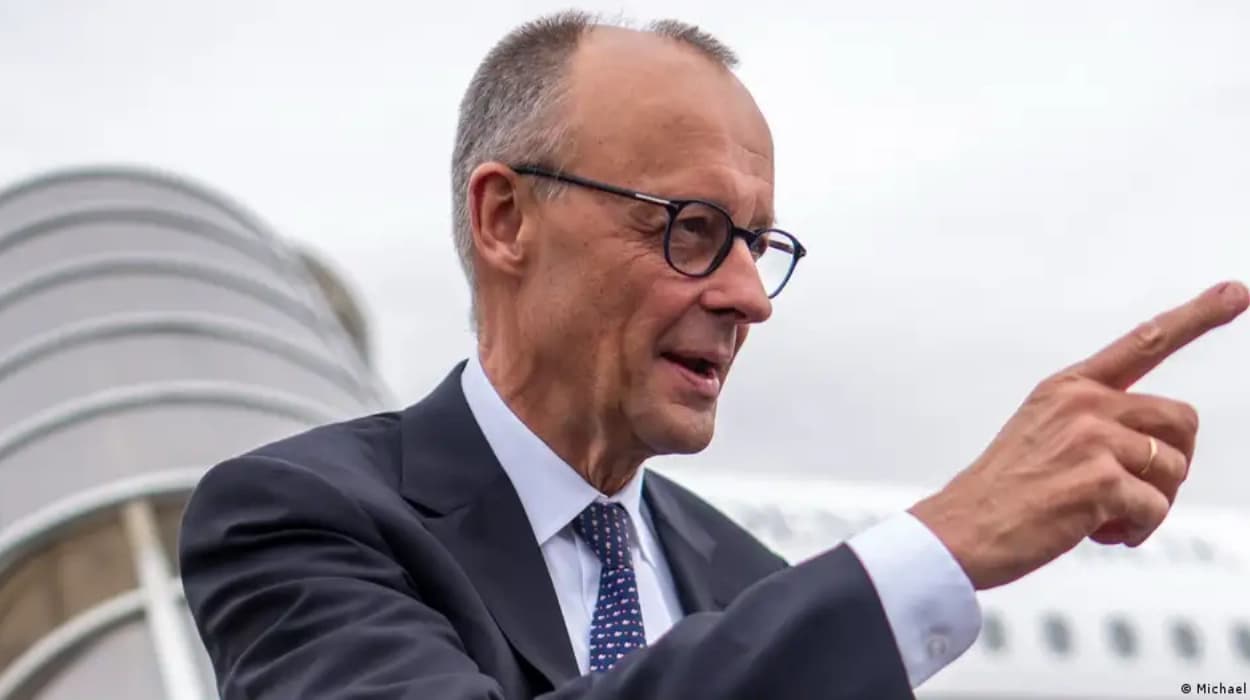
Berlin (The Palestine Telegraph Newspaper) February 05, 2026 – German Chancellor Friedrich Merz has pledged to relax military export restrictions and deepen defence cooperation with Gulf states including Saudi Arabia, Qatar and the United Arab Emirates during a three-day regional tour. Speaking in Doha, Merz described the partnerships as essential for mutual security and economic diversification amid transatlantic uncertainties. He committed to more intensive arms collaboration with reliable Gulf partners while maintaining case-by-case export scrutiny. The initiative accompanies efforts to increase liquefied natural gas imports and strengthen bilateral trade.
Merz outlined the policy shift during a press conference in Qatar's capital following meetings with Emir Sheikh Tamim bin Hamad Al Thani. He visited Saudi Arabia on Wednesday and travelled onward to Abu Dhabi, accompanied by executives from Uniper and Diehl Defence. The chancellor emphasised that Germany identifies Gulf monarchies as dependable partners capable of contributing to global stability through enhanced defence ties. Current German exports to the region total €12 billion since 2015, covering tanks, missiles and submarines.
Media reports captured Merz's specific commitments on export policy changes.
Arne Delfs - @ArneDelfs said in X post,
"German Chancellor Friedrich Merz vowed to relax military export restrictions to entice more business from Gulf countries like Saudi Arabia and Qatar."
Merz's Gulf tour itinerary and key meetings
Merz began the trip in Riyadh on February 4, meeting Saudi Crown Prince Mohammed bin Salman to discuss defence industrial cooperation and energy supplies. Conversations covered expanding Eurofighter Typhoon deliveries and joint Patriot missile production. The chancellor then proceeded to Doha for talks with Qatar's leadership, focusing on Leopard tank maintenance hubs and IRIS-T air defence systems.
In Abu Dhabi, Merz met UAE National Security Adviser Sheikh Tahnoun bin Zayed, prioritising submarine technology transfers and corvette construction. He extended invitations for official visits to Berlin, including Qatar's emir in July 2026. Each stop included business delegations seeking contracts in energy infrastructure and military logistics.
Germany exported €4.1 billion in arms to Gulf Cooperation Council states in 2025, with Saudi Arabia receiving €1.8 billion and the UAE €1.2 billion. Qatar operates 400 Leopard 2A7 tanks, the largest non-NATO fleet.
Proposed areas of defence industrial collaboration
Merz specified co-production of Patriot interceptors in Saudi facilities, corvette fleets assembled in UAE shipyards and drone manufacturing with Qatar. German training teams would deploy to Gulf bases supporting Leopard 2 and PzH 2000 operations. Technology transfer agreements enable local maintenance, reducing reliance on European contractors.
Rheinmetall seeks €20 billion in contracts over the next decade for tank upgrades and ammunition. ThyssenKrupp Marine Systems pursues submarine programmes funded by Emirati and Saudi partners. Diehl Defence expands IRIS-T deliveries protecting regional infrastructure from Houthi drones.
Offset requirements mandate 60% local content, creating factories for truck chassis and missile components. Gulf sovereign wealth funds propose €50 billion investments in German defence firms, though national security reviews limit equity stakes.

Germany's existing military export framework to Gulf
The War Weapons Control Act governs sales through Federal Security Council approvals. End-user certificates prevent third-party transfers, verified annually. Yemen operations prompted 2015 Saudi restrictions, lifted in 2019 after humanitarian compliance confirmation.
Current licences cover spare parts, ammunition and training for delivered platforms. Rheinmetall maintains Riyadh hubs servicing 1,200 Leopard systems. ThyssenKrupp embeds Emirati engineers in Kiel shipyards building Type 209 submarines.
Economy Ministry approved €429 million in new licences January 2026, including frigate radars and tank transporters. Cluster munitions and white phosphorus applications faced denial.
Strategic rationale for deepened Gulf partnerships
Merz positioned cooperation as response to Russia's Ukraine invasion, Red Sea Houthi attacks and Iran's nuclear threshold status. Gulf states diversify from US suppliers facing F-35 delays and THAAD backlogs. President Trump's Gulf force withdrawal threats accelerate European alternatives.
CDU manifesto targets €500 billion European Defence Union by 2035, integrating Gulf capital. Saudi Vision 2030 seeks 70% local production, negotiating offsets for SAMI factories assembling Leopard components. UAE pursues nuclear submarines via German designs complementing French Rafales.
Qatar hosts largest German-trained Arab tank brigade, conducting Grafenwoehr exercises with US Marines. Oman negotiates Eurocopter Tigers replacing British teams.
Economic dimensions beyond defence cooperation
Merz seeks increased Qatari LNG imports beyond 2 million tons annually, ensuring supply security. Germany reduces US and Russian energy dependence through long-term Gulf contracts. Qatar holds stakes in Volkswagen, RWE and Hapag-Lloyd.
Business delegations pursue €30 billion in infrastructure deals. Uniper negotiates gas turbine contracts; Siemens targets desalination plants. Merz's China visit later February complements Gulf diversification.

Reactions from German coalition partners and opposition
Chancellor Scholz reaffirmed arms exports to crisis regions require Bundestag approval and human rights vetting. SPD supports pragmatic partnerships with Gulf modernisers. Greens demand non-proliferation clauses barring technology transfers to Iran or Houthis. FDP credits exports for preserving 50,000 jobs.
Bundestag Defence Committee schedules March hearings inviting Gulf ambassadors. Die Linke opposes sales citing Yemen casualties.
Gulf leadership responses to Merz's overtures
Saudi Defence Minister Prince Khalid bin Salman signed letters of intent for corvettes during January 28 Berlin talks. UAE's Sheikh Tahnoun prioritised submarine designs. Qatari Emir Tamim committed $3 billion for 100 PzH 2000 howitzers.
Oman seeks attack helicopters with German instructors. Bahrain negotiates Eurofighters with simulators.
US perspective on European-Gulf defence integration
Defence Secretary Pete Hegseth described partnerships complementing American commitments. Jordan exercises integrate Saudi Leopards with US Abrams. Trump approved F-35 Gulf sales conditional on German missile integration.
Training and maintenance infrastructure in Gulf
Germany stations 120 instructors across bases, rotating from Munster. Qatar's brigade qualifies 800 drivers at Bergen-Hohne. Saudi crews train annually in Wildflecken.
Rheinmetall's Riyadh hub services region-wide. UAE operates IRIS-T command protecting Dubai ports.

Historical context of German-Gulf military relations
Leopard deliveries to Saudi Arabia began 1993 post-Gulf War. Qatar purchased 400 tanks post-2017 blockade. UAE submarine programme launched 2007, first boat delivered 2024.
2018 Der Spiegel revelations prompted Saudi scrutiny; Federal Court upheld licences 2020 citing national interest.
Merz's electoral positioning and polling lead
CDU leads Scholz coalition by 16 points ahead of February 27 elections. Gulf initiative targets eastern industrial states. Manifesto projects €80 billion revenue funding 100,000 jobs.
Scholz emphasises responsible partnerships versus Merz's approach. Surveys show 62% public support for employment-generating exports.
Human rights considerations in export policy
Merz acknowledged improvements in Saudi women's rights while noting further progress required. Government notes reform trajectory alongside case-by-case assessments. Qatar and UAE face no current export bans.
Discussions address regional stability, Israel normalisation and Iran de-escalation. Merz demands Tehran halt domestic violence, nuclear ambitions and destabilising activities.
Innovation contributions from Gulf partnerships
Saudi funds Rheinmetall tank simulators training 2,000 officers yearly. UAE co-develops quantum radar sharing desert data. Qatar invests €400 million in Fraunhofer AI for Leopard systems.