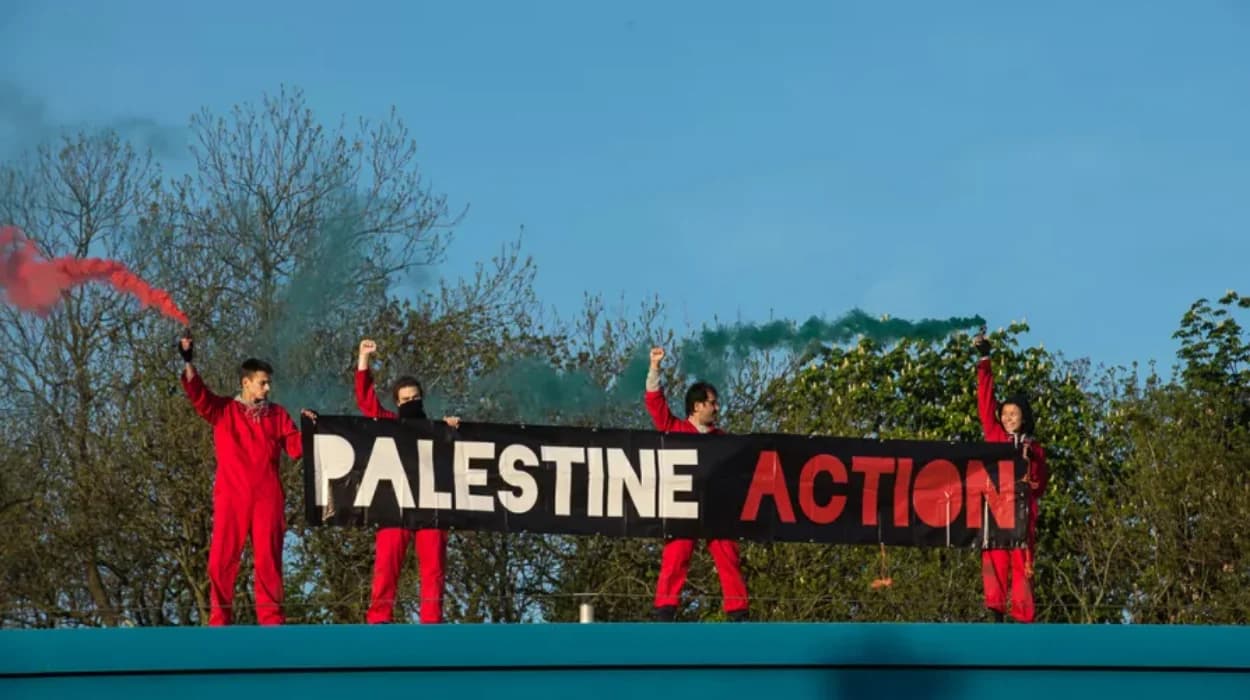
London (The Palestine Telegraph Newspaper) - Six activists from the British group Palestine Action have been acquitted of aggravated burglary over a 2024 break‑in at an Israeli defence company’s UK factory, a verdict that has drawn sharp criticism from senior British Jewish organisations and prompted Conservative calls for a retrial. A jury at Woolwich Crown Court in London on Wednesday found the defendants not guilty of the most serious charge relating to the raid on Elbit Systems UK’s site in Filton, near Bristol, while failing to reach verdicts on counts of criminal damage and some violent disorder allegations. The six, dubbed the “Filton 6” by supporters, were granted bail as prosecutors consider whether to seek a fresh trial on the unresolved charges. Elbit Systems UK and Jewish communal bodies said the outcome risked encouraging further attacks on sites linked to Israel.
The defendants – Charlotte Head, 29, Samuel Corner, 23, Leona Kamio, 30, Fatema Zainab Rajwani, 21, Zoe Rogers, 22, and Jordan Devlin, 31 – had all denied aggravated burglary over the incident at the Elbit‑owned factory in the early hours of 6 August 2024. Prosecutors alleged they were part of a larger group who used a former prison van to ram the perimeter gate, then entered the site armed with sledgehammers, causing extensive damage to buildings and equipment. Palestine Action says the plant manufactures components for Israeli military systems, a claim the company disputes. The raid took place around 10 months into the Gaza war triggered by the Hamas‑led attack on Israel in October 2023.
Jury acquittals and outstanding charges in Elbit case
After a trial that began in November 2025, the jury deliberated for more than 36 hours before acquitting all six defendants of aggravated burglary. Rajwani, Rogers and Devlin were also found not guilty of violent disorder, while the jury could not reach verdicts on violent disorder charges against Head, Corner and Kamio. Jurors were similarly unable to agree on a separate count of criminal damage brought against all six.
Corner faced an additional charge of causing grievous bodily harm with intent, after prosecutors said police body‑worn camera footage showed a female sergeant being struck in the back with a sledgehammer during the raid, resulting in a fractured spine. The jury was unable to reach a verdict on that allegation either. Judge Jeremy Johnson told the jury that the government’s decision in July 2025 to proscribe Palestine Action as a terrorist organisation under the Terrorism Act was irrelevant to their task, instructing them to decide the case solely on the evidence.
Following the verdicts, the defendants embraced in the dock and waved to supporters in the public gallery, who responded with loud cheers after the judge left court. Outside, families and campaigners described the acquittals on aggravated burglary as a “historic triumph”, while acknowledging that some charges remain unresolved.
Details of the Elbit Systems Filton factory raid
Prosecutors told the court that, shortly after 3am on 6 August 2024, the activists drove a white former prison van into the gates of the Elbit Systems UK facility at Filton, near Bristol, to gain entry. Once inside, members of the group allegedly used sledgehammers to smash windows, control panels and other equipment, and sprayed red paint on parts of the factory in an attempt to disrupt operations. The Crown said the damage totalled about £1 million, with further financial losses arising from the temporary halt in production.

Elbit Systems UK is a subsidiary of Israel’s largest defence contractor, Elbit Systems, and supplies technology including drone components and other systems used by the Israeli military. The Filton site sits near key aerospace facilities in south‑west England. Palestine Action argues that such factories play a direct role in the Gaza conflict by producing equipment used in Israeli operations, and has carried out a series of direct actions against Elbit‑linked sites since 2020.
Activists’ defence and claims about intent
During the trial, the defendants did not dispute that they were involved in the incursion but argued that they acted to prevent what they described as serious violations of international law in Gaza. They told the court they had targeted property rather than people and denied any intention to cause harm to individuals. In relation to the confrontation with security and police, defence lawyers said that any force used was in self‑defence after guards escalated the situation, a characterisation prosecutors rejected.
In media statements and campaign materials cited in court, Palestine Action has maintained that its aim is to shut down what it calls “complicity in war crimes” by disrupting operations at sites linked to Israel’s military supply chain. Elbit Systems insists that its UK operations comply with all applicable laws and export controls and denies producing weapons used in violations of international law.
Conservative calls for retrial after jury deadlock
Because the jury could not reach verdicts on several counts, including criminal damage and violent disorder for some defendants, prosecutors told the court they would take time to consider whether to seek a retrial on those outstanding charges. The prospect of further proceedings has already become a political issue, with senior Conservatives urging the Crown Prosecution Service to pursue a new trial.
Highlighting the opposition response, a senior security correspondent reported on Conservative demands on social media.
Charles Hymas - @charleshymas said in X post,
“The Tories have called for a retrial of Palestine Action activists acquitted of a raid on an Israeli defence company’s British factory
@CPhilpOfficial
@ShabanaMahmood
@DavidLammy
@DanJarvisMBE
@FightExtremism
@gwupoe
@CommissionCE
@PoliceInspForum
@NotThatBigIan
@PSCupdates
Conservative front‑benchers have framed the case as a test of the justice system’s response to what they describe as organised attacks on critical infrastructure and businesses linked to Britain’s defence and foreign policy. They argue that failing to retry the unresolved counts could embolden copycat actions.
Criticism from British Jewish organisations and leaders
The verdict has been met with concern by major Jewish communal bodies in the UK. The Board of Deputies of British Jews said it was “concerned by the troubling verdicts acquitting members of Palestine Action”, arguing that the group had “targeted businesses linked to the Jewish community in London and Manchester”. The organisation called for a retrial on the charges where the jury was unable to reach a decision.
Community Security Trust, which monitors antisemitic incidents, and other communal leaders also criticised the acquittals, warning that they could be interpreted as a licence to carry out further direct actions against sites associated with Israel. Jewish leaders pointed to previous Palestine Action campaigns that targeted premises in areas with significant Jewish populations and urged authorities to ensure that such protests do not escalate into intimidation.
Supporters and campaign groups hail verdict as “victory”
Campaigners backing the defendants welcomed the jury’s decision on aggravated burglary as a significant moment for protest‑related cases. Defend Our Juries, a group that has organised solidarity actions outside courts, said the verdicts “put to bed the deceitful accusations from ministers that these brave activists are ‘violent criminals’”. Families of the defendants described the outcome as a “historic triumph” and highlighted the lengthy periods some of the activists spent in custody before trial.

Six Palestine Action members linked to the case were among a broader group of 24 activists arrested over Elbit‑related actions, with some having spent more than a year on remand. Campaigners and human rights organisations have used the case to criticise the government’s broader approach to pro‑Palestinian protests under Prime Minister Keir Starmer, accusing authorities of heavy‑handed policing and over‑charging demonstrators.
Legal significance and terrorism designation background
The acquittals come less than a year after the UK government proscribed Palestine Action as a terrorist organisation in July 2025, following an incident in which activists entered a Royal Air Force base and spray‑painted two aircraft. The designation under the Terrorism Act made it a criminal offence to belong to, support or publicly endorse the group. That ban is now subject to a separate legal challenge at London’s High Court.
In his directions to the jury, Judge Johnson stressed that the proscription of Palestine Action was legally irrelevant to their deliberations in the Filton case and that they must not allow external views on the group or the Gaza war to influence their assessment of the evidence. Legal commentators have noted that the outcome may be cited in future trials involving activists charged in connection with direct action against defence or fossil fuel infrastructure, though each case will turn on its specific facts and evidence.
Possible next steps for prosecutors and defendants
With the aggravated burglary charges resolved in favour of the defendants and several other counts left undecided, the Crown Prosecution Service must now decide whether to seek a retrial on the unresolved allegations. Prosecutors told the court on Wednesday they needed time to consider that question in light of the jury’s split decisions.
In the meantime, five of the activists have been released on bail. Any retrial would focus on the outstanding counts of violent disorder, criminal damage and grievous bodily harm, and would likely revisit evidence such as CCTV footage, police body‑cam recordings and witness testimony regarding the events inside the factory. Elbit Systems UK has said it will continue cooperating with investigators and has reiterated that its operations comply with UK law and export regulations.
Wider context of protest, policing and arms exports
The Filton case forms part of a broader debate in the UK over the limits of protest, policing tactics and the regulation of arms exports to conflict zones. Since the start of the Israel‑Hamas war in October 2023, pro‑Palestinian demonstrations and direct actions have increased, including marches, sit‑ins and targeted protests at corporate sites. Human rights groups have documented concerns about restrictions on protest, while ministers argue that new powers are needed to prevent serious disruption.
Elbit Systems and its subsidiaries have been a recurring focus of campaigns by Palestine Action and other groups, which argue that UK‑linked production contributes to Israel’s military operations in Gaza and the West Bank. The government says all defence exports are assessed against its Strategic Export Licensing Criteria, including the risk that items could be used in serious violations of international humanitarian law. The outcome of the Filton trial, and any decision on a retrial, is therefore being closely watched by activists, industry and community organisations as they assess the future of both direct action and state responses in this area.