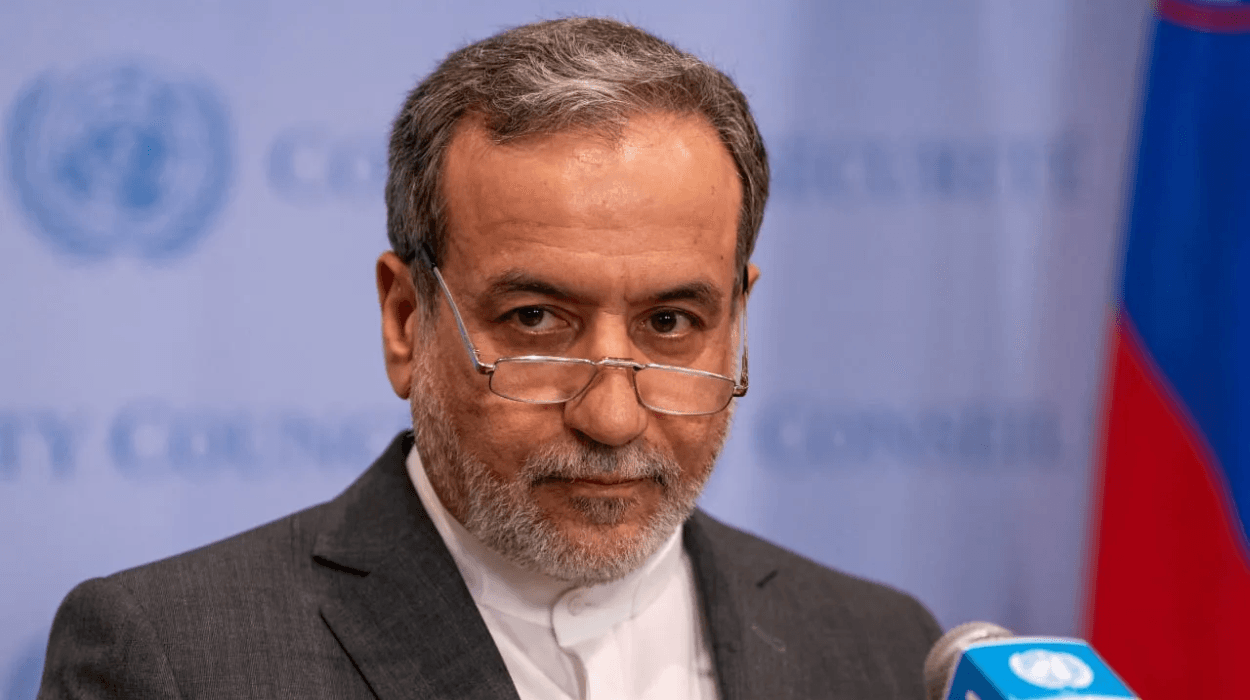
Tehran (The Palestine Telegraph Newspaper) February 07, 2026 – Iran’s Foreign Minister Abbas Araghchi has accused Israel of pursuing an “expansionist project” that he says depends on neighbouring countries being weakened militarily, technologically, economically, and socially to preserve Israel’s strategic dominance. Speaking at the Al Jazeera Forum in Doha, he argued that Israel is allowed to expand its military arsenal without limits, including what he described as weapons of mass destruction, while regional states face pressure to disarm and curb defensive capabilities.
His remarks came as diplomatic efforts continue over Iran’s nuclear programme and regional security, following renewed contacts with the United States and discussions with neighbouring countries about preventing their territory being used in any potential conflict. Israeli officials have long maintained that they must retain a qualitative military edge to defend against regional threats, but did not immediately comment on Araghchi’s latest accusations in the reports surveyed.
Araghchi’s central claims on Israel’s regional strategy
In his address at the Al Jazeera Forum in Doha, Araghchi characterised Israel as an “expansionist project” that, he argued, “requires that neighbouring countries be weakened: militarily, technologically, economically and socially.” He said this structure ensures that “the Israeli regime permanently enjoys the upper hand” by maintaining a persistent imbalance in power and capabilities across the region.
His core allegation was widely picked up by international media and shared on social platforms, including by Israeli and Iranian official or institutional accounts amplifying his quoted remarks. The Jerusalem Post summarised his core accusation in a post highlighting his characterisation of Israel’s project and the scope of weakening he alleged.
The Jerusalem Post (@Jerusalem_Post) said in X post,
“Iranian Foreign Minister Abbas Araghchi accused Israel of being an "expansionist project" that requires "neighboring countries to be weakened militarily, technologically, economically, and socially."
@Tobiholc”
According to detailed accounts of the speech, Araghchi argued that under what he called a “doctrine of domination,” Israel is “free to expand its military arsenal without limits,” including weapons of mass destruction that he claimed lie outside international inspection regimes. He contrasted this with policies he said are imposed on regional states, asserting that “other countries are demanded to disarm,” are pressured to reduce their defensive capacities, and “punished for scientific progress.”
Reports noted that Araghchi presented these arguments as part of a broader criticism of what he sees as unequal international standards on armaments and security arrangements in the Middle East. He framed Israel’s posture as a central factor in what he described as structural instability affecting neighbouring countries’ security and development.
Context of forum speech and timing of remarks
News outlets reported that Araghchi made the comments on Saturday during a session of the Al Jazeera Forum in Doha, Qatar, a platform that regularly hosts regional political figures and analysts. His remarks came a day after renewed nuclear talks with the United States in Muscat, although several reports noted that he did not explicitly reference those talks in his Doha speech.

Saudi-owned Asharq Al-Awsat and other outlets reported that Araghchi’s appearance in Doha followed indirect discussions with US Middle East envoy Steve Witkoff, described by him as a “good start” focused solely on the nuclear issue. In that context, he reiterated that Iran was ready to reach an agreement on uranium enrichment but insisted that enrichment could not be reduced to zero, citing national needs and describing Iran’s missile programme as a non‑negotiable “defence” matter.
Regional and international sources have previously noted that Araghchi has been positioning himself as a central figure in Iran’s diplomatic outreach since becoming foreign minister under President Masud Pezeshkian in 2024. Radio Free Europe/Radio Liberty and the Stimson Center have described him as an experienced diplomat and veteran nuclear negotiator, highlighting his roles in past talks with world powers and his standing in Iran’s political system.
Structural inequality and “doctrine of domination” claims
In elaborating his accusation of “permanent inequality,” Araghchi argued that Israel’s position in the region is built on a sustained effort to keep neighbouring states vulnerable across key sectors. He said the alleged strategy covers conventional military power, technological development, economic resilience, and social stability, and asserted that it is reinforced by sanctions and arms‑control policies directed at regional rivals, including Iran.
He cited punitive measures against Iran’s missile and nuclear programmes as evidence that, in his view, the objective is not non‑proliferation but the maintenance of Israels military superiority. Khaleej Times, citing an AFP report, quoted him describing this framework as a “doctrine of domination” that allows Israel to expand its arsenal while others are “pressured to reduce defensive capacity” and “punished for scientific progress.”
Iran’s diplomatic missions also echoed his central message in public communications, underscoring Tehran’s emphasis on the structural dimension of his critique. The Iranian Embassy in Austria was among those that highlighted his exact wording about Israel’s alleged need for weakened neighbouring states.
IRAN Embassy in Austria (@IraninAustria) said in X post,
“#Iran’s FM Abbas #Araghchi: #Israel’s expansionist project requires that neighboring countries be weakened, militarily, technologically, economically, and socially, so that the Israeli regime permanently enjoys the upper hand.”
One regional analysis outlet that reported on the same Doha speech said Araghchi accused Israel of openly violating borders, undermining national sovereignty, assassinating officials, conducting operations he described as terrorist, and expanding its military and intelligence reach across multiple fronts. These specific operational claims were reported as his assertions and were presented by that outlet as part of his broader argument about what he called systemic destabilisation.
Links to Gaza, the West Bank and “Greater Israel” narrative
The WANA news agency, which carried an extended account of Araghchi’s Doha remarks, reported that he linked his critique of Israel’s regional policies to the ongoing conflict in Gaza and conditions in the occupied West Bank. According to that report, he warned that if Gaza is “resolved” through destruction and forced displacement of Palestinians, a similar model could be applied in the West Bank and annexation of Palestinian territory could become formal policy.
In this account, Araghchi described these scenarios as part of what he called a long‑standing expansionist vision often referred to as the “Greater Israel” project. WANA said he characterised this as having both territorial and structural components, arguing that the project relies on both physical expansion and sustained weakening of surrounding states to secure what he termed Israel’s strategic superiority.

Earlier Iranian reporting in 2025 also quoted Araghchi as describing the “illusion” of Greater Israel as a threat to both regional security and world peace, citing what he said were examples of Israeli actions in Gaza, the West Bank, Lebanon, Syria and elsewhere. In that coverage, he argued that support from Western states and vetoes in the UN Security Council had, in his view, enabled Israeli policies he regarded as aggressive, although those assessments were presented as his opinions rather than independent findings.
Other international outlets covering his new Doha speech, including Asharq Al-Awsat and The Jerusalem Post, focused primarily on his description of an “expansionist project” and “doctrine of domination” and on the link he drew between these concepts and the weakening of neighbouring states. Across those accounts, his central contention remained that Israel’s security posture and the international policies surrounding it are, in his view, incompatible with long‑term stability for neighbouring countries.
Diplomatic backdrop: nuclear talks and regional assurances
Araghchi’s remarks in Doha also came against a background of ongoing, though intermittent, diplomatic contacts over Iran’s nuclear programme and wider regional security. Asharq Al-Awsat and other outlets reported that his forum appearance followed renewed nuclear talks with the United States in Oman, which he described as a positive opening but insisted would focus only on nuclear issues rather than Iran’s missile programme or regional activities.
Regional media have previously reported that Araghchi has sought assurances from neighbouring Arab states that their territory and airspace will not be used in any future Israeli military operations against Iran. In October 2024, Iran International and state‑linked outlets such as Nournews said he told domestic audiences that neighbouring states had given such guarantees, though those statements were not independently confirmed in the reports reviewed.
Chinese state media summaries published by People’s Daily Online recorded that during a regional tour in 2024 Araghchi called for a comprehensive ceasefire in Gaza and southern Lebanon and warned that any attack on Iranian nuclear facilities would draw a “similar response.” In those reports, he combined warnings about possible escalation with appeals for regional coordination to prevent their countries being drawn into broader confrontation.
Araghchi’s profile and Iran’s foreign policy posture
Araghchi’s comments on Israel’s regional role reflect his broader portfolio as Iran’s chief diplomat and nuclear negotiator. Radio Free Europe/Radio Liberty reported that President Masud Pezeshkian nominated him as foreign minister in August 2024, noting his long involvement in negotiations that led to the 2015 nuclear agreement and subsequent talks aimed at restoring or modifying its terms.
An analysis by the Stimson Center described him as both an experienced diplomat and a figure with strong credentials within Iran’s political establishment, arguing that this combination positions him to manage sensitive files such as nuclear talks and regional security dialogues. The same analysis noted his stated priorities of “comprehensive, active and effective” diplomacy, including seeking to reduce tensions with Western states while deepening ties with partners such as China and Russia.

Biographical entries, including updated reference material, indicate that Araghchi previously served as Iran’s ambassador to Helsinki and Tokyo, as well as deputy foreign minister for political affairs and spokesman for the Foreign Ministry under former president Hassan Rouhani. These sources record that he assumed the post of foreign minister after winning a parliamentary vote of confidence in August 2024.
Israeli position on military edge and security concerns
While the reports summarised here concentrated on Araghchi’s criticism, they also placed his comments in the context of Israel’s long‑standing assertion that it must maintain a qualitative military edge in a hostile regional environment. Israeli officials have repeatedly argued in public that advanced military capabilities, including missile defence systems and air power, are essential to deter threats from Iran and allied armed groups, though specific official reactions to Araghchi’s Doha remarks were not cited in the immediate coverage.
Regional reporting on recent flashpoints between Iran and Israel has noted that Israeli governments view Iran’s nuclear and ballistic missile programmes, as well as its support for groups such as Hezbollah, as core security challenges. In this narrative, Israeli operations and diplomatic efforts are presented by Israeli officials as measures to prevent Iran from acquiring a nuclear weapons capability and to curb the influence of Iran‑aligned actors near Israel’s borders.
International coverage of Araghchi’s latest speech therefore framed his accusations about an “expansionist project” and a “doctrine of domination” as part of a broader contest over regional security narratives, coinciding with cautious diplomatic moves on the nuclear file and continuing volatility on multiple regional fronts.