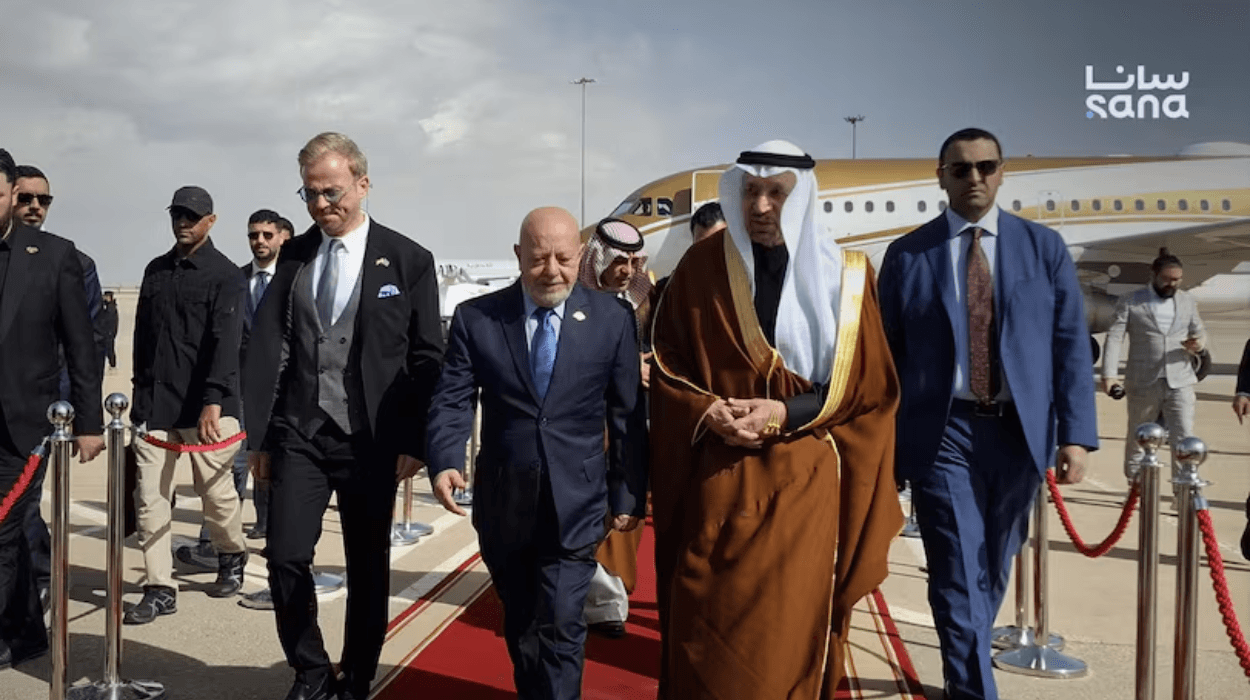
Damascus (The Palestine Telegraph Newspaper) February 07, 2026 – Saudi Arabia is scheduled to sign multiple investment agreements with Syria covering sectors including aviation, property, energy, and infrastructure. The deals, expected to be formalised at an event in Damascus on Saturday, involve Saudi public and private entities investing billions of dollars. Officials from both nations have confirmed participation from key Saudi organisations in the presence of Syrian President Ahmad al-Sharaa.
Saudi Arabia and Syria have finalized negotiations for a series of investment pacts that span diverse economic sectors. The agreements follow high-level talks between Saudi and Syrian officials held in Riyadh last month. These pacts mark a significant step in normalising economic ties between the two countries after years of strained relations.
Agreements Span Key Economic Sectors
The investment deals cover aviation, real estate, renewable energy, transportation infrastructure, telecoms, and agriculture. As negotiations concluded, details emerged on specific aviation commitments, including support for a new private Syrian airline.
Chief Saudi Correspondent for Reuters Timour Azhari said in X post,
“NEW — Saudi Arabia will invest in a new private Syrian airline as part of a multi-billion-dollar investment package expected to be announced on Saturday
— Syrian investment authority chief
Deals also set to include telecoms, real estate.
@ChoukeirJ”
Property investments focus on residential and commercial developments in Damascus and Aleppo, with Saudi firms leading urban redevelopment projects. Energy deals emphasise solar power plants and oilfield rehabilitation in eastern Syria. Infrastructure commitments involve upgrading highways connecting Damascus to the coast and building logistics hubs near the Jordanian border.
Syrian Economy Minister Muhammad Barakat confirmed the scope of the agreements during a press briefing in Damascus. He stated that the pacts represent over $5 billion in committed funds from Saudi entities over the next five years. Barakat highlighted the role of the Saudi Fund for Development in financing 40 per cent of the projects.
Signing Ceremony Details Confirmed
Reports from Syrian media outlets detailed the upcoming signing event scheduled for Saturday at the People’s Palace in Damascus. The ceremony will occur in the presence of Syrian President Ahmad al-Sharaa and involve multiple Saudi entities.
Levant24 said in X post,
“Seven major economic agreements are going to be signed between Syria and Saudi Arabia at the People’s Palace in Damascus, in the presence of Syrian President Ahmad al-Sharaa.
The signing will involve several Saudi entities, including the Ministry of Transport and Logistic Services, Flynas, the General Authority of Civil Aviation, Matarat Holding, Saudi Arabian Airlines, Sera Tourism and Travel, and Saudi Telecom Company.”
High-Level Talks Pave Way for Deals
Negotiations began in December 2025 during a visit by a Syrian delegation to Riyadh. Saudi Investment Minister Ibrahim Al-Assaf hosted the talks, which included representatives from the Public Investment Fund (PIF) and private conglomerates like Binladin Group and Al-Rajhi Holding. The discussions addressed regulatory frameworks, land allocation, and profit repatriation guarantees for Saudi investors.
A joint statement issued by both governments on January 28, 2026, outlined the sectors and timelines. Saudi Crown Prince Mohammed bin Salman sent a video message endorsing the initiative, describing it as a "new chapter of prosperity" for the region. Syrian President Ahmed Al-Sharaa welcomed the Saudi commitments in an interview with Al-Arabiya, noting alignment with Syria's five-year reconstruction plan.
Saudi Public and Private Sector Involvement
The Public Investment Fund will anchor several initiatives, committing $2 billion to aviation and energy ventures. PIF subsidiary Saudi Airlines Leasing Company plans to supply aircraft to Syrian carriers. Private firms, including Dar Al Arkan for property development and ACWA Power for renewables, have signed memoranda of understanding.

Saudi Arabian Airlines and Flynas expressed interest in expanding routes to Syrian cities, consistent with the listed participants in the signing ceremony. Property developer Emaar Properties of Dubai, with Saudi backing, will construct mixed-use complexes in Homs. These partnerships require Syrian government approvals for land titles and tax incentives, which were granted in January 2026.
The Saudi General Authority for Investment reported that 15 deals totalling $3.8 billion received preliminary approval. Remaining agreements, valued at $1.2 billion, await final technical reviews. All pacts include clauses for local Syrian employment, targeting 50,000 jobs over three years.
Syria's Reconstruction Priorities Align with Investments
Syria's economy contracted by 80 per cent during the civil war, which ended in late 2024. Reconstruction costs are estimated at $400 billion by the World Bank. The Saudi deals address immediate needs in housing, where 7 million people remain displaced, and aviation, crippled by 14 years of sanctions and conflict.
Damascus International Airport, handling 90 per cent of Syria's air traffic, requires $1.5 billion in upgrades for safety compliance. Property sectors in war-affected areas like Aleppo face shortages of 2 million units. Energy investments aim to restore power generation to pre-war levels of 10 gigawatts, while telecoms deals support broader connectivity improvements.

International donors, including the UAE and Qatar, have pledged complementary funds. The Saudi agreements form part of a $20 billion Gulf investment package announced at the 2025 Arab League Summit. Syrian officials project a 5 per cent GDP growth in 2026, driven by these inflows.
Regional Context of Saudi-Syrian Ties
Relations between Riyadh and Damascus normalised in 2023 when Syria rejoined the Arab League. Saudi Arabia lifted sanctions and established diplomatic ties in 2024. Trade volume reached $1.2 billion in 2025, up from $200 million pre-normalisation.
Previous Saudi aid included $500 million in humanitarian grants since 2024. The investment shift reflects confidence in Syria's stabilisation under Al-Sharaa's government. Both nations share memberships in the Organisation of Islamic Cooperation and the Islamic Development Bank.
Challenges include navigating US and EU sanctions on certain Syrian entities. The deals specify compliance with international law, focusing on non-sanctioned sectors. Saudi diplomats coordinated with Washington to ensure alignment with global regulations.
Economic Impact Projections
Syrian Chamber of Commerce President Abdullah Al-Khatib forecasted that aviation deals would boost tourism arrivals by 300 per cent within two years. Property investments are expected to stabilise rental markets in major cities. Energy projects could cut electricity shortages from 18 hours daily to under six.

Job creation targets prioritise war veterans and women, per Syrian labour ministry guidelines. Training programmes, funded by Saudi Technical and Vocational Training Corporation, will skill 20,000 workers. Infrastructure upgrades promise reduced transport times by 40 per cent on key routes.
Monitoring committees, comprising officials from both countries, will oversee implementation. Quarterly reports will track milestones, with penalties for delays built into contracts. The first projects, including Aleppo housing units, break ground in March 2026.
Official Statements from Key Figures
Saudi Foreign Minister Prince Faisal bin Farhan stated: "These agreements symbolise our commitment to Syria's stability and shared prosperity." Syrian Foreign Minister Asaad Al-Shaibani added: "Saudi partnership accelerates our recovery timeline by years."
World Bank Middle East Director Ferid Belhaj welcomed the developments, noting: "Private sector-led investments ensure sustainability." UN Special Envoy Geir Pedersen described the pacts as "a positive signal for regional cooperation."
The deals coincide with broader Gulf initiatives, including UAE's $10 billion pledge and Kuwait's infrastructure grants. Collectively, these commitments total $35 billion for Syrian recovery by 2030.