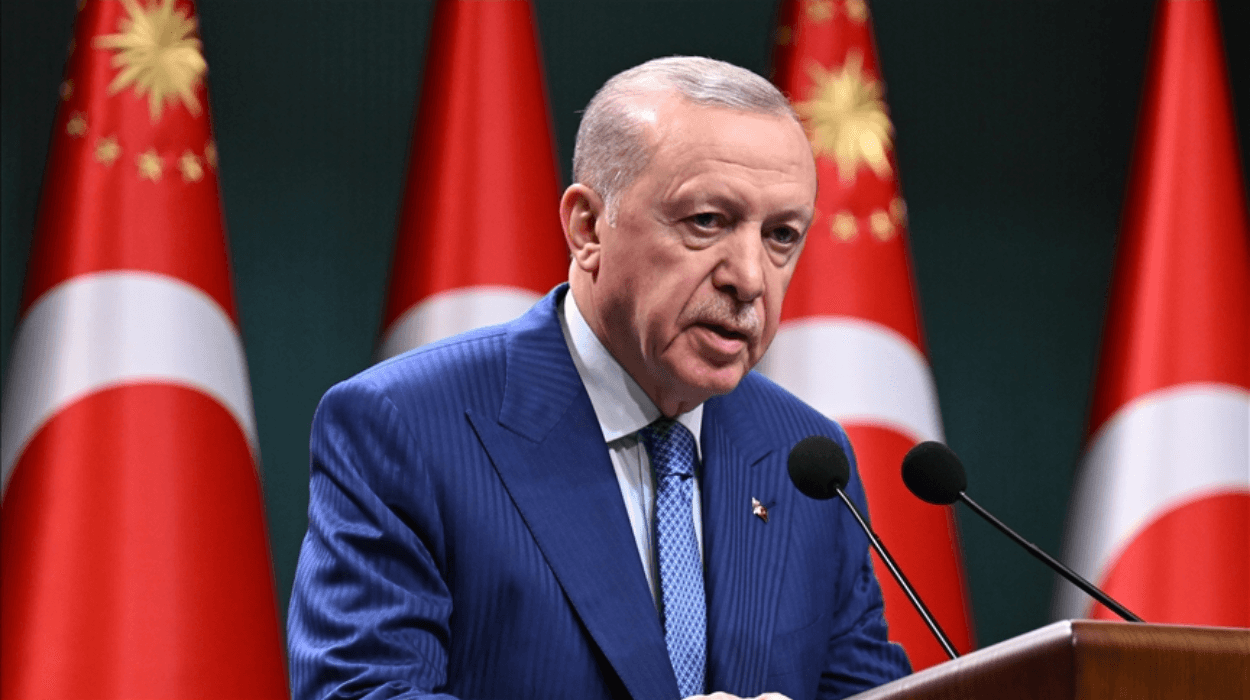
Ankara (The Palestine Telegraph Newspaper) – 5 February 2026 – Turkish President Recep Tayyip Erdoğan announced that Türkiye and Saudi Arabia could launch joint investment in the KAAN fifth-generation fighter jet project at any moment, following recent high-level visits and defence agreements. Speaking to reporters on his return flight from official trips to Riyadh and Cairo, Erdoğan highlighted major new defence industry cooperation deals signed with Saudi Arabia. The statements underscore expanding bilateral ties in defence manufacturing, technology transfer, and regional security collaboration.
Erdoğan’s remarks came amid reports of discussions on Saudi Arabia potentially acquiring up to 100 KAAN jets, with emphasis on co-production and localisation to align with Riyadh’s Vision 2030 defence industrial goals. Turkish Aerospace Industries (TAI), the lead developer, has positioned KAAN as a flagship indigenous platform featuring stealth capabilities, advanced sensors, and network-centric operations. The developments build on prior deals, including Saudi orders for Turkish drones, signalling a maturing strategic defence partnership.
Erdoğan Highlights Open Door for KAAN Investment Partnership
President Erdoğan directly addressed the potential Saudi involvement during his flight back from Egypt. He stated that KAAN has drawn significant international interest as a symbol of Türkiye’s engineering prowess.
Defence industry watchers noted the timing of the comments after Erdoğan’s Riyadh visit. International Defence Analysis reported on the president’s position.
International Defence Analysis - @Defence_IDA said in X post,
“Turkiye and Saudi Arabia can jointly invest in Turkish fifth generation fighter jet project KAAN at any moment. President Erdogan”
Erdoğan linked the opportunity to Türkiye’s growing global defence export profile, while stressing priority on domestic needs before friendly nations.
Breaking Reports Confirm Erdoğan’s Strategic Defence Signal
Media outlets across the region covered Erdoğan’s statement as a breakthrough in Turkish-Saudi relations. The emphasis on “at any moment” suggested advanced preparatory work.
Defence Index provided real-time coverage of the announcement.
Defence Index - @Defence_Index said in X post,
“BREAKING: Turkish President Erdogan says Saudi Arabia could invest in Turkey’s KAAN fifth-generation fighter jet, signaling a potential strategic defense partnership and fresh momentum for Ankara’s next-gen airpower ambitions.”
Turkish state media and Anadolu Agency confirmed the “major” defence pacts signed in Riyadh, covering broad industrial cooperation beyond KAAN.
KAAN Programme Details and Development Milestones
The KAAN project, contracted to TAI in 2016 with an initial $1.18 billion investment, aims to deliver a twin-engine stealth fighter to replace F-16s from the 2030s. Specifications include a 20.3-metre length, 13.4-metre wingspan, and maximum takeoff weight of 34,750 kg, powered initially by two General Electric F110 engines each providing 131 kN thrust.

Key milestones include the first prototype rollout and 13-minute maiden flight on 21 February 2024, reaching 8,000 feet at 230 knots, followed by a second flight on 6 May 2024. Additional prototypes are in production for expanded testing of avionics, weapons integration, and flight envelope. Serial production is targeted for 2028, with indigenous engines planned post-2030 via the TF35000 effort.
Türkiye accelerated KAAN after exclusion from the US F-35 programme in 2019 over S-400 purchases, framing it as essential for air superiority and export potential.
Saudi Arabia’s Localisation Drive Aligns with KAAN Talks
Riyadh seeks to localise over half its defence spending by decade’s end through the General Authority for Military Industries. Interest in KAAN fits this agenda, with prior talks reportedly covering up to 100 units emphasising joint production, technology transfer, and local content.
Saudi exclusion from F-35 acquisitions since 2012 has prompted diversification, including recent Bayraktar Akinci drone orders from Türkiye for delivery in 2025-2026. Vision 2030 integrates defence manufacturing into economic diversification, creating jobs and high-tech supply chains.
Erdoğan noted KAAN as more than an aircraft: “a symbol of Türkiye’s engineering capability and independent defense will,” praised during his Gulf engagements.
Recent High-Level Visits Seal Defence Agreements
Erdoğan’s Riyadh stop preceded Cairo for the second Türkiye-Egypt Strategic Cooperation Council. Joint statements referenced defence industry expansion alongside trade, energy, and regional issues like Palestine and Syria.
Agreements reportedly include solar projects in Sivas and Karaman, but defence pacts drew focus. Erdoğan affirmed: “We are signing important cooperation agreements with Saudi Arabia in the field of defense industry and we are determined to develop this further.”
These build on normalised ties post-2022, with defence trade surging via drones, armoured vehicles, and naval systems.
Export Interest Grows for KAAN Amid Regional Demand
Indonesia signed for up to 48 KAANs in June 2025, including local assembly and training. Azerbaijan contributes to development. Saudi talks position Riyadh as a potential anchor Gulf buyer.

Regional powers pursue next-generation fighters for deterrence amid Yemen, Syria, and Gulf tensions. UAE and others eye similar upgrades. Türkiye’s defence exports hit record highs, with Middle East markets key. KAAN embodies this shift to self-reliance and global sales.
Technical Features Enable Multi-Role Operations
KAAN incorporates low observability, internal weapons bays, sensor fusion, and high manoeuvrability for air superiority, strike, and networked warfare. Avionics draw national systems, reducing foreign dependency.
Flight tests validated aerodynamics, controls, and propulsion. Future phases integrate mission systems and weapons, aiming for certification in the late 2020s. For partners, KAAN offers industrial offsets: assembly lines, component production, and sustainment bases, as seen in Indonesia.
Broader Turkish-Saudi Ties Support Industrial Momentum
Bilateral trade and investment forums precede EXPO-2030 and FIFA World Cup 2034 opportunities. Defence forms a pillar, with Erdoğan eyeing further pacts.
Ankara prioritises “meeting our own needs” while exporting to “friends and brothers.” Riyadh’s participation could accelerate KAAN via funding and orders. No firm timeline or contract values disclosed, but Erdoğan’s “any moment” phrasing indicates readiness.
Regional Security Shapes Modernisation Priorities
Both nations cite threats in Yemen, Syria, and maritime routes driving airpower investments. KAAN complements Türkiye’s F-16 upgrades and drone fleets; Saudi plans blend Typhoons with new platforms.
Cooperation extends to exercises and intelligence sharing, per official readouts. Defence exhibitions have hosted talks, with memoranda signed on drones and air defence.