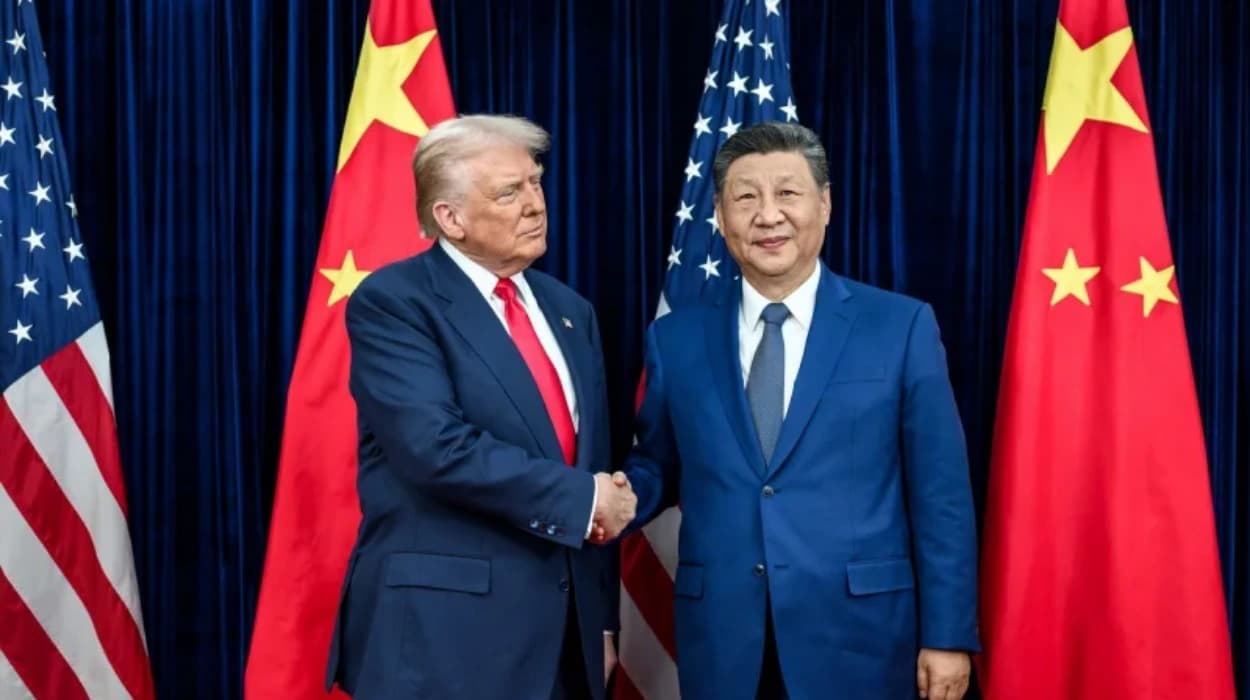
Beijing (The Palestine Telegraph Newspaper) February 05, 2026 – Chinese President Xi Jinping urged United States President Donald Trump to exercise prudence regarding arms sales to Taiwan during their first phone call since November. Xi described Taiwan as the most important issue in China-US relations and emphasised China's commitment to safeguarding its sovereignty and territorial integrity. The discussion followed a major US arms package to Taiwan valued at over $10 billion announced in December.
Chinese President Xi Jinping held a phone conversation with US President Donald Trump on Wednesday, marking their initial direct communication since Trump's reelection in November 2024. According to a summary released by China's foreign ministry, Xi stated that the Taiwan issue constitutes the most critical matter in bilateral relations between China and the United States. He explicitly cautioned that the United States must handle arms sales to Taiwan with prudence.
Xi reiterated Beijing's position that Taiwan forms an inseparable part of China's territory. China remains committed to protecting its sovereignty and territorial integrity and will not permit Taiwan independence, the foreign ministry summary indicated. Xi expressed hopes for collaborative efforts between the two nations to address differences through equality, respect, and mutual benefit.
Recent US Arms Package to Taiwan Draws Beijing's Response
The phone call occurred amid heightened tensions following the Trump administration's announcement in late December of a record arms sales package to Taiwan exceeding $10 billion. The State Department detailed eight agreements totalling $11.15 billion, according to Taiwan's Defense Ministry.
These sales encompass 82 high-mobility artillery rocket systems (HIMARS) and 420 Army Tactical Missile Systems (ATACMS), valued at more than $4 billion. Additional components include 60 self-propelled howitzer systems and related equipment, also worth over $4 billion, alongside drones valued at more than $1 billion. Other items comprise military software exceeding $1 billion, Javelin and TOW missiles worth more than $700 million, helicopter spare parts at $96 million, and refurbishment kits for Harpoon missiles at $91 million.
The State Department stated that these sales support US national, economic, and security interests by aiding Taiwan's efforts to modernise its armed forces and maintain a credible defensive capability. They aim to improve Taiwan's security, assist in maintaining political stability, military balance, and economic progress in the region.
China's Foreign Ministry condemned the package, asserting it violates diplomatic agreements between China and the US and gravely harms China's sovereignty, security, and territorial integrity. Spokesperson Guo Jiakun remarked that such support for Taiwan independence forces would only accelerate military confrontation and war in the Taiwan Strait. Beijing conducted military exercises near Taiwan in late December in response to the proposed sales, involving air, naval, and missile forces.
Taiwan's Defence Commitments and US Legislative Support
Taiwan's government pledged to increase defence spending to 3.3 per cent of its gross domestic product next year, aiming for 5 per cent by 2030. This follows requests from President Trump and the Pentagon for Taiwan to allocate up to 10 per cent of GDP to defence, a level above that of the US or its major allies. The proposal encountered opposition from Taiwan's Kuomintang (KMT) party and parts of the population.
Taiwanese President Lai Ching-te announced a special $40 billion budget for arms purchases last month, including development of the Taiwan Dome air defence system with advanced detection and interception capabilities. This budget spans eight years from 2026 to 2033.
The US arms assistance aligns with the National Defense Authorization Act passed by Congress, which the Trump administration anticipates signing. China's embassy in Washington criticised the legislation last week, stating it unfairly portrays China as an aggressor. The US Senate approved the bill on Wednesday.
Taiwan's Defense Ministry expressed gratitude for the sales, noting they enhance sufficient self-defence capabilities and provide strong deterrence. Foreign Minister Lin Chia-lung thanked the US for long-term support vital for deterring conflict in the Taiwan Strait.
Broader Context of China-US Phone Discussion
Beyond Taiwan, the leaders addressed several global issues. Topics included Russia's conflict in Ukraine, the situation in Iran, and China's purchases of US oil and gas. Trump highlighted trade aspects, including soybeans.
President Trump, in a prior interview, noted that Xi did not raise Taiwan during their October meeting but understood the consequences of military action against the island. US federal law obligates assistance to Taiwan for self-defence capabilities.
Taiwanese President Lai Ching-te described ties with Washington as "rock solid" hours after the leaders' call. The conversation represents the first between the two presidents since Trump's inauguration in January 2025.
This development underscores ongoing dynamics in China-US relations, with Taiwan remaining a focal point. The arms package surpasses the $8.4 billion in US sales to Taiwan during the previous administration.