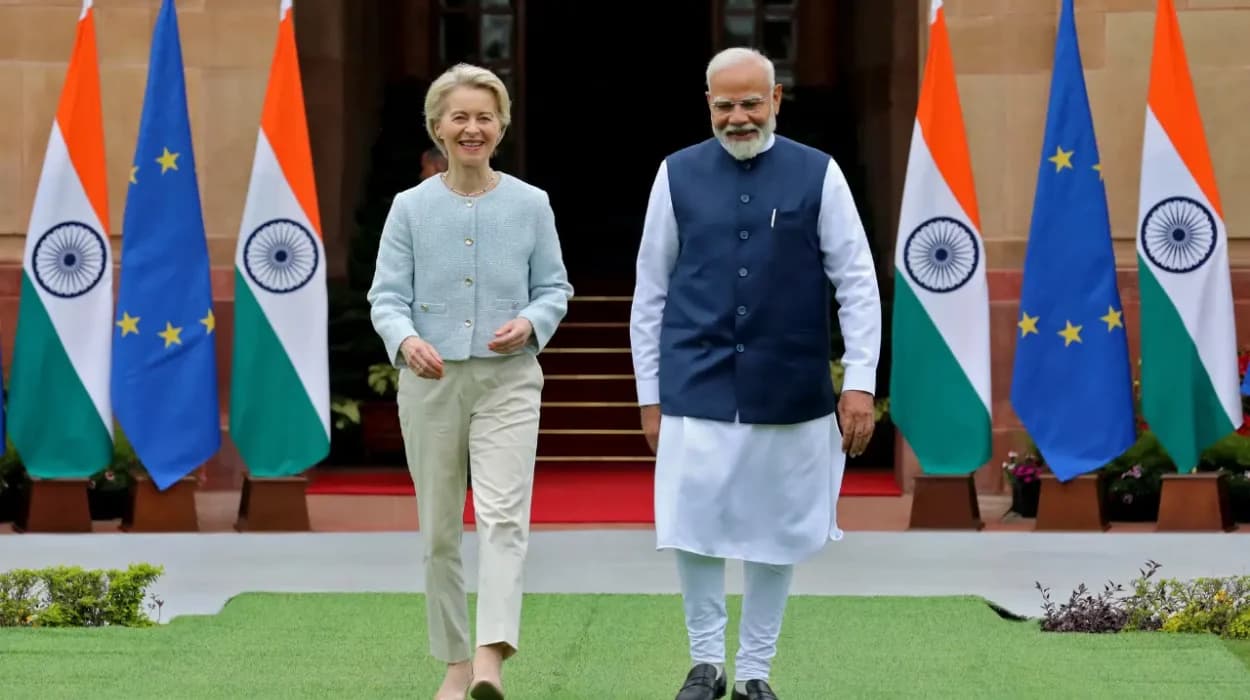
London (The Palestine Telegraph Newspaper) - 24 January 2026 – The European Union and India have launched negotiations for a comprehensive free trade agreement described as the 'mother of all deals'. Senior officials from both sides met in New Delhi to outline terms covering goods, services, investment, and digital trade. The pact aims to eliminate tariffs on 90 per cent of goods and open markets worth over €2 trillion combined.Talks build on five years of preparatory work amid global supply chain shifts.
European Commission President Ursula von der der Leyen and Indian Prime Minister Narendra Modi launched the negotiations on 23 January 2026 during a virtual summit. The agreement, formally titled the EU-India Free Trade Agreement (FTA), targets completion within two years. Both leaders hailed the move as a milestone in post-Brexit EU trade strategy and India's economic diversification efforts.
The deal encompasses 27 EU member states and India's 1.4 billion consumers.
The virtual ceremony followed marathon talks between EU Trade Commissioner Valdis Dombrovskis and Indian Commerce Minister Piyush Goyal. Officials reported progress on thorny issues including agricultural tariffs, data localisation rules, and labour standards. The EU seeks improved market access for cars, dairy, and wines, while India prioritises services, pharmaceuticals, and information technology exports.
Origins and Scope of the Trade Negotiations
 Credit: cscr.pk
Preliminary discussions began in 2021 under the EU-India Trade and Technology Council. Seventeen rounds of technical talks addressed non-tariff barriers, sanitary standards, and intellectual property rights. The 'mother of all deals' moniker emerged from Indian media reports highlighting the pact's unprecedented ambition.
The agreement divides into three pillars: trade in goods, trade in services and investment, and horizontal issues like sustainability and gender equality. Goods negotiations cover €100 billion in annual bilateral trade, with India exporting textiles, chemicals, and machinery to Europe. EU exports to India include machinery, chemicals, and premium food products.
Services trade, valued at €50 billion yearly, targets banking, telecoms, and professional qualifications.
Investment provisions aim to double bilateral flows to €200 billion by 2030. The EU seeks protections for 1,200 European firms operating in India, while India demands reciprocal market opening. Digital trade chapters address cross-border data flows and e-commerce platforms serving 800 million Indian internet users.
Key sticking Points Resolved in Recent Talks
Agricultural market access proved contentious, with the EU demanding reductions on dairy tariffs averaging 150 per cent. India agreed to phase out quotas on EU cheeses and wines over seven years. In return, the EU offered tariff cuts on basmati rice, mangoes, and spices, preserving India's sensitive farm sector.
Automotive trade featured prominently, as EU carmakers face 100-125 per cent duties in India. Negotiators settled on a 10-year tariff reduction to 10 per cent, benefiting manufacturers like Volkswagen, BMW, and Stellantis. India secured easier visa rules for its IT professionals and nurses seeking EU employment.
Intellectual property disputes centred on pharmaceuticals, where India produces 20 per cent of global generics. The EU dropped demands for stronger patent evergreening rules, accepting India's compulsory licensing regime for public health emergencies. Both sides committed to combating counterfeit goods trade estimated at €15 billion annually.
Economic Impact Projections
European Commission studies forecast the deal boosting EU exports to India by 27 per cent and Indian exports to the EU by 18 per cent within five years. Job creation estimates reach 2 million across sectors, with Germany's auto industry expecting 500,000 new positions. India's gems and jewellery sector anticipates $10 billion in additional exports.
The pact aligns with the EU's Carbon Border Adjustment Mechanism, imposing duties on high-emission imports. India secured exemptions for its steel and cement industries during a five-year transition. Sustainability chapters mandate deforestation-free supply chains for commodities like palm oil and soy.
Supply chain resilience drives urgency, as both regions diversify from China amid geopolitical tensions. The EU sources 40 per cent of its rare earths from India, while Indian refineries process Russian oil routed through European ports. Critical minerals cooperation covers lithium, cobalt, and graphite for electric vehicle batteries.
Strategic Context and Global Positioning
The FTA responds to stalled WTO reforms and US protectionism under President Donald Trump. EU officials positioned the deal as a rules-based alternative to bilateral pacts favouring state subsidies. India views the agreement as balancing ties with Russia, the US, and China through diversified partnerships.
Brussels prioritises Indo-Pacific engagement, with similar talks underway with Australia and Indonesia. The EU-India Connectivity Partnership facilitates infrastructure projects worth €50 billion, including high-speed rail and green hydrogen plants. Defence-industrial dialogue explores joint production of naval frigates and drone systems.
India's 'Act East' policy integrates the EU into its regional framework alongside ASEAN and Japan. New Delhi hosts Quad summits while negotiating with Brussels, signalling multi-alignment. The trade deal coincides with India's hosting of the G20 in 2023 follow-up meetings focused on digital public infrastructure.
Detailed Sectoral Agreements
 Credit: Bloomberg
Goods Trade Liberalisation
Tariffs on 95 per cent of industrial goods eliminate within seven years. Electronics face phased reductions from 20 per cent, aiding India's smartphone assembly hubs. Chemicals and plastics gain duty-free status, supporting Bayer and BASF plants in Gujarat.
Services Market Opening
Mutual recognition agreements cover accountants, architects, and engineers. EU
architects gain work rights in India's smart cities programme. Indian nurses
receive fast-track registration in Germany's ageing population support system.
Investment Protection
Investor-state dispute settlement covers €300 billion in foreign direct investment.
India commits to minority shareholder rights for EU firms in joint ventures.
The EU guarantees non-discrimination for Indian investments in renewable energy
projects.
Digital and Green Chapters
Data adequacy decisions ease GDPR compliance for Indian firms serving EU
customers. Green procurement mandates favour low-carbon steel and electric
buses. Both sides pledge net-zero supply chains by 2050.
Official Statements and Reactions
European Commission President von der Leyen stated:
"This agreement opens a new chapter in EU-India relations, creating jobs and growth while upholding our values."
Indian Prime Minister Modi added:
"The mother of all deals will power India's development and Europe's competitiveness."
German Chancellor Olaf Scholz welcomed automotive concessions, noting 50,000 German jobs linked to India. French President Emmanuel Macron praised wine market access, projecting €1 billion in exports. India's Commerce Minister Goyal highlighted services gains for 5 million professionals.
Trade unions from both sides urged labour safeguards. The European Trade Union Confederation demanded enforceable rights in India, while Indian unions sought migrant worker protections in Europe. Business lobbies, including Eurochambres and FICCI, endorsed the balanced outcome.
Implementation Timeline and Ratification
Provisional application begins 1 January 2028 pending ratification by the European Parliament and India's Parliament. Goods tariff cuts start immediately upon entry into force. Services liberalisation phases over 10 years. A joint committee oversees dispute resolution.
Monitoring mechanisms track SME participation and regional development impacts. Annual reviews address emerging issues like artificial intelligence governance. Safeguard clauses protect against import surges, with compensation funds for affected farmers.
The agreement texts, spanning 2,000 pages, release for public consultation in March 2026. Stakeholder forums in Brussels and New Delhi gather feedback before final signatures.