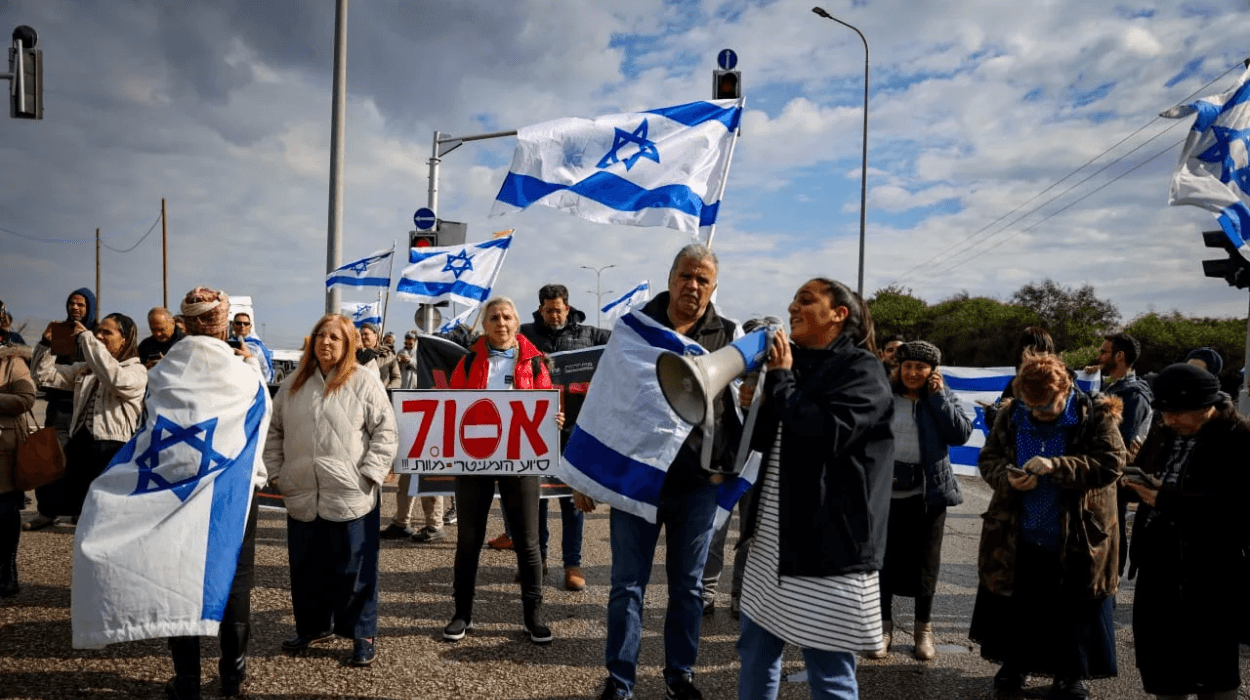
Paris (The Palestine Telegraph Newspaper) February 3, 2026 – French judges have issued arrest warrants for two French–Israeli women accused of complicity in genocide and public and direct incitement to genocide in connection with efforts to block humanitarian aid convoys bound for the Gaza Strip, according to reports in French and international media. The warrants, issued in mid‑2025 but revealed publicly in early February 2026, target activist and lawyer Nili Kupfer‑Naouri and fellow activist Rachel Touitou, both born in France and now living in Israel.
The case stems from a wider French judicial investigation into whether the obstruction of aid to Palestinians in Gaza can amount to complicity in genocide under French and international law. The women have not been detained, but they are ordered to appear before an investigating judge while remaining presumed innocent unless and until a court finds otherwise.
The investigation, led by specialised French magistrates, focuses on actions carried out between 2024 and 2025, when activists in Israel sought to block trucks carrying food and other essential goods into Gaza during Israel’s military campaign. Rights groups and French–Palestinian complainants say the case marks the first time a court in France has treated the deliberate obstruction of humanitarian aid to Gaza as potential complicity in genocide. French authorities have not issued any judicial finding that genocide has occurred in Gaza, and the current proceedings are at the investigative stage.
Warrants target alleged obstruction of aid convoys to Gaza
According to detailed reporting, the arrest warrants were issued in July 2025 as part of an ongoing inquiry opened in spring 2025 into French nationals alleged to have participated in or encouraged actions to block humanitarian aid headed to Gaza. The investigation covers incidents between January and November 2024 and in May 2025, when convoys carrying supplies were reportedly stopped or disrupted near border crossings by groups of protesters.

The suspects are accused of taking part in or helping organise efforts to prevent trucks from reaching the Palestinian enclave at a time when international organisations were warning of critical shortages of food, water, medicine, and fuel. One of the women is identified as Kupfer‑Naouri, president of the group Israel Is Forever, which presents itself as mobilising French‑speaking supporters of Israel. The other, Touitou, is described as an activist linked to Tsav 9, a right‑wing Israeli collective that has publicly campaigned against the delivery of aid to Gaza and was later sanctioned by the United States and the European Union for its actions against humanitarian convoys.
As news of the French warrants spread, campaigners highlighted the alleged link between the activists’ actions and the delivery of essential supplies. Introducing the development as an example of growing legal scrutiny, Kristyan Benedict said in an X post,
“One to watch - French judges issue arrest warrants for French-Israeli activists over complicity in genocide.
Two French-Israeli women are accused of having obstructed the delivery of humanitarian aid to occupied Gaza.”
Charges of complicity and incitement to genocide
Media reports state that the two French–Israeli women are under suspicion for “complicity in genocide” and “public and direct incitement to genocide”, offences provided for under the French criminal code and grounded in the Genocide Convention. The core allegation is that by obstructing or helping to obstruct aid convoys, and by making public calls to limit supplies to Gaza, the suspects may have contributed to conditions that could be legally characterised as part of a genocidal campaign if that is ultimately established by competent courts.
The charges, as reported, are based on the hypothesis that depriving civilians of humanitarian assistance in a context of widespread violence and displacement can amount to “inflicting conditions of life” calculated to bring about the physical destruction of a protected group, one of the acts listed in the Genocide Convention. Investigators from France’s Central Office for Combating Crimes Against Humanity and Hate Crimes (OCLCH) are understood to be working on the case, gathering evidence and testimonies about the nature and impact of the alleged obstruction. However, no French court has yet ruled that the legal threshold for genocide or complicity in genocide has been met in this specific case.
The legal characterisation remains contested, and it will be up to the investigating judge to decide whether to pursue the case to trial or close it without further action once the investigation is complete. If the case proceeds, a trial court would have to assess evidence of intent and causality, as well as the precise role played by each defendant.
Profiles of the two French–Israeli activists
Reports identify Kupfer‑Naouri as a French‑Israeli lawyer and the founder of Israel Is Forever, a charity which describes its mission as mobilising French‑speaking supporters of Israel and has been associated with right‑wing nationalist circles. Touitou, the second woman named in the warrants, is reported to be an activist with Tsav 9, a group that organised or supported protests against the transfer of aid to Gaza and whose members were photographed and filmed at aid‑truck blockades.
Both women were born in France but have long resided in Israel, where they have taken part in public campaigns opposing certain forms of assistance to Palestinians in Gaza during the conflict. In an interview with a pro‑Israel media outlet posted on X in January 2026, Kupfer‑Naouri acknowledged the existence of a French arrest warrant against her and described the investigation as an “antisemitic delusion” or “antisemitic madness”, stating that she had no intention of returning to France to face possible detention. The warrants, as reported, require them to appear before an investigating magistrate but do not request that they be held in custody.
Complaints from Palestinian and French solidarity organisations
The case originates from complaints lodged by a coalition of Palestinian human rights organisations and French solidarity groups. According to the reports, three major Palestinian NGOs – Al‑Haq, Al‑Mezan and the Palestinian Centre for Human Rights (PCHR) – joined French complainants, including a French–Palestinian individual and the French Jewish Union for Peace (UJFP), in filing a detailed dossier with French prosecutors. These organisations have been active in international legal efforts related to the Gaza conflict and have previously submitted evidence to bodies such as the International Criminal Court.
Lawyers representing the complainants argue that the arrest warrants are a significant step in recognising that deliberate interference with humanitarian aid can have criminal consequences under international criminal law. One lawyer is quoted as saying that complicity in genocide is not an abstract concept but can involve “very concrete and specific actions”, such as blocking trucks carrying essential supplies. The complainants view the French investigation as part of a broader push for legal accountability for actions that may have exacerbated Gaza’s humanitarian crisis.
Wider international and European legal context
The French warrants have been issued against the backdrop of increasing international legal scrutiny of the Gaza war, including proceedings at the International Court of Justice (ICJ) in The Hague, where South Africa has accused Israel of violating the Genocide Convention. While the ICJ case concerns state responsibility rather than individual criminal liability, arguments and evidence presented there have been cited by rights groups as reinforcing calls for national courts to investigate potential complicity by individuals and organisations involved in the conflict.

Across Europe, lawyers and human rights advocates have launched or supported legal actions seeking to hold officials, companies, and activists accountable for alleged involvement in violations of international humanitarian law in Gaza, including through arms transfers, political decisions, or direct actions against aid convoys. Some national courts have agreed to hear such cases, whereas others have declined, citing jurisdictional or evidentiary limitations. Observers of the French case say it could help clarify how far domestic courts are prepared to go in treating obstructed humanitarian aid as grounds for serious international crime allegations.
Reactions on social media and public debate
News of the arrest warrants has prompted strong reactions online and has been cited by commentators engaged in debates over accountability for actions in Gaza. Some campaigners have framed the French investigation as a sign that individuals involved in blocking aid face growing legal risks, while others have criticised the warrants as politically motivated and unjust. The tone and content of the responses illustrate wider tensions in public discussions of the conflict and of the role of foreign courts in scrutinising Israeli and pro‑Israeli actors.
In one widely shared reaction, British writer and activist Yvonne Ridley referenced widely circulated images of settlers blocking aid convoys and linked them to the French decision to act against two dual nationals. Referring to the warrants in strongly worded terms, Yvonne Ridley 4 Glasgow said in X post,
“Remember those images of rabid, salivating settlers blocking humanitarian aid to #GazaHolocaust ? Well the French recognised two of its citizens and now they’ve been nicked and will answer for their beastly behaviour in court! Justice delivered gives closure. Which nasty Zionist is next? It is important we all bear witness, study the photographs and bring war criminals to account.”
While such posts underscore the intensity of feeling around the case, the judicial process in France remains bound by legal standards of evidence, procedure, and neutrality. The outcome will depend on the findings of the investigating magistrate and any subsequent court rulings, rather than on public or political commentary.
Next steps in the French judicial process
Under French criminal procedure, the execution of the arrest warrants would typically mean that if Kupfer‑Naouri or Touitou enter French territory or a place where the warrants can be enforced, they could be brought before an investigating judge for questioning. The judge would then decide whether to place them under formal investigation, maintain them as witnesses with special status, or, if the evidence is insufficient, drop the proceedings. Defence lawyers would be entitled to contest the jurisdiction of the French courts, the legal characterization of the alleged acts, and the factual basis for the charges.
If, after the completion of the investigation, the judge considers there are sufficient grounds, the case could be referred to a trial court, where prosecutors would present the charges and both sides could call witnesses and experts. Any verdict could be appealed, and questions of law could ultimately reach France’s highest court, the Court of Cassation. Until then, the case remains at the pre‑trial stage, symbolising a significant but still unresolved attempt to use domestic criminal law to address alleged complicity in atrocities linked to the Gaza conflict.