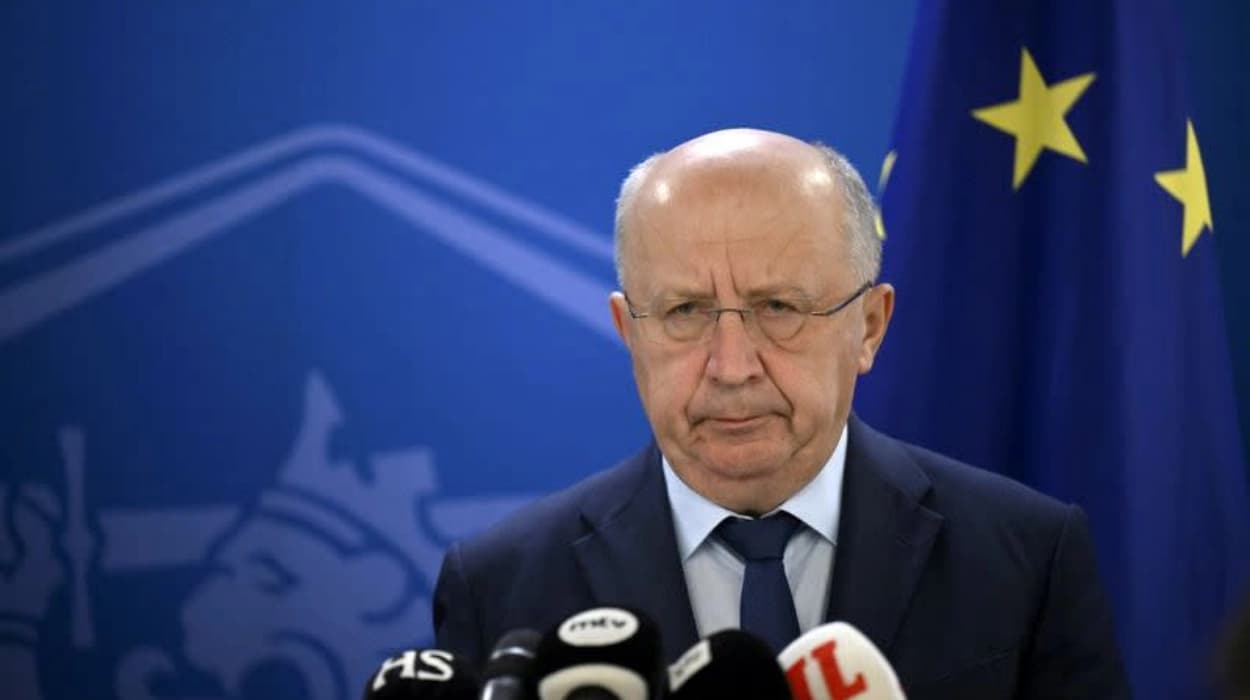
Brussels (The Palestine Telegraph Newspaper) January 27, 2026 – EU Defence and Space Commissioner Andrius Kubilius stated IRIS2 satellite constellation initial services begin in 2029. The multi-orbit array of 290 satellites responds to Starlink with encrypted backbone for governments. Acceleration from 2030 timeline addresses geopolitical dependencies on US services.
Commissioner Kubilius spoke at European Space Conference on January 27, 2026. IRIS2 provides high-speed WiFi for citizens alongside secure governmental communications. Russia's Ukraine invasion prompted Europe'ssatellite sovereignty drive overlapping civilian and defence needs.
IRIS2 Satellite System Overview and Capabilities

IRIS2 comprises 290 satellites across low, medium, and geostationary orbits. Encrypted backbone serves EU governments and public agencies exclusively. Broadband internet targets underserved rural regions complementing 5G terrestrial networks. Sovereign military cloud integrates secure data storage and processing.
System capacity reaches 1.5 Tbps total throughput supporting 10 million simultaneous users. Quantum-resistant encryption protects against state actor interception. Inter-satellite laser links enable global mesh connectivity independent of ground stations.
Acceleration from Original 2030 Timeline
Initial government services launch 2029 one year ahead of baseline schedule. Kubilius cited geopolitical urgency necessitating compressed development cycle. €11.5 billion public-private partnership funding accelerates procurement and launch cadence.
GOVSATCOM precursor connects eight satellites from five member states providing interim secure communications. Kubilius confirmed GOVSATCOM eliminates zero-service gap through 2029 transition period. Full operational capability targets 2032 with constellation complete.
Geopolitical Context Driving IRIS2 Urgency
Russia's Ukraine invasion demonstrated satellite vulnerability to electronic warfare. Starlink provisioned Ukrainian military communications prompting EU autonomy requirements. Political tensions with United States underscore dependency risks on American orbital assets.
Kubilius stated Europe requires sovereign military cloud amid transatlantic frictions. IRIS2 design specifications prioritise governmental precedence over commercial services. Defence-grade encryption exceeds commercial standards protecting classified traffic.
GOVSATCOM Initial Services Operational Status

GOVSATCOM launched week prior featuring Airbus, Thales Alenia Space satellites. Eight-satellite constellation serves 27 member states military and civilian agencies. Secure voice, data, imagery transmission operational across Europe, Africa, Middle East.
French Syracuse, German SATCOMBw, Italian SICRAL integrate providing X-band, Ka-band capacity. Spanish, Portuguese contributions expand Atlantic coverage. Belgian, Luxembourgian ground stations ensure redundancy.
National Level Space Defence Initiatives
Germany allocated €35 billion to space defence programmes through 2035. Bundeswehr Space Command established 2025 coordinates satellite procurement. Franco-German Odin's Eye missile warning system targets early 2030s initial operations.
France invests €6 billion in space superiority capabilities including ASAT demonstration. Italy develops quantum communication satellites under ESI programme. Spain commits €1.2 billion to dual-use Earth observation constellations.
Technical Challenges in Satellite Launch Cadence
EU launch rate lags SpaceX Falcon 9 manifest averaging three missions annually versus 120. Vega-C qualification delays impacted GOVSATCOM deployment. Ariane 6 initial flights slipped to mid-2026 constraining manifest.
Kubilius identified missile warning and independent launch capability as priority gaps. European Space Agency targets 25 annual launches by 2030 requiring infrastructure expansion. Kourou, French Guiana pad upgrades accommodate higher throughput.
Commercial Partnerships and Funding Structure
SES, Eutelsat, Hispasat lead €6 billion private investment complementing €5.5 billion public funds. Viasat, Telespazio contribute ground segment integration. Leonardo provides encryption modules meeting NSA Type 1 equivalents.
Public-private partnership model allocates risk sharing production milestones. Milestone payments trigger satellite deliveries ensuring schedule discipline. European Investment Bank provides €2 billion loan guarantees.
Comparison with Competing Mega-Constellations
Starlink operates 6,000 satellites serving 4 million subscribers generating $6 billion annual revenue. OneWeb constellation reaches 634 satellites with UK government backing. China's GuoWang plans 13,000 satellites by 2030.
IRIS2 prioritises governmental service levels exceeding commercial reliability guarantees. Sovereign control prevents foreign service interruptions experienced during geopolitical crises. Multi-orbit architecture optimises coverage versus single-shell designs.
Defence Applications and Military Integration
IRIS2 supports real-time tactical communications replacing vulnerable HF radios. Synthetic aperture radar satellites enable persistent ISR over conflict zones. SIGINT payloads detect electronic emissions across wide areas.
European Defence Agency coordinates tactical data links integration. NATO SATCOM services board approves EU interoperability standards. Multinational ground terminals ensure collective defence connectivity.
Ground Infrastructure and User Terminals
150 ground stations planned across member states with primary hubs in Germany, France, Italy. Mobile user terminals support maritime, aviation, dismounted soldier applications. VSAT deployments target rural connectivity gaps.
5G non-terrestrial network integration enables seamless handovers. Direct-to-handset capability targets 2030 leveraging 3GPP Release 17 standards. IoT connectivity serves smart agriculture, environmental monitoring.
Regulatory and Spectrum Coordination
International Telecommunication Union frequency coordination completed for Ka, Ku, Q/V bands. European Commission spectrum policy harmonises allocation across member states. 5G standalone spectrum auction revenues fund ground segment.
ETSI standards development accelerates non-terrestrial network specifications. CEPT coordinates cross-border beam management procedures. National regulatory authorities certify user equipment compliance.
Industrial Policy and Job Creation Projections
€20 billion total investment creates 25,000 high-skill jobs across supply chain. Airbus, Thales Alenia Space ramp production facilities in Toulouse, Cannes. OHB System expands Bremen satellite integration halls.
SME participation targets 40 per cent contract value supporting 8,000 companies. Regional development funds distribute economic benefits across cohesion regions. Vocational training programmes prepare 5,000 technicians annually.
Cybersecurity Architecture and Threat Mitigation
Zero-trust architecture segments governmental, commercial traffic flows. AI-driven anomaly detection correlates orbital, terrestrial threat intelligence. Quantum key distribution links ground stations via GEO relays.
European Union Agency for Cybersecurity certifies encryption modules. ENISA coordinates red team exercises simulating state-sponsored attacks. NATO CCDCOE participates defensive cyber operations planning.
Export Potential and Third Country Participation
IRIS2 services offered to NATO partners, Indo-Pacific allies under service level agreements. Ukraine capacity leasing negotiations advanced post-GOVSATCOM activation. Indo-Pacific Framework participants receive priority capacity.
Norway, United Kingdom associate partner status confirmed contributing E-band spectrum. Switzerland neutral status permits capacity leasing governmental users. New Zealand Five Eyes integration explores terminal interoperability.
Budget Allocation and Funding Instruments
Horizon Europe contributes €2.5 billion research development funding. European Defence Fund allocates €1.8 billion prototype development. InvestEU guarantees mobilise €3 billion commercial lending. NextGenerationEU digital pillar supports ground segment.
Member state contributions total €8 billion weighted by GDP. Germany leads with €2.1 billion, France €1.8 billion, Italy €1.2 billion. Cohesion countries receive preferential terminal pricing.
Timeline Summary and Milestone Calendar
2026 Ariane 6 ramp-up supports first five IRIS2 launches. 2027 LEO shell deployment begins 50 satellites. 2028 MEO constellation reaches 100 capacity. 2029 governmental services operational 150 satellites on orbit.
2030 full commercial broadband activation 200 satellites. 2031 GEO complement completes 290 total. 2032 full operational capability declared constellation complete.
International Cooperation Agreements Signed
ESA-NASA Artemis accords extend civil cooperation military interoperability. CNES-ESA bilateral covers launch services coordination. UK Space Command MoU establishes capacity sharing protocols.
Japan QZSS augmentation system negotiates inter-satellite ranging cooperation. Australia Defence Space Command explores southern hemisphere coverage.