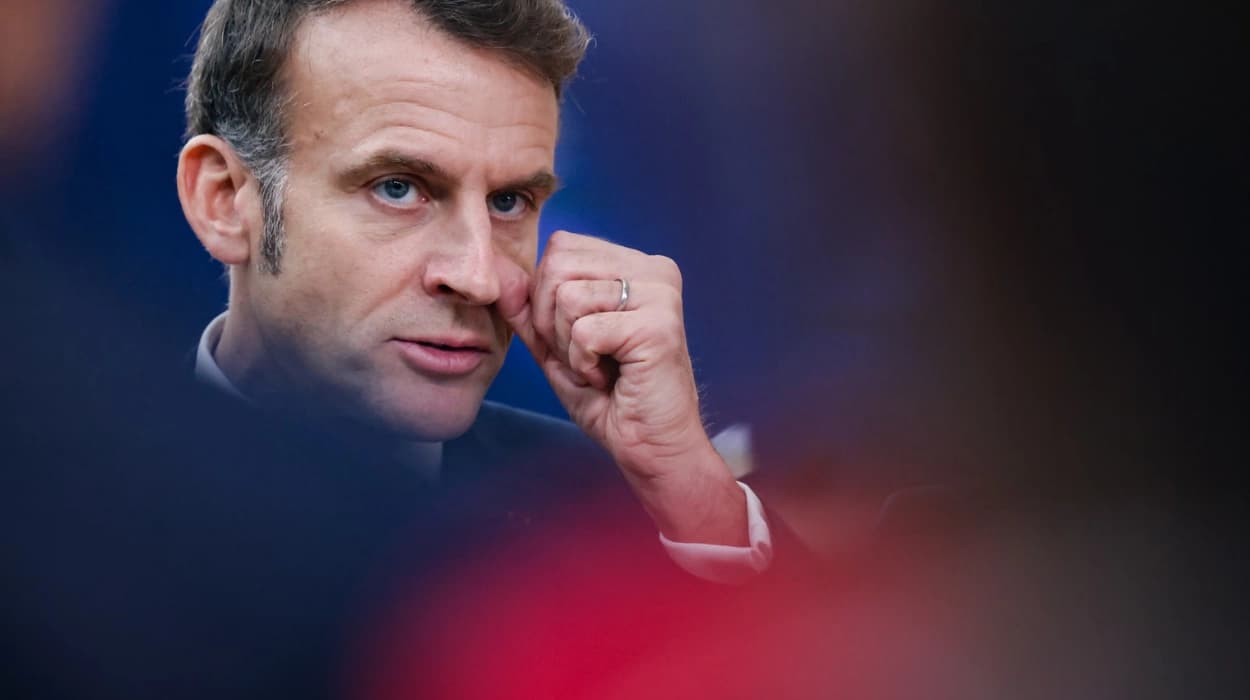
French President Emmanuel Macron criticised the Trump administration for imposing visa bans on European campaigners fighting disinformation and hate.
The French president attacked Washington's action, calling it "intimidation."
Imran Ahmed, the British CEO of the US-based Center for Countering Digital Hate, was one of five activists whose visas were banned by the United States.
Morgan McSweeney, Sir Keir Starmer's No. 10 chief of staff, was one of its founding directors.
Prior to this year's first trade agreement with the United States, the Prime Minister has refrained from criticizing Trump and his administration in an effort to preserve strong US-UK relations.
The British government had not yet responded to the visa restrictions by midday.
However, Mr. Macron was not holding back, emphasizing in particular the suspension on former European Union commissioner Thierry Breton's visa.
Mr. Breton was one of the designers of the EU's Digital Services Act, a historic piece of legislation that has angered US authorities and aims to make the internet safer.
The French president messaged on social media platform X:
“France condemns the visa restriction measures taken by the United States against Thierry Breton and four other European figures.
These measures amount to intimidation and coercion aimed at undermining European digital sovereignty.
Together with the European Commission and our European partners, we will continue to defend our digital sovereignty and our regulatory autonomy.”
Despite Vice President JD Vance and other senior Trump officials lecturing Europe on the value of free speech, the US government took this action.
Seeking to defend the bans, Secretary of State Marco Rubio said:
“For far too long, ideologues in Europe have led organised efforts to coerce American platforms to punish American viewpoints they oppose.
The Trump administration will no longer tolerate these egregious acts of extraterritorial censorship.”
Five European people, including Mr. Breton, were denied visas by Trump's government on Tuesday. The administration claims that these individuals are attempting to restrict free speech or unfairly target US IT companies with excessively onerous regulations.
The US decision was sharply denounced by the European Commission.
The rising divisions between Washington and several European capitals on topics including trade, immigration, free speech, defense, Far-Right politics, and Vladimir Putin's war in Ukraine are expected to worsen as a result of the visa restrictions.
They follow a warning in a US National Security Strategy paper that Europe faces "civilizational erasure" and needs to alter its trajectory if it is to continue being a trustworthy friend of the United States.
The blueprint, which would represent a significant change in US foreign policy, was welcomed by the Kremlin, which described it as "largely consistent" with Moscow's agenda.
Elon Musk's X platform was fined €120 million (£105 million) by the European Commission earlier this month for violating online content regulations, which has particularly infuriated US officials.
Breton and Tesla CEO Musk have frequently engaged in online arguments over EU tech regulations, with Musk calling Breton the "tyrant of Europe."
Additionally, the US millionaire has entered European politics by endorsing Far-Right leader Tommy Robinson and criticizing Sir Keir Starmer.
Additionally, he has backed Germany's Far-Right AfD party.
According to US Under Secretary for Public Diplomacy Sarah Rogers, the visa restrictions also targeted Mr. Ahmed, Clare Melford, co-founder of the Global Disinformation Index, and Anna-Lena von Hodenberg and Josephine Ballon of the German non-profit HateAid.
In order to make the internet a safer place, the EU's Digital Services Act requires tech companies to take more action against illicit content, such as hate speech and images of child sexual abuse.
Washington has claimed that the DSA unfairly targets US tech companies and US persons, and that the EU was pursuing "undue" limits on freedom of expression in its efforts to combat hate speech, misinformation, and disinformation.
The most well-known target was Breton, a former French finance minister who served as the European commissioner for the internal market from 2019 to 2024.
“Is McCarthy’s witch hunt back?”
he wrote on X.
“As a reminder: 90% of the European Parliament - our democratically elected body - and all 27 Member States unanimously voted the DSA.
To our American friends: Censorship isn’t where you think it is.”
The two German activists had the government's "support and solidarity," according to Germany's justice ministry, which also stated that HateAid helped those impacted by illegal online hate speech and that the visa restrictions on them were intolerable.
“Anyone who describes this as censorship is misrepresenting our constitutional system,”
it said in a statement.
“The rules by which we want to live in the digital space in Germany and in Europe are not decided in Washington.”
The visa restrictions are "an authoritarian attack on free speech and an egregious act of government censorship," according to a Global Disinformation Index representative.
“The Trump Administration is, once again, using the full weight of the federal government to intimidate, censor, and silence voices they disagree with,”
it said.
“Their actions today are immoral, unlawful, and un-American.”
How could visa bans affect upcoming EU US negotiations on tech?
Visa bans on European officers could significantly complicate forthcoming EU- US tech accommodations by eroding trust, egging retaliatory measures, and stalling addresses on data flows, AI norms, and the Digital requests Act( DMA).
Particular bans targeting numbers like Thierry Breton hamper direct engagement, forcing reliance on lower- position diplomats and risking escalation where EU envoys face U.S. entry walls, mirroring the current impasse seen in previous Trump- period spats over digital levies.
Conversations on collective recognition of tech rules or safe harbors for U.S. enterprises under DSA could be induced, with Brussels withholding concessions on forfeitures for platforms like Meta or Google; heightened rhetoric from Macron and von der Leyen may lead to WTO forms or complementary U.S. functionary bans.