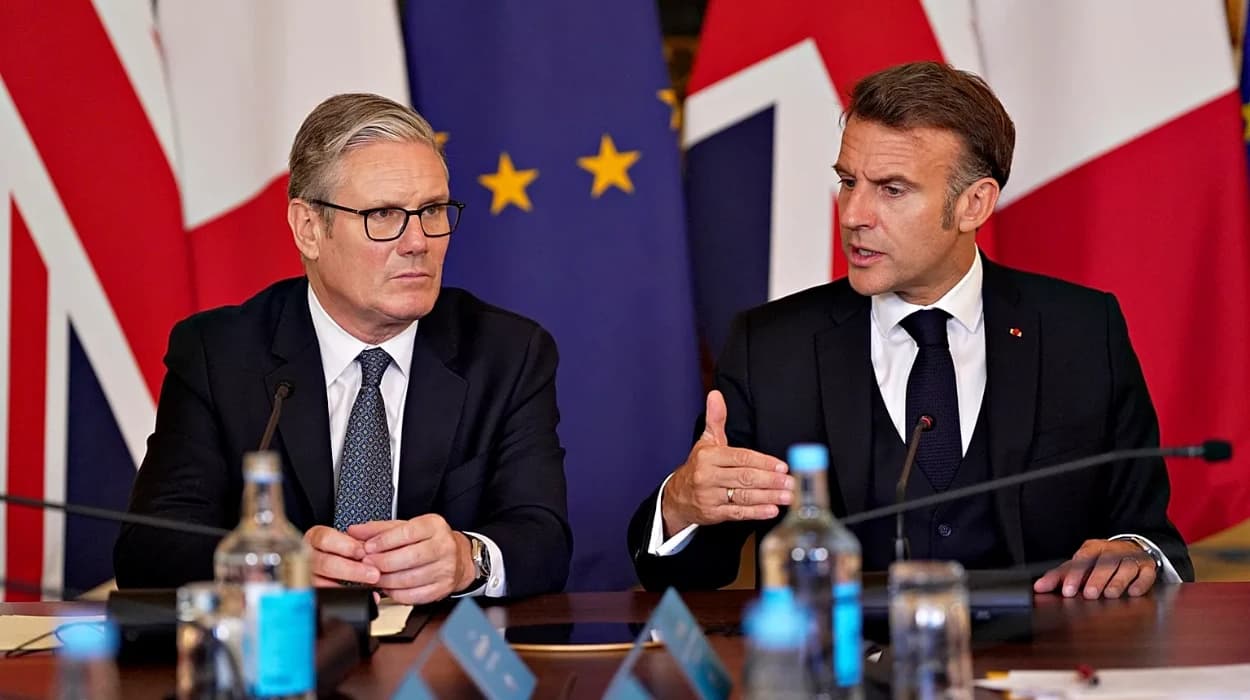
France and the UK urge “Coalition of the Willing” members to provide strong security guarantees for Ukraine, including potential troop deployment for peace.
The "Coalition of the Willing," which consists of the majority of European nations, Turkey, Canada, Australia, New Zealand, and Japan, convened virtually on Tuesday to deliberate on the diplomatic effort initiated by the United States to reach a peace agreement.
In keeping with the Kremlin's long-standing objections, the original 28-point proposal, which was covertly drafted by US and Russian officials, excluded any NATO presence on Ukrainian territory.
"There's finally a chance to make real progress toward a good peace. But the absolute condition for a good peace is a set of very robust security guarantees, and not paper guarantees,"
French President Emmanuel Macron said in his introductory remarks.
However, France and the UK are unwavering in their plans, claiming that their armed presence would serve as a deterrent to future attacks.
Earlier on Tuesday, Macron clarified that the coalition's "reassurance force" would be stationed in key Ukrainian cities including Kyiv and Odessa following the end of hostilities.
"French, British and Turkish soldiers will be present (there) when a peace is signed to conduct training and security operations,"
the French president told RTL radio.
This year, requests to deploy troops in post-war Ukraine have been spearheaded by France and the UK. This is a risky mission that has caused significant division among Western allies. While Poland, Greece, and Italy have declined, Sweden, Denmark, and Australia have expressed openness.
After 35 nations and US Secretary of State Marco Rubio participated virtually in the meeting, Macron declared that a "working group" would be formed to finalize the security assurances and each participant's contribution.
The United States and Turkey will join the group, which will be headed by France and the United Kingdom.
The meeting on Tuesday took place just hours after Ukraine declared that a
"common understanding on the core terms of the agreement"
had been reached through bilateral talks with the United States.
The content of the 28-point proposal, which included broad elements that mostly favored Moscow's interests and provoked dismay across European capitals, has been drastically changed by the frenzy of discussions.
Following high-level negotiations with the Ukrainians in Geneva, Switzerland, a US group met with Russian counterparts in Abu Dhabi to discuss the revisions.
In the meantime, Europeans are banding together to demand "full involvement" in every matter that comes under their purview, including the economic sanctions and the €210 billion worth of Russian Central Bank assets that are immobilized on EU territory.
The absence of strong and enforceable security assurances, which Russia can use to launch another attack against Ukraine in the future, is another issue that worries Europeans.
"We are united in support for a just, dignified, and lasting peace for Ukraine that would preserve its sovereignty and ensure its long-term security,"
Macron said.
The White House initially wanted a framework deal signed by Thanksgiving, which falls on 27 November, but the Geneva talks injected more flexibility in the process.
What are the proposed roles and rules of engagement for the reassurance force?
The proposed consolation force for Ukraine, led by the" Coalition of the Willing" including France and the UK, is envisaged primarily as a peacekeeping and deterrence charge to guarantee compliance with a ceasefire.
The force would operate only with the unequivocal assignment and concurrence of Ukraine and would be stationed in hindered areas rather than on frontline combat zones. The Ukrainian army remains the first line of defense, with the consolation force acting as an alternate subcaste concentrated on covering the ceasefire and inhibiting any rejuvenescence of conflict.
Rules of engagement for the consolation force are still being batted and not completely agreed upon. Still, the force is anticipated to have a limited accreditation, abstain from direct combat with Russian forces unless under strict conditions to apply the ceasefire.