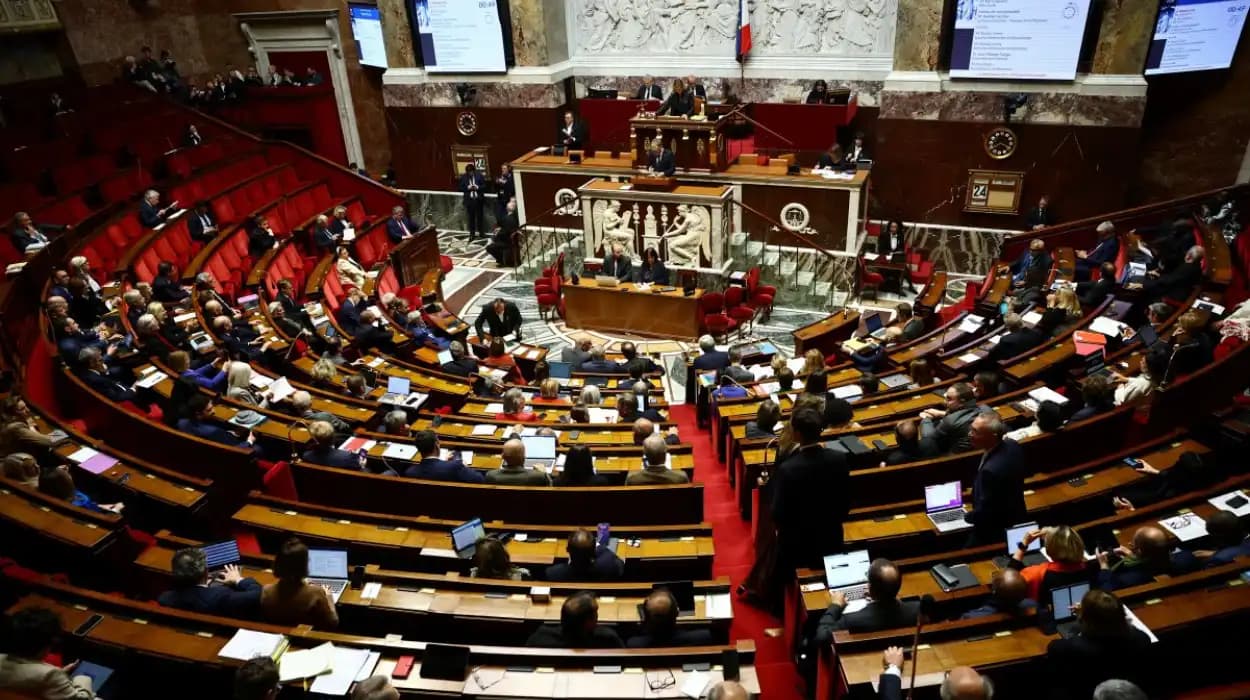
French lawmakers fail to reach a compromise on the 2026 state budget, leaving France without an approved financial plan ahead of the new year.
In less than an hour, the seven senators and seven deputies that made up the joint committee disbanded due to intense disputes that prevented any meaningful debate.
The Senate's budget rapporteur, Philippe Juvin, admitted
"the absence of agreement on a common version"
that both chambers could pass in the allotted time.
Sébastien Lecornu, the prime minister, expressed concern that the house would not be able to vote on a budget before December 31.
In a post on X, Lecornu stated that his cabinet
"regrets the lack of will on the part of parliamentarians"
and noted
"the failure of the joint committee in which deputies and senators sat, without the government."
He declared that starting on Monday, he would meet with political figures to talk about safeguarding French nationals.
After January 1st, the state would be able to continue paying civil servants and collecting taxes thanks to such laws.
The Banque de France's governor, François Villeroy de Galhau, said on France Inter that a special law would only be a temporary fix and result in a deficit "far higher than desired."
According to him, the special law would prohibit required spending increases, such as those for defense, and would not include any savings measures. Villeroy went on to say that if France's deficit surpassed 5% of GDP, it would endanger itself.
France now has the largest deficit in the eurozone, at 5.4% of production this year. After abandoning its initial goal of 4.7%, the minority government had urged that the fiscal deficit be kept below 5% in the 2026 budget.
With spending €9 billion over the target, the Senate's budget proposal, the only one that was put to a vote, reached 5.3%. Disagreements between the Socialists, who desire larger budgets, and the government camp, which supports lower taxes and expenditure, proved to be irreconcilable.
Following the removal of his two predecessors by parliament due to cost-cutting measures, Lecornu was appointed prime minister in September and reappointed in October.
In contrast to prior years, he had promised to enact a budget before year's end without utilizing constitutional powers to push it through without a vote.
"There is no reason to begin examining the articles" because the rapporteurs were unable to provide a compromise language, according to Eric Coquerel, president of the joint committee and a member of the far-left France Unbowed party.
Days after the Social Security budget, which was equally controversial, was finally approved, there is now a financial deadlock. In light of the country's mounting debt, rating agencies and investors are keeping a careful eye on France's fiscal situation.
France's 2025 budget was last briefly extended into early this year through a special law, and a complete spending plan was adopted in February when then-prime minister François Bayrou pushed it through the lower chamber.
Since President Emmanuel Macron called emergency elections in 2024 with the intention of consolidating his power, but instead produced a hung parliament and advances for the far right, France has been in a political crisis.
The Senate's version of the budget, which was the most recent document to be voted on, is anticipated to resume the legislative shuttle.
All political participants agree, however, that a special law would be insufficient since it would prohibit important changes, such as higher defense spending in the face of unstable international conditions.
In the third quarter of 2025, France's debt increased from earlier quarters to 117.4% of GDP. Villeroy has cautioned that France's bond yields have drastically increased borrowing costs by moving dangerously away from Germany's and toward Italy's.
What are the political risks for the government after this setback?
French lawmakers' failure to authorize the 2026 budget by time- end exposes President Macron's nonage government to heightened political insecurity, including implicit no- confidence movements and snap choices.
Without a budget, the administration reverts to 2025 spending situations via automatic extension, eroding credibility amid 5.5 deficiency pressures; opposition from National Rally and left- sect alliances could spark a stricture vote, forcing PM Lecornu's abdication as in previous heads.
Composition 49.3 override remains an option but pitfalls mass demurrers like 2023 pension reforms; prolonged impasse detainments reforms on levies and security, weakening EU financial compliance and Macron's lame- duck status pre-2027 pates.