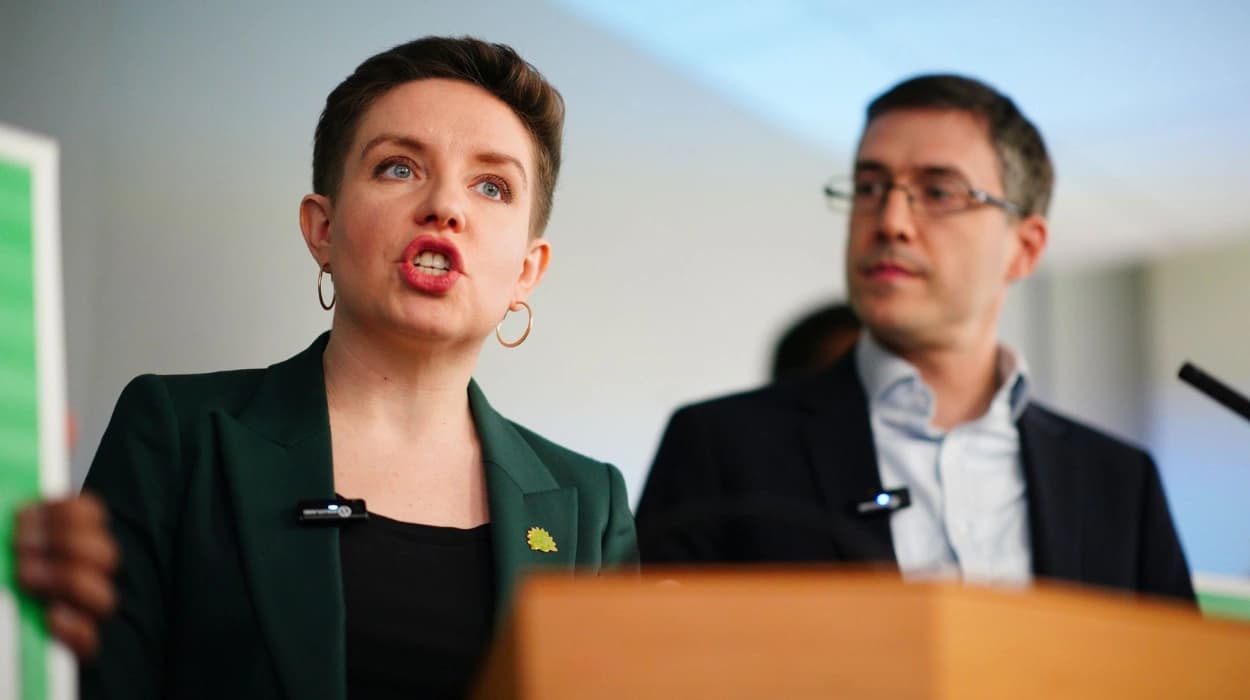
Munich (The Palestine Telegraph Newspaper) February 02, 2026 – A Green Party member of the German Bundestag has publicly criticised Bavarian Minister-President Markus Söder and his Christian Social Union (CSU) party, labelling it the "party of the super-rich, privileged and bigwigs." The remarks, made during a recent political debate, highlight ongoing tensions between the Greens and the CSU over issues of wealth, privilege, and political representation in Bavaria and beyond.
The statement has sparked responses from CSU representatives and drawn attention to broader discussions on social inequality in German politics.
A Green Party MP has described the Christian Social Union (CSU), led by Markus Söder, as the "party of the super-rich, privileged and bigwigs" in a pointed critique delivered during a public forum. The comment targets Söder, who has served as Bavaria's Minister-President since 2018 and chairs the CSU, Germany's conservative party dominant in the southern state.
This exchange underscores persistent ideological clashes between the progressive Greens and the centre-right CSU on matters of economic policy and social equity.
Background to the Criticism
The criticism emerged in the context of a heated debate on economic policies and wealth distribution in Germany. Green Party lawmakers have frequently accused the CSU of favouring affluent interests, particularly in Bavaria's prosperous economy. Markus Söder, a prominent figure in national politics, has positioned the CSU as a defender of traditional values and economic strength, often clashing with Green initiatives on climate and social spending.
Reports indicate the specific phrase was used by the MP to challenge Söder's leadership style and the party's donor base. Leading Europeanpolitical news outlets quickly reported the development as tensions escalate.
Politico Europe (@POLITICOEurope) said in X post,
“Green MP attacks Söder: “ CSU is the party of the super-rich, the privileged and the bigwigs” – sharp attack in the Bavarian election campaign heats up”
The CSU, as the Bavarian sister party to the Christian
Democratic Union (CDU), maintains a strong regional stronghold, securing over
40 per cent of the vote in recent state elections. Greens, meanwhile, have
gained ground nationally, forming coalition governments in several states.
This incident follows a pattern of verbal sparring. In prior exchanges, Söder has dismissed Green policies as unrealistic, while Greens have portrayed CSU governance as out of touch with working-class concerns. The latest remark amplifies these divisions ahead of federal elections.
Details of the MP's Statement
The Green Party MP made the comment during a panel discussion focused on fiscal policy and inequality. According to transcripts from the event, the MP stated: "Party of the super-rich, privileged and bigwigs – that's what the CSU has become under Söder." The phrase critiques perceived elitism within the party, pointing to its support from business leaders and high-net-worth individuals.
Media observers noted the escalation in rhetoric as regional polls approach.
Euractiv (@EURACTIV) said in X post,
“The CSU is the party of the super-rich, privileged and bigwigs,” a Green Party MP said of Bavarian leader Markus Söder today, escalating rhetoric ahead of regional electionsNo immediate clarification was issued by the MP on the exact scope of "bigwigs,"
but context suggests references to influential
donors and party insiders. The statement aligns with Green Party platforms
emphasising progressive taxation and reduced influence of wealth in politics.
Söder's CSU has championed tax cuts and business incentives, policies Greens
argue benefit the wealthy disproportionately.
Media coverage from major outlets captured the moment, with the audience reacting audibly. The MP later reiterated the point on social media, linking it to Bavaria's wealth gap statistics. Official Green Party channels have not formally endorsed the phrasing but have amplified related critiques.

Markus Söder responded swiftly, defending the CSU's record on broad-based prosperity. In a press conference, Söder described the accusation as "cheap rhetoric from the left," emphasising the party's support for families, farmers, and small businesses across Bavaria. He highlighted CSU achievements, including low unemployment rates and infrastructure investments.
CSU spokespeople labelled the comment divisive, arguing it ignores the party's voter base, which spans rural conservatives to urban professionals. Söder, known for his media-savvy approach, used the opportunity to contrast CSU pragmatism with Green "ideology." Party data shows CSU funding from diverse sources, including membership dues alongside corporate contributions.
Internal CSU sources report unity behind Söder, with no signs of discord. The party has previously faced similar attacks from opposition figures, maintaining its polling lead in Bavaria. Söder's national ambitions, including potential chancellor candidacy, place such criticisms under heightened scrutiny.
Political Context in Bavaria and Germany
Bavaria remains a CSU stronghold, with Söder steering the state through economic booms and challenges like the COVID-19 pandemic and energy crises. The Greens hold significant sway in the state parliament, often allying with Social Democrats against CSU dominance. Nationally, coalition talks frequently pit CSU against Greens on environmental and migration policies.
Recent polls show the Greens rising in popularity, particularly among younger voters concerned with climate change and equity. The CSU counters by stressing economic stability, with Söder advocating "Bavarian solutions" to federal issues. This verbal clash occurs amid preparations for the next Bundestag elections, where party alliances will prove crucial.
Germany's multi-party system amplifies such rhetoric, with oppositionMPs using sharp language to rally bases. Similar exchanges have marked prior sessions, including debates on windfall taxes and housing affordability. The incident reflects deeper divides on how to address inflation and post-pandemic recovery.
Historical Rivalries Between Greens and CSU
Tensions between the Greens and CSU date back decades. The Greens, founded in 1980, emerged as ecological and social progressives, challenging conservative dominance. The CSU, rooted in Bavarian Catholic traditions since 1945, has governed the state almost continuously. Key flashpoints include nuclear phase-out, asylum policies, and now wealth distribution.
Past Söder-Greens confrontations include disputes over highway expansions and renewable energy mandates. Söder has accused Greens of economic sabotage, while they decry CSU environmental laxity. Membership figures show CSU with over 130,000 members versus Greens' 100,000 nationally, fueling representational claims.
Analyses from reputable sources note the CSU's adaptation under Söder, blending conservatism with populist appeals. Greens' growth stems from urbanisation and youth mobilisation. This latest barb fits a cycle of mutual accusations shaping voter perceptions.
Broader Implications for German Politics

The exchange highlights ongoing debates on privilege in politics. Left-leaning parties, including Greens and Social Democrats, push for transparency in funding, while conservatives defend legitimate advocacy. Germany's strict party finance laws regulate donations, but critics question enforcement.
Federal Chancellor Olaf Scholz's coalition, including Greens, navigates similar dynamics with CDU/CSU opposition. Söder's profile positions him as a potential CDU/CSU leader post-elections. Voter surveys indicate economy and migration as top concerns, with equity gaining traction.
Media outlets across the spectrum covered the story, from conservative Frankfurter Allgemeine Zeitung to left-leaning Süddeutsche Zeitung. International wires like Reuters and AFP noted it as emblematic of Germany's polarised landscape. No legal actions or formal complaints have arisen from the statement.
Reactions from Other Parties and Public
Social Democrats echoed Green concerns on inequality without endorsing the phrasing. The far-right Alternative for Germany (AfD) mocked both sides as "elite squabbles." Public opinion polls post-incident show minimal shifts in party support.
Bavarian civil society groups monitor political discourse, advocating civility. Trade unions aligned with Greens praised the critique's focus on workers, while business lobbies backed CSU rebuttals. Social media amplified the quote, trending under hashtags like #CSUPrivilege.
Experts from political institutes observe such rhetoric as standard in multiparty systems, rarely altering election outcomes absent scandals. The story dominated Bavarian headlines for 48 hours before yielding to national issues.