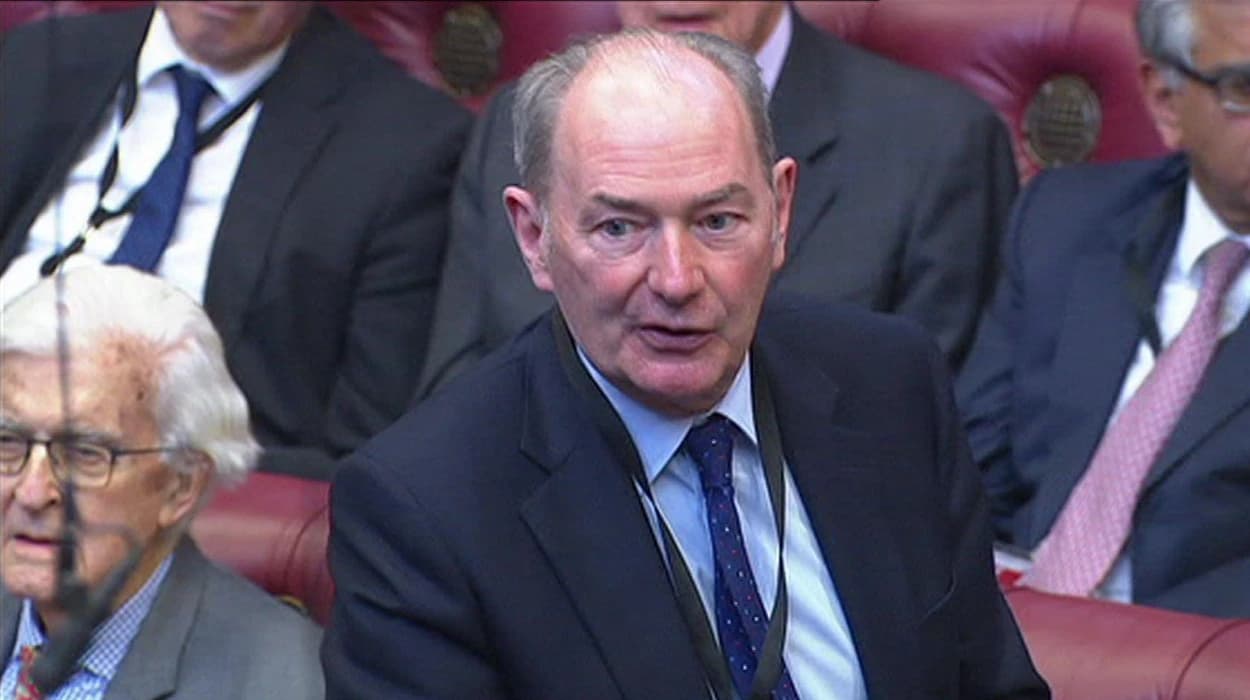
Former Conservative minister Lord Michael Forsyth of Drumlean has been appointed as the new Speaker of the House of Lords.
The top job's duties include presiding over peer discussions, serving in ceremonial capacities at occasions like the State Opening of Parliament, and having the last word when calling ministers to address pressing issues.
Lord John McFall of Alcluith, who is stepping down to care for his wife after learning that she had Parkinson's disease, will be replaced by Lord Forsyth.
Following King Charles' assent, Lord Forsyth, who defeated Baroness Deborah Bull for the position, will assume his place on the renowned Woolsack in February for a five-year term.
He claimed that "as the Commons continues to struggle to scrutinise legislation effectively, greater pressure will fall on this House" and pledged "leadership for a more effective, respected and influential House" in his election campaign.
Speaking following the outcome's approval, Lord Forsyth commended Baroness Bull for running a "vigorous, courteous, and friendly campaign" and his supporters for their confidence.
"I would also like to pay tribute to Lord McFall the outgoing Lord Speaker,"
he said.
"He has made great strides in improving the governance of the House and the accountability of the administration to Members.
I intend to build on that work as chair of the House of Lords Commission and Lord Speaker."
Lord Forsyth, who has served in politics for almost 50 years, was initially elected to the Westminster City Council in 1978, not long after earning his degree from the University of St Andrews in Scotland.
He was elected MP for Stirling in 1983 and held a number of cabinet posts throughout the administrations of Margaret Thatcher and John Major.
Before being appointed secretary of state for Scotland in 1995, he held positions in the Home Office and as an employment minister. However, his majority was overthrown in the 1997 Labour landslide.
The village of Dunblane, where a shooter slaughtered sixteen elementary school students and their teacher in 1996, was part of his constituency. According to Lord Forsyth, he still has flashbacks to the school gym where the children perished.
In 1999, he was appointed a Conservative peer in the Lords, where he has presided over several committees, including the Financial Services Regulation Committee.
Both retired senior judge Baroness Butler-Sloss and former Labour Home Secretary Lord Blunkett backed his bid for Lord Speaker.
Earlier this month, peers cast a vote between former ballet dancer Baroness Bull and Lord Forsyth.
Currently serving as deputy speaker, Baroness Bull was a main dancer at the Royal Ballet for nearly twenty years.
Who supported and opposed his candidacy in the Lords?
No detailed public signatures or resistances from specific peers have been extensively reported for Lord Michael Forsyth's successful training in the 2026 House of Lords Speaker election.
As former Association of Conservative Peers president( 2021-) and Economic Affairs Committee leader( 2017- 22), Forsyth probably secured strong Tory support among the 270 Conservative peers, using his fiscal regulation moxie and Scotland Office term( 1995- 97). Cross-party procedural reform lawyers may have championed his chairmanship pledges.
Crossbenchers and Liberal Egalitarians favoring Baroness Bull's training conceivably opposed Forsyth over perceived prejudiced leanings, given Lords reform debates favoring tagged chambers. Labour peers remained neutralpost-McFall's bipartisan term, prioritizing election conduct over bloc voting in the January 6- 8 ballot.