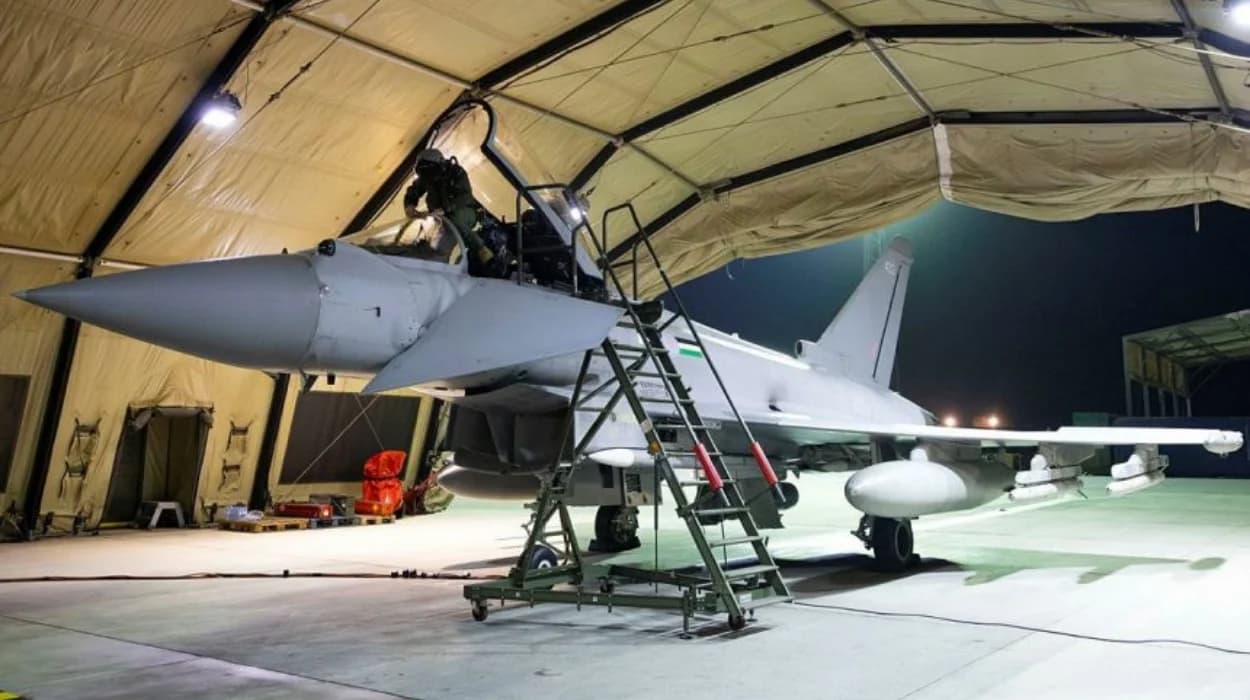
London (The Palestine Telegraph Newspaper) – 24 January 2026 - The United Kingdom has deployed RAF Typhoon fighter jets to Qatar as part of a strengthened military presence in the Middle East. This move coincides with a significant build-up of United States forces in the region. The deployment aims to enhance regional security and support ongoing multinational operations.
The Royal Air Force announced the deployment of Typhoon FGR4 jets to Al Udeid Air Base in Qatar, a key facility hosting coalition forces. Four Typhoon aircraft, supported by approximately 75 personnel, arrived on 20 January 2026 to conduct air policing missions and enhance interoperability with allies.
The Ministry of Defence stated that the jets will operate alongside Qatar Emiri Air Force assets and US Central Command forces already stationed there.
This deployment forms part of Operation Shader, the UK's contribution to the international coalition against Daesh in Iraq and Syria. RAF Typhoons have previously flown from Al Udeid, logging thousands of hours in support of ground operations. The current rotation replaces Italian Tornado jets and underscores Britain's commitment to regional stability amid heightened tensions.
Background to RAF Qatar Deployment
The UK maintains a permanent presence at Al Udeid Air Base under a long-standing defence agreement with Qatar signed in 2014. This base serves as the forward headquarters for US Central Command, accommodating over 10,000 US personnel and allied aircraft. RAF deployments to Qatar occur on a rotational basis, typically lasting four to six months, to support air surveillance and combat readiness.
In December 2025, the UK government authorised the extension of Typhoon operations in the Middle East following requests from coalition partners. Defence Secretary John Healey confirmed the move in a statement to Parliament on 15 January 2026, noting that the jets carry advanced weaponry including AMRAAM missiles and Paveway IV guided bombs.
The deployment includes Voyager air-to-air refuelling support from RAF Brize Norton to extend operational range.
Qatar hosts the largest US military installation in the Middle East, with recent expansions including additional hangars and fuel storage completed in late 2025. The base facilitates operations across the Persian Gulf, Arabian Sea, and Central Asia, playing a central role in US deterrence strategies.
Context of US Military Build-Up
 Credit: twz.com
The United States has intensified its military footprint in the Middle East since early 2025, deploying two carrier strike groups to the Arabian Sea in November 2025. The USS Abraham Lincoln and USS Carl Vinson carrier groups, accompanied by destroyers and submarines, arrived to counter threats from Houthi militants in Yemen and Iranian proxies.
Pentagon officials reported on 18 January 2026 that over 40,000 US troops now operate across bases in Qatar, Bahrain, UAE, and Jordan.
This build-up followed a series of Houthi attacks on Red Sea shipping lanes, which disrupted 12 per cent of global trade. US Central Command conducted over 200 airstrikes against Houthi targets since October 2025, destroying missile launchers and radar systems. Additional deployments include B-52 bombers to Diego Garcia and F-22 stealth fighters to Al Udeid.
The US State Department cited Iran's nuclear advancements and ballistic missile tests as primary drivers for the reinforcement. In a briefing on 22 January 2026, Secretary of Defense Pete Hegseth announced the deployment of 2,000 additional Marines to the region, bringing Marine Corps strength to 18,000. Patriot air defence batteries have been repositioned from Jordan to Saudi Arabia to protect critical oil infrastructure.
Details of RAF Typhoon Capabilities
Eurofighter Typhoon FGR4 jets represent the backbone of the RAF's fast-jet fleet, capable of air-to-air and air-to-ground missions. Each aircraft features a twin-seat configuration for enhanced sensor operation, equipped with Litening III targeting pods and Captor-E radar for beyond-visual-range engagements. The Qatar deployment includes two-seat variants to optimise ground attack roles.
RAF personnel from 1(F) Squadron and 6 Squadron, based at RAF Lossiemouth, form the core of the detachment. Ground crews maintain 24-hour readiness, with quick-reaction alert status to intercept unauthorised aircraft. The Typhoons integrate with NATO-standard data links, sharing real-time intelligence with US F-35s and Qatari Rafales stationed at the base.
Previous rotations from 2024 and 2025 logged over 1,500 sorties, including reconnaissance missions over Syria. The Ministry of Defence reported no RAF losses during these operations, crediting advanced electronic warfare suites. Fuel efficiency allows Typhoons to cover 1,850 nautical miles without refuelling, extended by Voyager tankers.
Regional Security Dynamics
 Credit: Majid Asgaripour/Reuters
Tensions in the Middle East escalated after Iran's launch of 180 ballistic missiles at Israel on 1 October 2025, intercepted by US, UK, and Jordanian air forces. RAF Typhoons from Romania contributed to subsequent patrols over the Eastern Mediterranean. Houthi drone attacks on Saudi oil facilities in December 2025 prompted Qatar to request additional allied air cover.
The UK-Qatar defence pact includes joint exercises like Operation Zayid, conducted biannually since 2018. Qatar Emiri Air Force Mirage 2000s and Typhoons train alongside RAF assets, improving coalition tactics. US officials welcomed the RAF arrival, stating it strengthens layered air defence across the Gulf.
Bahrain, UAE, and Saudi Arabia host parallel US deployments, with 5,000 troops each. The US Fifth Fleet in Manama coordinates naval patrols, while Al Udeid serves as the nerve centre for air operations. Combined task forces monitor Iranian naval movements in the Strait of Hormuz.
Statements from Officials
Prime Minister Sir Keir Starmer addressed the deployment in the House of Commons on 21 January 2026, affirming the UK's resolve to deter aggression.
"Our forces stand ready to protect freedom of navigation and support our allies,"
he said. Defence Secretary Healey added that the rotation demonstrates Britain's enduring partnerships.
A Pentagon spokesperson noted on 23 January 2026 that RAF Typhoons enhance US operational tempo. Qatar's Ministry of Defence issued a statement praising the UK's contribution to joint security efforts. No official comments emerged from Iran or Houthi representatives regarding the deployments.
Operational History at Al Udeid
Al Udeid has hosted RAF aircraft since 2003, supporting operations in Afghanistan and Iraq. Typhoons first deployed there in 2015 as part of Operation Shader, striking Daesh oil convoys. By 2025, the base handled 8,000 annual take-offs, including US drones and bombers. Infrastructure upgrades in 2024 added climate-controlled hangars for 50 additional jets.
The UK's 50-year lease, renewed in 2023, secures long-term access without host nation costs. RAF Voyager tankers forward-deployed to Qatar refuelled 300 sorties monthly in 2025. Intelligence fusion cells at the base process data from satellites and MQ-9 Reapers.
Broader Coalition Efforts
NATO allies contribute variably to Middle East operations. France maintains Rafales in Jordan, while Italy rotates Tornados from Qatar. Australia and Canada provide refuelling and transport aircraft. The coalition, comprising 80 nations, focuses on counter-terrorism without ground combat roles.
US President Donald Trump, in a 20 January 2026 address, praised allied reinforcements as essential to regional deterrence. The deployment aligns with the Abraham Accords, normalising ties between Israel and Gulf states. UK forces emphasise defensive postures, avoiding offensive actions without parliamentary approval.